Demographics of Petersburg City County
Affluence Level in Petersburg City County
A below-average socioeconomic profile. Incomes, home values, and educational attainment trail the U.S., with higher poverty and unemployment.
People of Petersburg City County
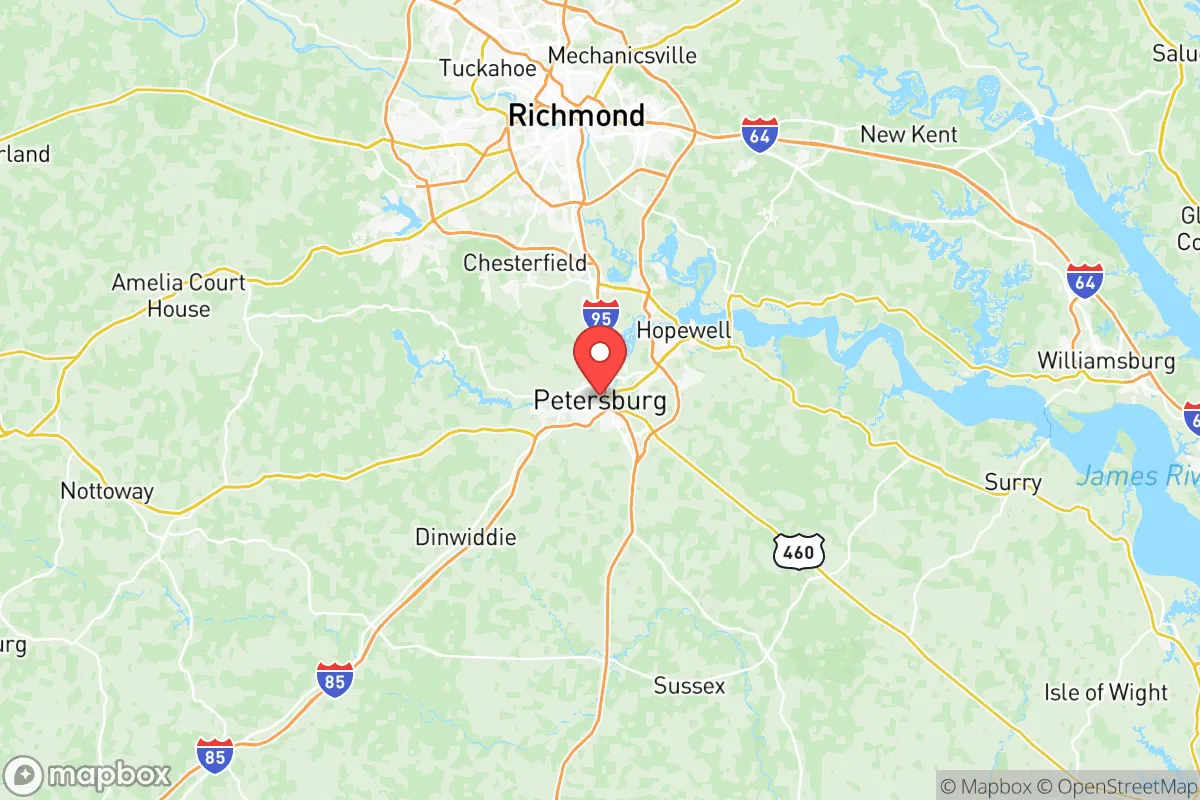
Petersburg City County, Virginia, is a predominantly Black-majority city of 33,365 residents, where 74.6% of the population identifies as Black or African American, a legacy of its deep roots as a center of free Black life and post-Civil War migration. The city is densely populated for a county-equivalent, with a tight urban grid and a strong sense of historic identity, though its foreign-born share is just 2.0%, making it one of the least internationally diverse cities in the region. White residents make up 14.7% of the population, while Hispanic residents account for 6.0%, and East/Southeast Asian communities represent 1.0%. The city’s character is shaped by its role as a historic industrial and transportation hub, its Civil War battlefields, and a modern identity that is both proud of its African American heritage and grappling with economic transition.
Settlement & growth (pre-1960)
Long before European settlement, the area that is now Petersburg was inhabited by the Appamattuck, a Virginia Algonquian-speaking tribe, who lived along the Appomattox River. The river was a key trade and travel route, and the Appamattuck maintained a fortified village near what is now the city’s historic district. English colonists from Jamestown began pushing into the region in the 1640s, and by 1675, a trading post called Fort Henry was established at the falls of the Appomattox, near present-day Old Towne Petersburg. The area was originally part of Prince George County, but by the mid-1700s, a small settlement called Petersburg—named after Peter Jones, a local planter—had emerged as a tobacco inspection and shipping point.
During the colonial and early American periods, Petersburg grew as a tobacco market and a manufacturing center for cotton and flour. The city was incorporated in 1784 and quickly became a hub for free Black artisans, merchants, and laborers. By 1830, Petersburg had one of the largest free Black populations in the Upper South, concentrated in neighborhoods like Pocahontas Island and the Gillfield area. These communities were built by skilled tradesmen—blacksmiths, coopers, and boatbuilders—who worked the river and the railroads. The city also attracted Scots-Irish and English merchants, as well as a small number of German and Jewish families who established dry goods stores and banks along Sycamore Street.
The Civil War devastated Petersburg. The city was besieged for nine months in 1864–65, and much of its infrastructure was destroyed. After emancipation, thousands of freedmen and women moved into the city, settling in the wards around Harrison Street and Halifax Street, creating a dense, self-contained Black community with its own churches, schools, and businesses. The post-Reconstruction era saw the rise of Virginia State University (founded in 1882 in nearby Ettrick, just across the river), which became a major anchor for Black educational and professional life. The city’s industrial base—tobacco factories, cotton mills, and railroad yards—drew Black workers from rural Virginia and North Carolina through the early 1900s, while white residents increasingly moved to the western edges of the city, near the Blandford and Walnut Hill neighborhoods.
By the mid-20th century, Petersburg was a majority-Black city, but segregation kept these communities separate. The Great Migration did not pull many Black residents out of Petersburg—instead, the city was a destination for Black migrants from the surrounding counties. White flight accelerated after World War II, as new suburban developments in Chesterfield and Dinwiddie counties drew white families away. The city’s population peaked at around 41,000 in 1960, then began a slow decline as manufacturing jobs left and the tax base eroded.
Modern era (post-1965)
The 1965 Hart-Cellar Act had a minimal direct effect on Petersburg, as the city’s foreign-born population remains very low at 2.0%. However, the broader demographic shifts of the post-1965 era reshaped the region indirectly. The most significant change was the acceleration of Black suburbanization and the continued outmigration of white residents. By 2020, the city’s white share had fallen to under 15%, while the Black share remained dominant at nearly 75%. Hispanic residents, now 6.0% of the population, began arriving in the 1990s and 2000s, primarily from Mexico and Central America, drawn by low-cost housing and service-sector jobs. They have concentrated in the southern and eastern parts of the city, particularly around the South Crater Road corridor and near the Fort Lee military base (now Fort Gregg-Adams).
East/Southeast Asian communities, at 1.0%, are a small but visible presence, with a handful of Vietnamese and Filipino families connected to the military and to regional healthcare jobs. The Indian subcontinent population is negligible at 0.2%. Domestic migration has been largely outward: Petersburg has lost population steadily since 1960, dropping from 41,000 to 33,365, as younger residents move to Richmond, Hampton Roads, or the Raleigh-Durham area for better job opportunities. The city’s housing stock is old and often in poor condition, and the poverty rate is high, which has discouraged in-migration from other parts of the country. Suburbanization has been a one-way street: the growth has all gone to Chesterfield County to the north and Dinwiddie County to the south, while Petersburg itself has become more isolated and economically distressed.
The closure of major industrial employers—the Brown & Williamson tobacco plant, the city’s textile mills—has left a hole in the local economy. Fort Gregg-Adams (formerly Fort Lee) remains the largest employer, but its workforce is largely commuter-based, with many military and civilian personnel living in Chesterfield or Prince George counties. The city’s identity as a historic Black cultural center persists, anchored by institutions like the Petersburg Public Library, the Siege Museum, and the Virginia State University campus just across the river in Ettrick, but the population is aging and the school-age population is shrinking.
The future
Petersburg’s population is projected to continue a slow decline, with the city losing roughly 1–2% of its residents per decade. The Black majority is likely to remain stable, as the city does not attract significant international immigration and domestic migration is limited. The Hispanic share may grow modestly, possibly reaching 8–10% by 2040, as families are drawn by low housing costs and proximity to Richmond’s growing service economy. The white share is unlikely to rebound significantly, as the city lacks the amenities and job base to attract young professionals or retirees from outside the region. East/Southeast Asian and Indian populations will likely remain very small, below 2% combined.
The most significant demographic wild card is the potential for redevelopment. The city has a historic downtown, a riverfront, and a stock of 19th-century architecture that could attract investment if regional housing prices continue to rise. If Richmond’s suburbs push further south, Petersburg could see a wave of gentrification, particularly in neighborhoods like Old Towne and Pocahontas Island, which could bring a new, more diverse population—but also risk displacement of long-term Black residents. For now, the city remains a place where the past is deeply present, and where the population is more likely to stabilize than to boom.
For someone moving in now, Petersburg offers a deeply rooted community with a strong African American cultural identity, low housing costs, and a central location between Richmond and the Hampton Roads region. The trade-offs are clear: limited job growth, an aging infrastructure, and a population that is not growing or diversifying quickly. It is a city for people who value history, community, and affordability over rapid change or career opportunity.

* Values derived from national, state, county, city and local statistics and may differ in a specific area. Last updated: 2026-07-05T20:39:50.000Z
Narrative content on this page is AI-generated and may contain mistakes. Verify any details that matter before acting on them.
ReloMaps may earn a commission from affiliate links at no extra cost to you.

