Political ClimatePolitical Climate in Newport News City County
Showing district-level results — no local-only data available.
Local Political AnalysisPolitical Analysis of Newport News City County
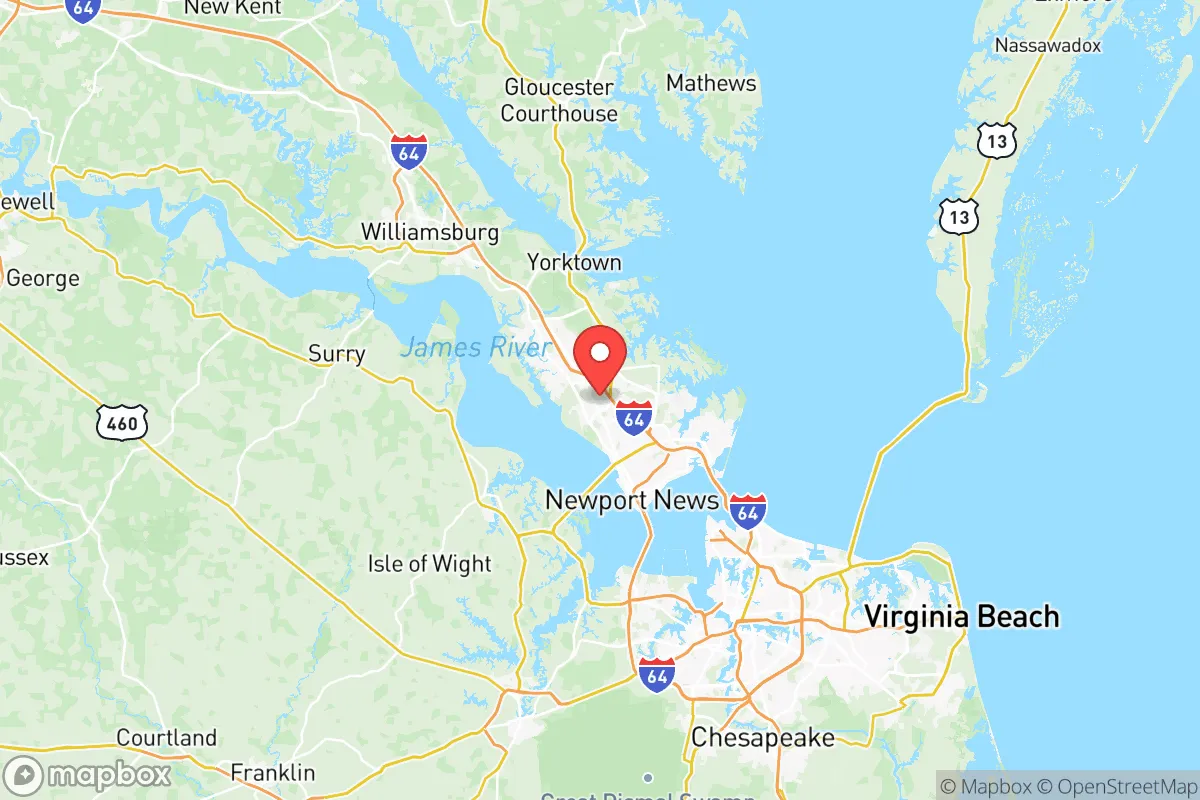
Newport News City County is a solidly Democratic stronghold with a Cook PVI of D+18, making it significantly more liberal than Virginia as a whole, which sits at D+4. This isn't a recent shift; the city has voted blue in every presidential election since at least 2000, with margins often exceeding 20 points. The political center of gravity is in the central and eastern parts of the city, particularly around the historic Hilton Village and the neighborhoods near Christopher Newport University, where you'll find the highest concentration of progressive voters and Democratic campaign signs.
How it compares
The contrast between Newport News and the rest of Virginia is stark. While the state has moved from a purple swing state to a lean-blue one over the past decade, Newport News has remained a reliable Democratic anchor. The city's D+18 rating is more than four times the state's D+4, meaning local elections are rarely competitive for Republicans. However, there's real variation within the county. The northern end, near the York County line and the more suburban neighborhoods like Denbigh and Kiln Creek, tends to be more moderate and occasionally flips to Republican in local races. The southern end, including the downtown area and the East End, is overwhelmingly Democratic, often delivering margins of 70% or higher for Democratic candidates. The swing precincts are in the central corridor, around the Oyster Point area and the neighborhoods near the shipyard, where working-class voters sometimes split tickets between Democratic presidential candidates and more conservative local officials.
What this means for residents
For liberal residents, Newport News offers a comfortable environment where Democratic policies are the norm and progressive candidates have a clear path to office. The city council and school board are reliably Democratic, and issues like affordable housing, public transit expansion, and environmental justice get serious attention. For conservative residents, the reality is more nuanced. While you won't find many elected Republicans at the city level, the broader Hampton Roads region includes conservative strongholds like Chesapeake and Virginia Beach, which are just a 30-minute drive away. Many conservatives in Newport News find their political home in state-level races, where Virginia's D+4 rating means their votes still matter. The city's political culture is generally pragmatic rather than ideological, with a focus on the shipyard, military bases, and port operations that dominate the local economy. This means even Democratic officials tend to be more centrist on economic and defense issues than their counterparts in Northern Virginia.
One cultural distinction that sets Newport News apart from the rest of Virginia is the outsized influence of the Newport News Shipbuilding division of Huntington Ingalls Industries. The shipyard is the largest employer in the city, and its unionized workforce gives the area a strong blue-collar Democratic tradition that feels different from the tech-driven liberalism of Northern Virginia or the university-town progressivism of Charlottesville. You'll hear more talk about defense contracts and maritime policy at local political events than about tech startups or cultural issues. The city also has a significant military retiree population, which adds a layer of fiscal conservatism to an otherwise liberal electorate. Looking ahead, the trajectory is likely to remain steady: Newport News will stay reliably Democratic, but the real political action will be in the swing precincts of the central corridor, where the city's future growth and demographic changes will play out.

State Political ClimatePolitical Climate in Virginia
State Political AnalysisPolitical Environment in the State
Virginia has shifted from a reliably purple swing state to a solidly Democratic-leaning one, carrying a Cook PVI of D+4. The transformation has been driven primarily by the explosive growth of the Washington, D.C. suburbs in Northern Virginia, which now dominate state elections and policy. Over the past 15 years, the state has moved leftward on nearly every major issue, though a strong conservative counterweight remains in the rural south and west, creating a deeply divided political landscape that feels like two different states under one capitol dome.
Urban vs. rural divide
The political map of Virginia is a study in stark geographic polarization. The entire Democratic majority is built on the suburban crescent of Northern Virginia—counties like Fairfax, Loudoun, and Prince William—plus the urban centers of Richmond and Norfolk/Virginia Beach. These areas have grown younger, more diverse, and more educated, and they vote overwhelmingly Democratic. In contrast, the rural Southside and Southwest Virginia—places like Danville, Martinsville, and the coal country around Bristol—vote just as overwhelmingly Republican. The I-95 corridor and the Tidewater region are the battlegrounds; Chesterfield County and Hanover County outside Richmond have been trending purple, while Loudoun County flipped from red to deep blue in less than a decade. A conservative moving to Virginia will find a welcome home in the rural counties, but will have little influence on statewide elections.
Policy environment
Virginia’s tax structure is moderate compared to its neighbors. The state income tax is a flat 5.75% on all income above $17,000, and the sales tax is 5.3% (higher in some localities). Property taxes are set at the local level and are generally lower than in Maryland but higher than in Tennessee. The regulatory posture is business-friendly in some respects—Virginia has a right-to-work law and a relatively low corporate income tax rate of 6%—but the state has aggressively expanded environmental regulations, including joining the Regional Greenhouse Gas Initiative (RGGI), which has raised electricity costs. Education policy is a flashpoint: the state has adopted the Virginia Literacy Act and expanded school choice through charter schools and lab schools, but the Democratic-controlled legislature has resisted broad private school voucher programs. Healthcare policy leans left, with Medicaid expansion under the Affordable Care Act covering over 400,000 additional Virginians. Election laws are among the most accessible in the South: no-excuse absentee voting, 45 days of early voting, and automatic voter registration at the DMV.
Recent policy direction
The last five years have seen a rapid leftward shift across multiple policy domains. On gun and self-defense law, the Democratic trifecta in 2020 passed a package of bills including universal background checks, a red flag law, a one-handgun-per-month limit, and the restoration of local authority to ban firearms in government buildings and public parks. Concealed carry permit holders from other states are no longer recognized unless their state has a reciprocity agreement. On parental and education rights, the state has moved to expand LGBTQ+ protections in schools, including model policies on transgender student accommodations that have sparked intense local battles in conservative counties like Loudoun and Spotsylvania. On speech and privacy, Virginia passed the Consumer Data Protection Act in 2021, one of the strongest state privacy laws in the country, but has also expanded hate crime statutes in ways that some free speech advocates view as chilling. On medical and bodily autonomy, Virginia has become a safe haven for abortion access in the South, with no gestational limit on abortion before the third trimester and a law protecting providers from out-of-state lawsuits. On property rights, the state has tightened zoning laws to allow more accessory dwelling units and missing-middle housing, particularly in Northern Virginia, but has also expanded eminent domain for transmission lines tied to renewable energy goals. On voting and ballot access, the state has made it easier to vote but has also seen controversies over the security of drop boxes and the accuracy of voter rolls, with the Republican Party of Virginia filing multiple lawsuits over the past two cycles.
Civil unrest & political movements
Virginia has been a stage for some of the most visible political flashpoints in the country. The 2017 Unite the Right rally in Charlottesville left a lasting scar and led to the removal of Confederate statues across the state, a process that continues to generate local controversy. The 2020 protests in Richmond over police brutality and the removal of the Robert E. Lee statue on Monument Avenue drew national attention and resulted in clashes between protesters and state police. On the right, the "Parents Matter" movement that erupted in Loudoun County in 2021 over school policies on transgender students and critical race theory became a national template for conservative school board activism. Immigration politics are less heated than in border states, but Prince William County and Arlington have declared themselves sanctuary jurisdictions, refusing to cooperate with ICE detainers, which has drawn criticism from Republican state legislators. Election integrity remains a live issue: the 2020 and 2021 elections saw Republican activists challenging absentee ballot procedures, and the state's handling of the 2021 gubernatorial race—won by Republican Glenn Youngkin—was seen by both sides as a test of the system's credibility. A new resident will notice that political yard signs, bumper stickers, and even conversations about local schools can quickly turn heated, especially in the purple suburbs.
Projection
Over the next 5-10 years, Virginia is likely to continue its leftward drift, but at a slower pace. The demographic engine of Northern Virginia shows no signs of slowing—it remains one of the fastest-growing regions in the country, driven by federal employment, defense contracting, and tech jobs. The rural areas, meanwhile, are aging and losing population, which will further dilute the conservative vote share. However, the 2021 election of Glenn Youngkin showed that a Republican who can appeal to suburban moderates on education and economic issues can still win statewide. The wild card is the 2030 redistricting cycle, which could reshape the congressional map. For a new resident, the practical takeaway is that Virginia will remain a competitive state for governor and down-ballot races, but the state legislature and the presidential vote will likely stay in Democratic hands. A conservative moving to Richmond or Virginia Beach will find a purple environment where their vote matters; a conservative moving to Fairfax County will be in a deep blue area where local policy will often run contrary to their preferences.
For a relocator, the bottom line is that Virginia offers a mix of urban opportunity and rural tradition, but the political direction is clear. If you value low taxes, gun rights, and local control over schools, you will find strong communities in the western and southern parts of the state, but you will be swimming against the statewide current. If you prioritize access to abortion, strong environmental regulations, and a diverse, fast-growing economy, the northern and eastern parts of the state will feel like home. Either way, Virginia is a state where your vote matters, your voice can be heard at the local level, and the political landscape will continue to evolve in ways that reflect the broader national divide.
* Values derived from national, state, county, city and local statistics and may differ in a specific area. Last updated: 2026-07-23T18:21:16.000Z
Narrative content on this page is AI-generated and may contain mistakes. Verify any details that matter before acting on them.
ReloMaps may earn a commission from affiliate links at no extra cost to you.

