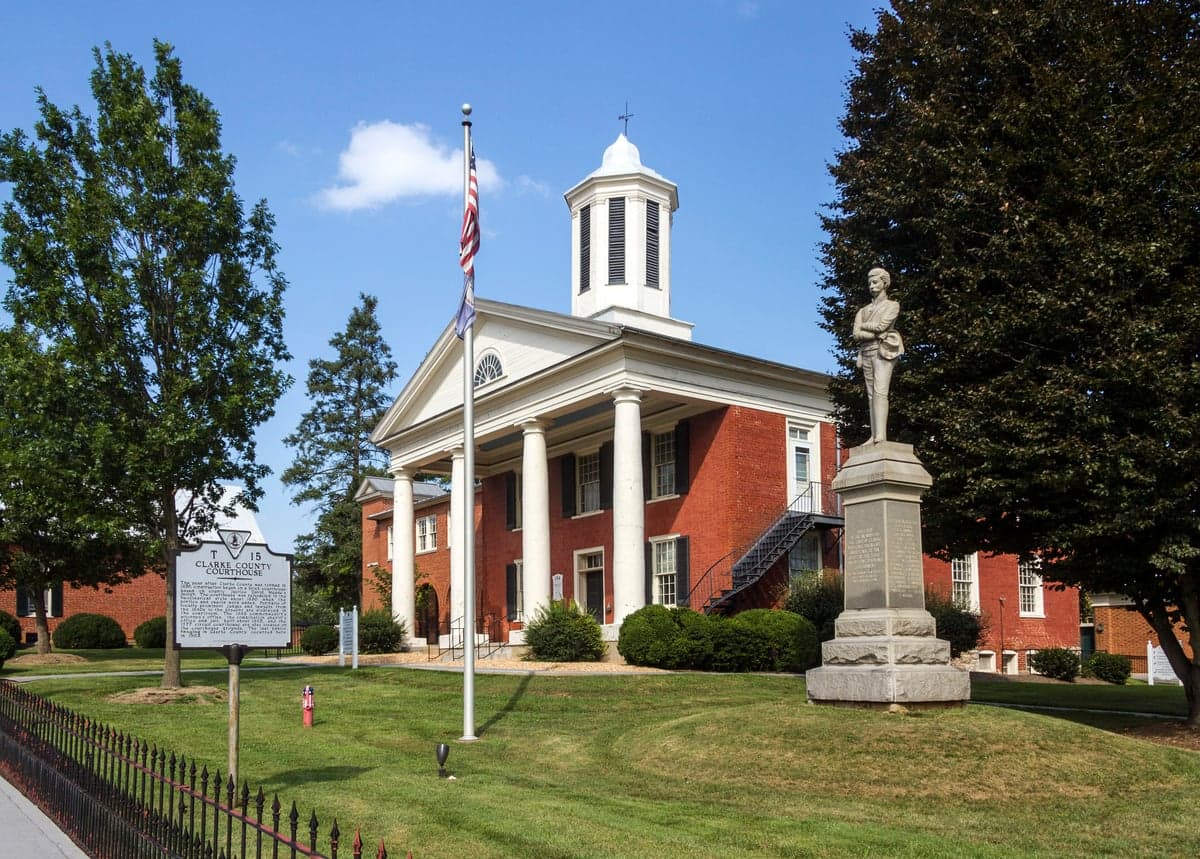
Photo: Wikipedia
Political ClimatePolitical Climate in Clarke County
Showing county-level results — no local-only data available.
Lean and PVI are calculated from this county’s 2020 and 2024 presidential results, Cook-style.
Political rankings in Virginia
- Most Conservative Cities in Virginia
- Most Liberal Cities in Virginia
- Best Liberal-Leaning Towns in the South
- Best Liberal-Leaning Towns in Appalachia
- Best Conservative-Leaning Towns in the Mid-Atlantic
- Safest Liberal-Leaning Towns in the South
- Safest Conservative-Leaning Towns in the South
- Safest Conservative-Leaning Towns on the East Coast
- Most Conservative Counties in Virginia
- Most Liberal Counties in Virginia
Local Political AnalysisPolitical Analysis of Clarke County
Clarke County, Virginia, is a reliably Republican stronghold in a state that has shifted decisively blue in recent years. With a Cook Partisan Voting Index (PVI) of R+9, the county is a full 13 points more conservative than Virginia as a whole, which carries a PVI of D+4. This isn't a new development; the county has been a GOP bastion for decades, but the gap between its lean and the state's trajectory has widened significantly since the 2010s. The real story, however, is the internal variation within the county, where you'll find a clear split between the rural, agricultural heartland and the more suburbanized, commuter-friendly areas near the Loudoun County line.
How it compares
The contrast between Clarke County and the rest of Virginia is stark. While the state has been carried by Democrats in every presidential election since 2008, Clarke County has voted Republican in every one of those races, often by double-digit margins. In 2024, for example, Donald Trump won the county by roughly 15 points, even as Kamala Harris carried the state by about 5. This isn't just a presidential phenomenon; down-ballot races for the state legislature and local offices consistently favor Republicans. The county's R+9 PVI is a reflection of a deeply rooted conservative culture, particularly in the unincorporated areas and the town of Berryville, which serves as the county seat and a traditional GOP hub. However, the picture is more nuanced in Boyce and the southern end of the county near the Loudoun border. These areas, particularly around the Millwood and White Post communities, have seen an influx of residents from the D.C. suburbs, bringing a more moderate or even liberal tilt. These precincts often swing closer to the countywide average, but they can break for a moderate Democrat in a good year, making them the only real swing territory in an otherwise solidly red county.
What this means for residents
For conservative residents, Clarke County offers a political environment where their views are the norm. Local government, school board meetings, and civic organizations tend to reflect traditional values, and a Republican candidate can expect a friendly reception. For liberal residents, the reality is more about finding your niche. You won't be isolated, but you'll be in a clear minority. The Berryville town council and the county board of supervisors are dominated by Republicans, and progressive policy proposals—on land use, taxes, or social issues—face an uphill battle. That said, the county is not a monolith. The growing population near the Loudoun line has introduced a more diverse set of political voices, and local elections can be competitive, especially for school board seats. The key takeaway is that while the county's overall lean is solidly red, the internal dynamics are shifting, and the political conversation is becoming less one-dimensional than it was a decade ago.
Cultural and policy distinctions
One of the most tangible ways Clarke County's political climate manifests is in its approach to growth and development. The county has a strong tradition of land-use conservatism, with strict zoning and a vocal anti-growth sentiment that cuts across party lines. This is a point of common ground: both conservative farmers and liberal newcomers often unite to oppose large-scale subdivisions or commercial projects that threaten the county's rural character. This shared value creates a unique political dynamic where the usual left-right divide is less pronounced on local issues. Another distinction is the county's relationship with the state government in Richmond. Clarke County frequently finds itself at odds with the Democratic-controlled state legislature on issues like gun rights, education policy, and renewable energy mandates. This tension reinforces a sense of local identity and self-reliance, with many residents feeling that the state government doesn't understand their way of life. Looking ahead, the county's political trajectory will likely hinge on how it manages growth. If the influx from Loudoun continues, the R+9 lean could soften, but the deep-rooted conservative culture in Berryville and the rural areas suggests that Clarke County will remain a Republican stronghold for the foreseeable future, even as the state around it becomes more blue.

State Political ClimatePolitical Climate in Virginia
State Political AnalysisPolitical Environment in the State
Virginia is a classic swing state that has drifted left over the past two decades, now carrying a Cook PVI of D+4, but it’s far from a monolith. The shift is driven almost entirely by the explosive growth of the Washington, D.C. suburbs in Northern Virginia, which now dominate statewide elections, while the rest of the state—from the Shenandoah Valley to Southside and Southwest Virginia—has become increasingly Republican. A relocator in 2026 will find a state where your political experience depends almost entirely on which of the state’s distinct regions you choose to call home.
Urban vs. rural divide
The political map of Virginia is a tale of three regions. Northern Virginia—Arlington, Alexandria, Fairfax, Loudoun, and Prince William counties—is the Democratic engine, producing massive vote margins that can overcome Republican wins everywhere else. Fairfax County alone cast over 360,000 votes in 2024, with a Democratic margin of roughly 30 points. Richmond and its surrounding counties (Henrico, Chesterfield) are a purple battleground trending blue, while Hampton Roads (Virginia Beach, Norfolk, Chesapeake) leans slightly Democratic but has competitive pockets. The rest of the state—Roanoke, Lynchburg, the Shenandoah Valley, and the rural Southside—votes solidly Republican. The 2021 gubernatorial election was a perfect snapshot: Republican Glenn Youngkin won by running up margins in the exurbs and rural areas while keeping Northern Virginia’s margin close enough. But in 2024, Democrats swept all statewide offices again, powered by NoVA turnout. The divide isn’t just urban vs. rural; it’s also suburban vs. exurban. Loudoun County, once a bellwether, has flipped from purple to solid blue as its population has grown denser and more diverse.
Policy environment
Virginia’s policy environment is a mixed bag that reflects its purple status. Taxes: The state income tax is a flat 5.75% (down from 5.75% under a 2023 cut), and the sales tax is 5.3% (higher in Northern Virginia and Hampton Roads for local transportation projects). Property taxes are set locally and vary widely—Loudoun County’s rate is around $1.20 per $100 of assessed value, while rural counties like Pittsylvania are under $0.60. Regulatory posture: Virginia is a Dillon Rule state, meaning localities only have powers explicitly granted by the General Assembly, which keeps zoning and land-use decisions relatively centralized. Education: The state has a strong public school system overall, but there’s been a fierce battle over parental rights and curriculum. Governor Youngkin’s 2022 executive order on “inherent parental rights” and the 2024 law requiring school boards to notify parents of sexually explicit content in materials have been flashpoints. Healthcare: Virginia expanded Medicaid under the ACA in 2019, and the state has a robust insurance marketplace. Election laws: Virginia has no-excuse absentee voting, 45 days of early voting (including weekends), and same-day voter registration. Voter ID is required but can be a photo ID or a utility bill. The state has not adopted ranked-choice voting for general elections.
Recent policy direction
The last five years have seen Virginia swing back and forth on key issues. Gun and self-defense law: In 2020, Democrats passed a package of gun control measures including universal background checks, a one-handgun-per-month limit, and a “red flag” law allowing temporary seizure of firearms from individuals deemed a threat. In 2024, a Republican-backed bill to allow permitless concealed carry passed the House but died in the Senate. The state remains a “shall-issue” for concealed carry permits, with a 45-day processing time. Parental and education rights: The 2022 Youngkin administration pushed through policies requiring parental notification of “sexually explicit” instructional materials and allowing parents to opt their children out of lessons they find objectionable. The 2024 “Parents’ Bill of Rights” law codifies these rights. Speech: Virginia has no state-level hate speech law that restricts protected speech, but public universities have faced lawsuits over campus speech policies. Privacy and surveillance: The 2021 Virginia Consumer Data Protection Act gives residents rights to access, correct, and delete personal data held by companies, but it does not cover government surveillance. Medical and bodily autonomy: Abortion is legal up to 26 weeks, with a 24-hour waiting period and parental consent for minors. In 2024, a proposed 15-week ban failed in the Senate. Property rights: Virginia has no statewide rent control, and localities are prohibited from imposing it. The state’s “right to farm” law protects agricultural operations from nuisance lawsuits. Taxation: The 2023 tax reform lowered the top income tax rate from 5.75% to 5.5% and doubled the standard deduction. Voting and ballot access: The 2020 Voting Rights Act restored preclearance requirements for localities with a history of discrimination, and the state now has automatic voter registration at DMVs.
Civil unrest & political movements
Virginia has been a stage for national political flashpoints. The 2017 “Unite the Right” rally in Charlottesville remains the most infamous, leading to the removal of Confederate statues and a statewide debate over public monuments. In 2020, Richmond saw weeks of protests over racial justice, with the Robert E. Lee statue becoming a focal point. The 2021 election saw intense debate over critical race theory in schools, with Loudoun County at the epicenter of school board battles. Immigration politics are less heated than in border states, but Prince William County and Fairfax County have sanctuary policies limiting cooperation with ICE. Election integrity controversies flared in 2020 and 2021, with Republican activists questioning absentee ballot procedures, but no widespread fraud was found. The 2024 election saw a lawsuit over the state’s voter roll maintenance, with Republicans alleging non-citizens were registered. A new resident in Northern Virginia will see political yard signs and bumper stickers year-round; in rural areas, the culture is more quietly conservative.
Projection
Over the next 5-10 years, Virginia will likely continue its slow drift leftward, driven by Northern Virginia’s growth. The D.C. suburbs are adding tens of thousands of new residents annually, many of them young professionals and federal employees who lean Democratic. The 2030 redistricting cycle could further entrench Democratic control of the General Assembly. However, the exurbs—places like Spotsylvania and Stafford counties—are growing fast and trending red, which could keep statewide races competitive. The wild card is remote work: if federal agencies reduce in-office requirements, some NoVA residents may move to lower-cost areas like Richmond or the Shenandoah Valley, potentially shifting those regions. A relocator moving in now should expect a state where the political center of gravity is in the D.C. suburbs, but where rural and exurban areas will continue to push back. The state will remain a battleground for control of the governorship and the legislature, with policy swinging between the two parties depending on turnout.
For a new resident, the bottom line is that Virginia offers a genuinely mixed political experience. If you live in Northern Virginia, you’ll be in a deep-blue environment with high taxes and strong public services. If you live in Roanoke or Lynchburg, you’ll be in a reliably red area with lower costs and a more traditional culture. The state’s laws are a patchwork: gun rights are moderately restricted, abortion is broadly legal, and education policy is contested. Your daily life will be shaped more by your locality than by Richmond. If you’re conservative, you can find a welcoming community in the exurbs or rural areas, but you’ll need to accept that statewide elections will likely go Democratic. If you’re liberal, you’ll find a strong base in the cities and suburbs, but you’ll encounter sharp cultural divides as soon as you leave the interstate. Virginia is not a state where one party dominates; it’s a state where you choose your political reality by choosing your address.
* Values derived from national, state, county, city and local statistics and may differ in a specific area. Last updated: 2026-11-15T14:32:31.000Z
Narrative content on this page is AI-generated and may contain mistakes. Verify any details that matter before acting on them.
ReloMaps may earn a commission from affiliate links at no extra cost to you.

