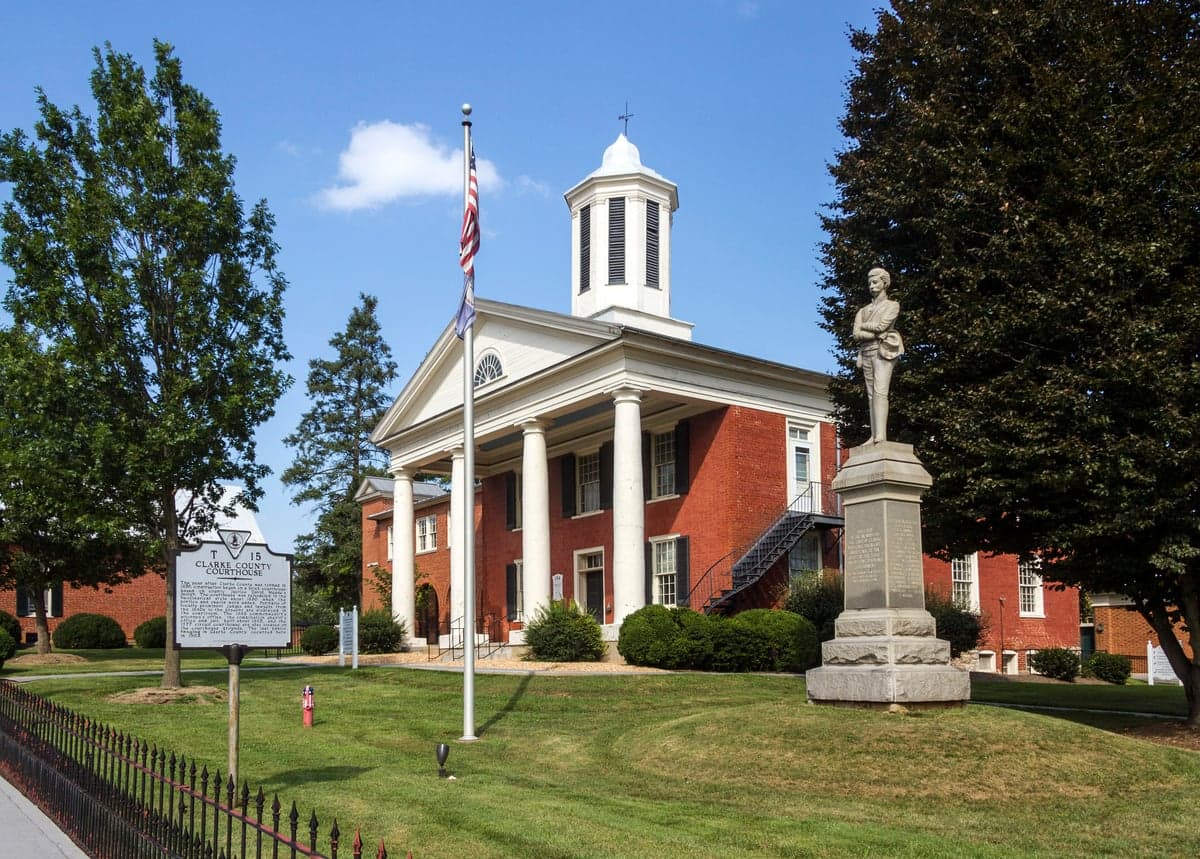
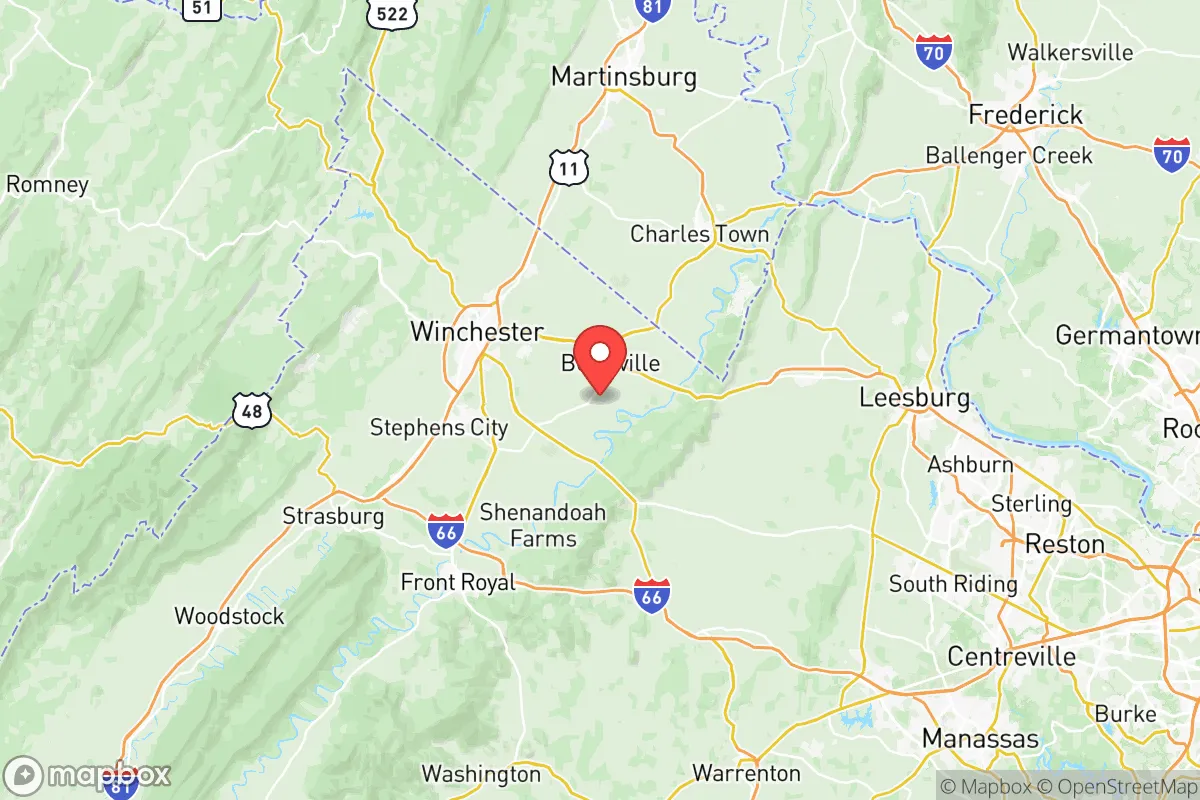
Photo: Wikipedia
Demographics of Clarke County
Affluence Level in Clarke County
An upper-middle-class area. Household wealth, education levels, and homeownership run ahead of national benchmarks.
People of Clarke County
Clarke County, Virginia, is a rural, historically agrarian community of 15,060 residents that retains a distinctly old-Virginia character, marked by a predominantly white population (83.2%) and a modest but growing Hispanic presence (7.1%). The county’s identity is shaped by its deep roots in the Shenandoah Valley, its legacy as a center for thoroughbred horse breeding and apple orchards, and a quiet, family-oriented lifestyle that appeals to those seeking space and tradition. With a foreign-born population of just 2.9% and a college-educated rate of 37.3%, Clarke County is less diverse and less transient than nearby Loudoun County, but it is not static—newer residents are arriving from the Washington, D.C. exurbs, slowly shifting the county’s demographic and cultural landscape.
Settlement & growth (pre-1960)
Long before European settlers arrived, the area now known as Clarke County was part of the ancestral homeland of the Iroquoian-speaking Tuscarora and Algonquian-speaking tribes, including the Shawnee, who used the Shenandoah Valley as a hunting ground and travel corridor. The first Europeans to explore the region were German and Scots-Irish frontiersmen pushing west from the Tidewater region in the early 1700s. By the 1730s, the Virginia General Assembly had opened the Valley to settlement, and land grants drew families to the fertile limestone soils along the Shenandoah River.
The county’s earliest permanent settlements clustered around Berryville, the county seat, and Millwood, a small hamlet founded in the 1780s by the Burwell family, who established a grist mill and a plantation economy. These early settlers were predominantly English and Scots-Irish, many of them members of the Anglican Church or Presbyterian congregations. They brought with them a system of large-scale agriculture—tobacco, wheat, and later apples—that relied on enslaved African labor. By 1790, enslaved people made up roughly 40% of the county’s population, a figure that would remain high through the Civil War.
Clarke County was officially formed from Frederick County in 1836, named for Revolutionary War hero George Rogers Clark. The county’s economy in the 19th century revolved around grain, livestock, and fruit orchards, with the Winchester and Potomac Railroad arriving in the 1830s to ship goods east. The Civil War devastated the region—the county saw heavy fighting during the 1864 Valley Campaigns, and the Battle of Berryville in September 1864 left much of the countryside scorched. After emancipation, many formerly enslaved families remained in the area as sharecroppers or tenant farmers, forming small communities such as Briggs and Wadesville, where their descendants still live today.
Through the late 1800s and early 1900s, Clarke County remained overwhelmingly rural and agricultural. The apple industry boomed, with orchards around Boyce and White Post shipping fruit to eastern markets. A small wave of German and Irish immigrants arrived to work on the railroads and in the orchards, but the county’s population remained remarkably stable—hovering around 7,000 to 8,000 residents from 1870 through 1940. The Great Depression hit hard, but the county’s agricultural base provided a buffer against the worst of the urban unemployment crisis. World War II brought little demographic change, as most young men enlisted or moved to defense plants in Winchester and Washington.
Modern era (post-1965)
The 1965 Hart-Cellar Act had a minimal direct impact on Clarke County, as the county’s foreign-born population remains just 2.9% today—far below the national average. However, the act’s broader effect on the Washington, D.C. metropolitan area did eventually reach Clarke County. Beginning in the 1980s and accelerating after 2000, domestic migration from the D.C. suburbs—particularly Loudoun and Fairfax counties—began reshaping the county’s population. Families seeking larger lots, lower taxes, and a slower pace of life moved into developments around Berryville and along the Route 7 corridor, commuting to jobs in Leesburg, Reston, and even D.C. This influx brought a more educated, wealthier demographic: the county’s college-educated share rose from roughly 20% in 1990 to 37.3% today.
The Hispanic population, now 7.1% of the county, grew steadily from the 1990s onward, driven by labor demand in the apple orchards, nurseries, and horse farms that define the local economy. Many of these families are of Mexican and Central American origin, and they have concentrated in and around Berryville and the unincorporated area of Keyes Gap, where seasonal agricultural work is most available. The Black population, at 4.9%, has remained stable, with historic communities in Briggs and Wadesville maintaining their identity even as younger generations move to larger cities for employment. East and Southeast Asian residents make up 0.8% of the population, and Indian-subcontinent residents 0.3%, with most of these families employed in professional roles in the county’s small but growing healthcare and education sectors.
Suburbanization has been selective. Unlike neighboring Loudoun County, which exploded into a sprawling exurb, Clarke County has maintained its rural zoning and agricultural preservation programs. New subdivisions are concentrated near Berryville and along the Route 340 corridor, while the rest of the county remains in farmland, horse pastures, and apple orchards. The county’s population grew by about 12% between 2000 and 2020, a modest pace compared to the explosive growth of the D.C. exurbs, but enough to create tension between longtime farming families and newcomers who commute to the city.
The future
Clarke County is likely to become slightly more diverse and more suburban over the next 10–20 years, but the pace of change will remain slow compared to the rest of Northern Virginia. The Hispanic population is projected to grow to around 10–12% by 2040, driven by continued agricultural labor demand and family reunification, with new arrivals settling in Berryville and Boyce. The white population, while still the overwhelming majority, will continue to see an influx of D.C.-area transplants, many of whom are younger families with children, which will push the county’s median age down slightly from its current 45 years.
New development will likely concentrate along the Route 7 and Route 340 corridors, with small-lot subdivisions and townhomes appearing on the edges of Berryville. The county’s agricultural preservation program will keep most of the land in farming, but pressure from developers is constant. The cultural identity of Clarke County will remain rooted in its rural, equestrian, and agricultural heritage, but the growing presence of commuters and Hispanic families will gradually broaden the county’s social and political landscape. For someone moving in now, Clarke County offers a stable, safe, and scenic environment with a strong sense of place—but one that is quietly, steadily evolving.
Clarke County is becoming a place where the old Virginia farming tradition meets the new exurban reality—a community that values its open spaces and slow pace, but is slowly absorbing the diversity and commuter culture of the greater D.C. region. For relocating families, it offers excellent schools, low crime, and a tight-knit feel, but with the understanding that the county’s future will be shaped by the balance between preservation and growth.

* Values derived from national, state, county, city and local statistics and may differ in a specific area. Last updated: 2026-11-15T14:32:31.000Z
Narrative content on this page is AI-generated and may contain mistakes. Verify any details that matter before acting on them.
ReloMaps may earn a commission from affiliate links at no extra cost to you.

