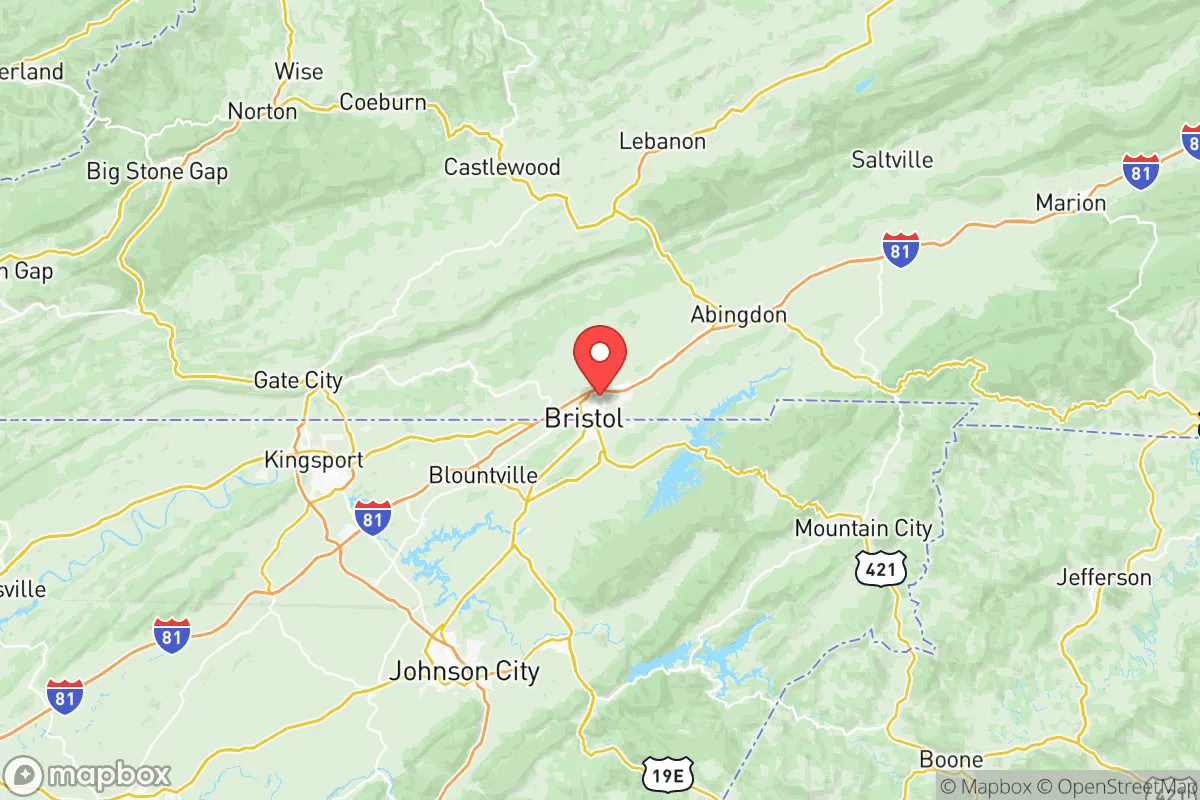
Demographics of Bristol City County
Affluence Level in Bristol City County
A low-income area with significant economic hardship. Household wealth and educational attainment are well below national averages.
People of Bristol City County
Bristol City County, Virginia, is a small, independent city-county with a population of 17,024, characterized by a predominantly white (85.3%) and native-born (99.8%) populace. Its people are defined by deep Appalachian roots, a strong sense of local identity, and a demographic profile that has remained remarkably stable over decades, with very limited foreign-born influence. The community is less educated than state averages (23.9% college-educated) and leans conservative, reflecting its history as a manufacturing and transportation hub in the Blue Ridge Highlands.
Settlement & growth (pre-1960)
The area now known as Bristol City County was originally inhabited by the Cherokee and Shawnee nations, who used the region for hunting and seasonal settlements along the Holston River. European settlement began in earnest after the American Revolution, with the first permanent white settlers arriving in the late 1700s. These were primarily Scots-Irish and English frontiersmen moving southwest along the Great Wagon Road from Pennsylvania and the Shenandoah Valley, drawn by cheap land grants and the promise of self-sufficiency. They established small farms and isolated homesteads in what would become the communities of Bristol (the city proper) and the surrounding rural areas like Goodson (an early name for the Virginia side) and King's Mill.
The town of Bristol was formally established in 1856, straddling the Virginia-Tennessee state line. Its growth was propelled by the arrival of the Virginia and Tennessee Railroad in the 1850s, which transformed the settlement into a regional transportation and commercial center. The railroad brought a wave of laborers, merchants, and tradesmen, many of whom were native-born whites from surrounding counties. The post-Civil War era saw modest industrial development, with tobacco processing, lumber mills, and later textile and furniture factories drawing workers from the rural Appalachian hinterland. By the early 20th century, Bristol had become a small but bustling city, with a population that was overwhelmingly white and native-born. The Great Depression and World War II slowed growth, but the post-war boom of the 1950s brought a modest influx of families seeking work in the region's expanding manufacturing base, including the Bristol Steel & Iron Works and Raytheon plants. No significant immigrant communities formed during this period; the population remained almost entirely native-born white, with a small African American community (descendants of enslaved people and post-Reconstruction migrants) concentrated in neighborhoods like Washington County's adjacent areas and the Fairmount section of Bristol.
Modern era (post-1965)
The 1965 Hart-Cellar Act had virtually no impact on Bristol City County. The foreign-born population stands at just 0.2% in 2026, one of the lowest rates in Virginia. Unlike many American cities that experienced waves of immigration from Latin America, Asia, and the Indian subcontinent after 1965, Bristol remained demographically isolated. The small Hispanic population (2.7%) and Black population (6.7%) are largely native-born, with the Black community tracing its roots to the early 20th century rather than recent migration. East/Southeast Asian residents (0.3%) and Indian subcontinent residents (0.0%) are negligible, and no ethnic enclaves have formed.
Domestic migration has been the primary demographic force since the 1970s. The decline of manufacturing in the 1980s and 1990s led to population stagnation and out-migration of younger residents seeking opportunities in larger cities like Charlotte, Nashville, and Richmond. However, the region has seen a modest counter-trend since 2010: a small but steady influx of retirees and remote workers drawn by low housing costs, a slower pace of life, and proximity to outdoor recreation in the Jefferson National Forest and the Appalachian Trail. These newcomers are predominantly white and native-born, reinforcing the existing demographic character. Suburbanization has been limited; the city-county's small geographic size and lack of major new housing developments have kept growth concentrated in the historic core of Bristol and the adjacent unincorporated areas of Washington County, such as Abingdon and Mendota, which serve as bedroom communities.
The future
Bristol City County is projected to remain one of the least diverse places in Virginia over the next 10-20 years. The foreign-born share is unlikely to rise significantly, as the area lacks the job base, housing stock, or cultural infrastructure to attract international migrants. The Hispanic population may grow slowly through natural increase and some domestic migration from other parts of the Southwest, but will likely remain below 5%. The Black population is stable, with no major in-migration expected. The white population will continue to age, with a median age likely rising above the current 42.5 years, as younger adults leave for urban job markets.
The most significant demographic trend is the potential for modest growth from domestic migration of remote workers and retirees, particularly if broadband infrastructure improves and housing remains affordable. This could bring a slightly more educated and politically moderate cohort, but the overall cultural identity of the area—Appalachian, conservative, and community-oriented—is unlikely to shift dramatically. New residents are dispersing across the county rather than concentrating in specific enclaves, as there are no distinct immigrant neighborhoods. The city-county's small size and lack of major employers mean that population growth will be incremental, not transformative.
For someone moving in now, Bristol City County offers a stable, homogenous community with deep historical roots and a strong sense of place. It is not a place of rapid demographic change or cultural diversity, but rather a region where the population's character—white, native-born, and rooted in Appalachian traditions—has been remarkably consistent for over a century. The future points to slow, organic change driven by domestic migration, not immigration, making it an ideal choice for those seeking continuity and predictability in their new home.

* Values derived from national, state, county, city and local statistics and may differ in a specific area. Last updated: 2026-07-16T01:25:42.000Z
Narrative content on this page is AI-generated and may contain mistakes. Verify any details that matter before acting on them.
ReloMaps may earn a commission from affiliate links at no extra cost to you.

