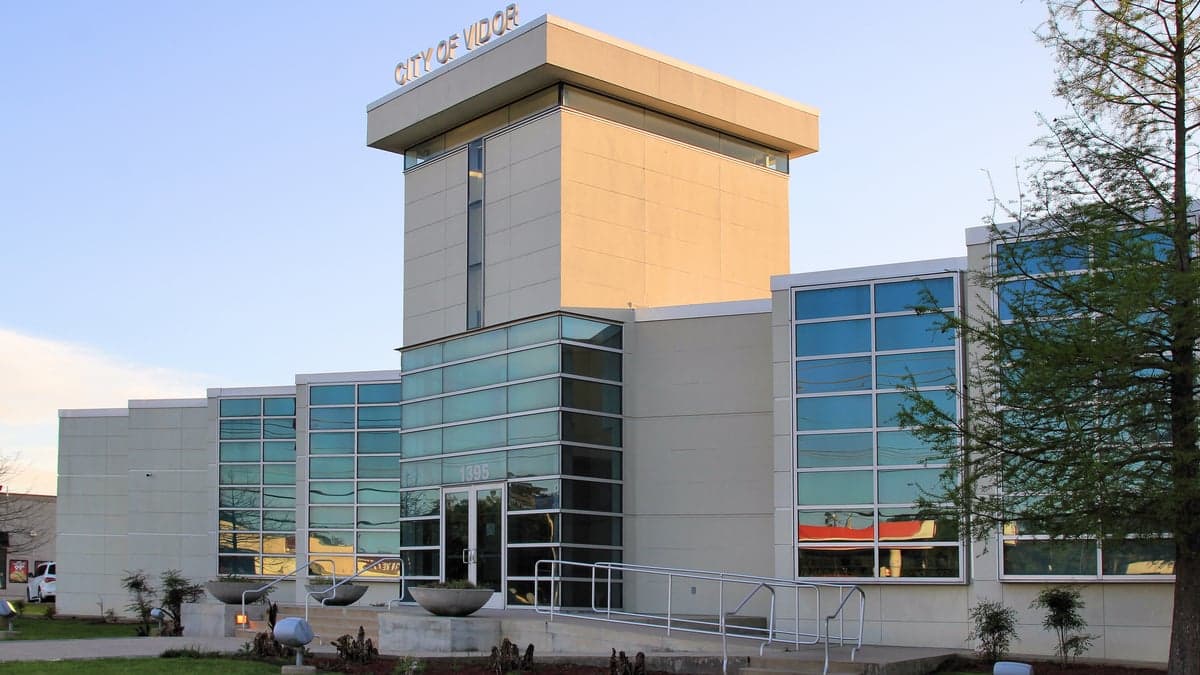
Photo: Wikipedia
Political ClimatePolitical Climate in Vidor, TX
District shown is the primary district for this city’s centroid. Cities may span multiple districts.
Local Political AnalysisPolitical Analysis of Vidor, TX
Vidor, Texas, is one of the most reliably Republican small towns in the state, with a Cook Partisan Voting Index (PVI) of R+17, meaning it votes about 17 points more Republican than the national average. That’s a deep red pocket even by Texas standards, where the statewide PVI sits at R+4. Locals will tell you this isn’t a recent shift—Vidor has been a conservative stronghold for decades, and the 2024 election results only reinforced that trend, with Orange County (where Vidor sits) delivering a margin well above the state average. The trajectory here isn’t toward purple; if anything, the area has become more uniformly Republican as surrounding rural counties have hardened their partisan lines.
How it compares
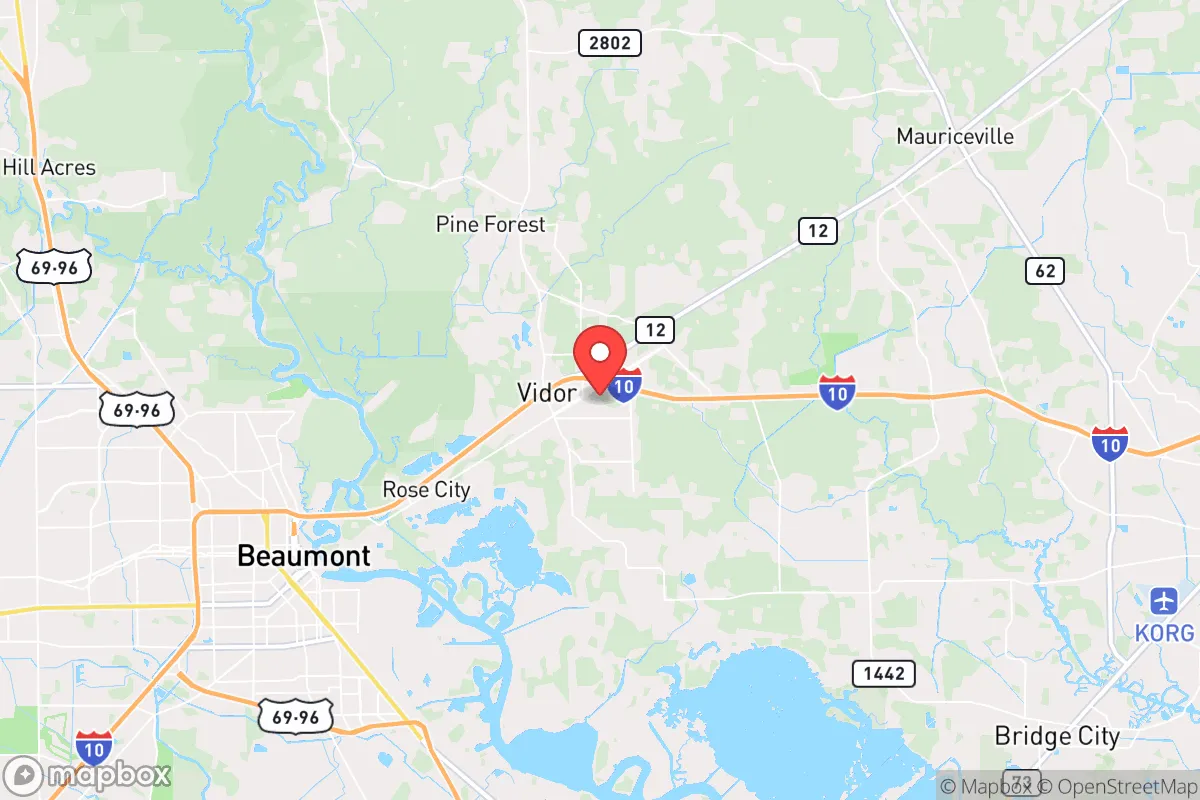
Compared to Texas as a whole, Vidor is a political outlier. The state’s R+4 rating reflects a competitive balance in major metro areas like Houston, Dallas, and Austin, where Democrats often win by large margins. Vidor, by contrast, sits in a region where Democratic candidates rarely crack 30% of the vote. The nearest city of any size, Beaumont (about 15 miles west), is more politically mixed—Jefferson County leans Democratic in local races, though it’s still competitive. Head south to Port Arthur, and you’ll find a reliably Democratic stronghold with a large Black and Hispanic population. Vidor’s political culture is more akin to small towns in East Texas like Jasper or Newton, where conservative social values and gun rights are central to local identity. The contrast with the fast-growing, diversifying suburbs of Dallas-Fort Worth or Houston is stark—those areas are trending toward toss-up status, while Vidor remains a bastion of old-school Texas conservatism.
What this means for residents
For conservative residents, Vidor’s political climate means local government, school board policies, and law enforcement priorities align closely with their values. You’ll find strong support for Second Amendment rights, low taxes, and a hands-off approach to business regulation. The local economy is driven by petrochemical plants and small businesses, and there’s little appetite for progressive social policies. For liberal residents, the reality is more isolating. While no one is openly hostile, you’ll likely be in the minority in most civic conversations, and local candidates who align with Democratic positions rarely gain traction. That said, the area is not a political pressure cooker—most people are neighborly regardless of party, and the day-to-day focus is on family, work, and community events like the Vidor Homecoming Festival. The biggest practical difference is in policy: expect a conservative approach to land use, school curriculum, and public spending, with little push for the kind of urban amenities or transit projects you’d see in blue-leaning cities.
One cultural distinction worth noting is Vidor’s history with racial integration, which has shaped its political identity in ways that still echo today. The town was a Klan stronghold in the mid-20th century, and while overt racism has faded, the community remains overwhelmingly white (over 95%) and politically homogeneous. This isn’t a place where you’ll find much political diversity in public life—local elections are often decided in the Republican primary. Looking ahead, the long-term trend is stability: Vidor’s population is aging slowly, and without major new industry or migration, the political lean is likely to stay R+17 or deeper. For anyone moving here, the takeaway is simple: if you’re conservative, you’ll feel right at home; if you’re not, you’ll need to find your community in nearby Beaumont or online, because local politics won’t be changing anytime soon.

State Political ClimatePolitical Climate in Texas
State Political AnalysisPolitical Environment in the State
Texas has been a reliably Republican state for decades, with a Cook Partisan Voting Index of R+4, meaning it votes about four points more Republican than the national average. However, the state’s political landscape is shifting: while Republicans still hold every statewide office and both legislative chambers, the margin of victory has narrowed from double digits in the 2000s to roughly 5-6 points in recent presidential elections. The dominant coalition is a mix of rural conservatives, suburban moderates, and a growing number of Hispanic voters leaning right, but the explosive growth of metros like Austin, Dallas-Fort Worth, and Houston is steadily injecting Democratic votes into the mix, making Texas a true battleground by the early 2030s.
Urban vs. rural divide
The political map of Texas is a stark checkerboard of deep blue urban islands surrounded by a sea of red. The major Democratic strongholds are the big cities and their inner suburbs: Harris County (Houston) alone cast over 1.2 million votes for Biden in 2020, while Dallas County, Travis County (Austin), and Bexar County (San Antonio) all went blue by double digits. Meanwhile, the rural and exurban counties—places like Lubbock, Midland, and the Panhandle—routinely vote 75-80% Republican. The real story is in the suburbs: once-reliable red counties like Collin (north of Dallas) and Fort Bend (southwest of Houston) have flipped or become competitive, driven by an influx of college-educated professionals and diverse populations. The Rio Grande Valley, historically a Democratic stronghold, has shifted rightward, with Zapata County flipping from +40 D in 2012 to +10 R in 2024, a trend driven by conservative social values and a growing Hispanic middle class.
Policy environment
Texas’s policy environment is defined by a low-tax, low-regulation posture that appeals strongly to conservative relocators. The state has no personal or corporate income tax, relying instead on high property taxes (averaging 1.6-2.2% of assessed value) and a 6.25% state sales tax (local add-ons can push it to 8.25%). Education policy is a flashpoint: the state funds schools through a complex “Robin Hood” system that redistributes property tax revenue from wealthy districts to poorer ones, and the 2023 school voucher bill (SB 1) passed, allowing families to use public funds for private or homeschool expenses. Healthcare is a mixed bag—Texas has the highest uninsured rate in the nation (about 17%) because it has not expanded Medicaid under the ACA, but it also has a robust network of private hospitals and a growing telehealth sector. Election laws have tightened: SB 1 (2021) restricted mail-in voting, added ID requirements, and banned 24-hour and drive-through voting, changes that were heavily litigated but largely upheld. For gun owners, Texas is a “constitutional carry” state (permitless carry since 2021) with strong preemption laws that prevent local governments from enacting stricter ordinances.
Recent policy direction
The last five years have seen Texas move decisively in a conservative direction on several fronts, while also carving out some unique libertarian spaces. On gun rights, HB 1927 (2021) eliminated the requirement for a license to carry a handgun, making Texas one of the largest permitless carry states. Parental rights in education were strengthened by HB 900 (2023), which restricts “sexually explicit” material in school libraries and requires parental consent for certain health services. On speech and privacy, the state passed HB 20 (2023) requiring age verification for adult websites and a law banning TikTok on government devices. Medical and bodily autonomy saw a sharp reversal: Texas’s trigger law (SB 8, 2021) banned abortion after about six weeks, and the 2023 Human Life Protection Act (HB 1280) effectively outlawed the procedure entirely, with no exceptions for rape or incest. Property rights remain strong, with no statewide rent control and a homestead exemption that protects a primary residence from forced sale to satisfy most creditors. On voting, SB 1 (2021) added a new ID requirement for mail ballots and banned election officials from proactively sending mail-in ballot applications, which critics say suppresses turnout but supporters argue ensures integrity. The overall direction is toward more local control on education and less on guns, with a clear tilt toward protecting individual liberty in the traditional conservative sense.
Civil unrest & political movements
Texas has seen its share of political flashpoints, though large-scale civil unrest has been relatively contained compared to other states. The 2020 George Floyd protests in Austin, Houston, and Dallas were significant, with Austin alone seeing over 100 consecutive nights of demonstrations and a controversial police budget cut that was later partially restored. The border politics are a constant source of tension: Governor Abbott’s Operation Lone Star (2021) deployed state troopers and National Guard to the border, bused migrants to sanctuary cities like New York and Chicago, and installed razor wire along the Rio Grande, leading to ongoing legal battles with the Biden administration. The “Texit” movement (Texas secession) is a fringe but vocal element, with the Texas Nationalist Movement claiming tens of thousands of supporters, though no serious political momentum exists. Election integrity remains a hot-button issue: after the 2020 election, Attorney General Ken Paxton launched a failed lawsuit to overturn results in four swing states, and the 2022 primary saw purges of voter rolls that removed over 1 million inactive registrations. A new resident would notice the political polarization in everyday life—bumper stickers, yard signs, and even church affiliations often signal political allegiance, especially in the suburbs of Dallas and Houston.
Projection
Over the next 5-10 years, Texas is likely to become more competitive at the statewide level, but not necessarily more liberal. The key demographic driver is in-migration: Texas adds about 1,000 new residents per day, many from California and the Northeast, who tend to be more moderate or libertarian than the state’s traditional conservative base. The Hispanic population, now about 40% of the state, is not monolithic—younger, more secular Hispanics lean Democratic, while older, churchgoing Hispanics are trending Republican. The suburbs of Fort Bend, Collin, and Williamson counties will continue to be the battlegrounds, with their growing diversity and education levels pushing them toward the center. The state’s political leadership will likely remain Republican for the next decade, but the margin will shrink, forcing the party to moderate on some issues (like Medicaid expansion or property tax relief) to hold onto suburban voters. A relocator moving in now should expect a state that remains conservative on fiscal and gun policy, but where the culture wars over education, abortion, and immigration will intensify as the electorate becomes more evenly split.
For a new resident, the bottom line is that Texas offers a low-tax, high-freedom environment for conservatives, with strong gun rights, school choice, and a business-friendly climate. Liberals will find a vibrant counterculture in the major cities and a growing political influence, but will face a state government that is actively hostile to their priorities on abortion, voting access, and public education. The practical takeaway: choose your county carefully. A family moving to Collin County will experience a very different political reality than one settling in Travis County, and the gap is only widening. Texas is not a monolith—it’s a collection of fiercely independent regions, and your experience will depend almost entirely on which one you call home.
* Values derived from national, state, county, city and local statistics and may differ in a specific area. Last updated: 2026-07-23T02:41:22.000Z
Narrative content on this page is AI-generated and may contain mistakes. Verify any details that matter before acting on them.
ReloMaps may earn a commission from affiliate links at no extra cost to you.

