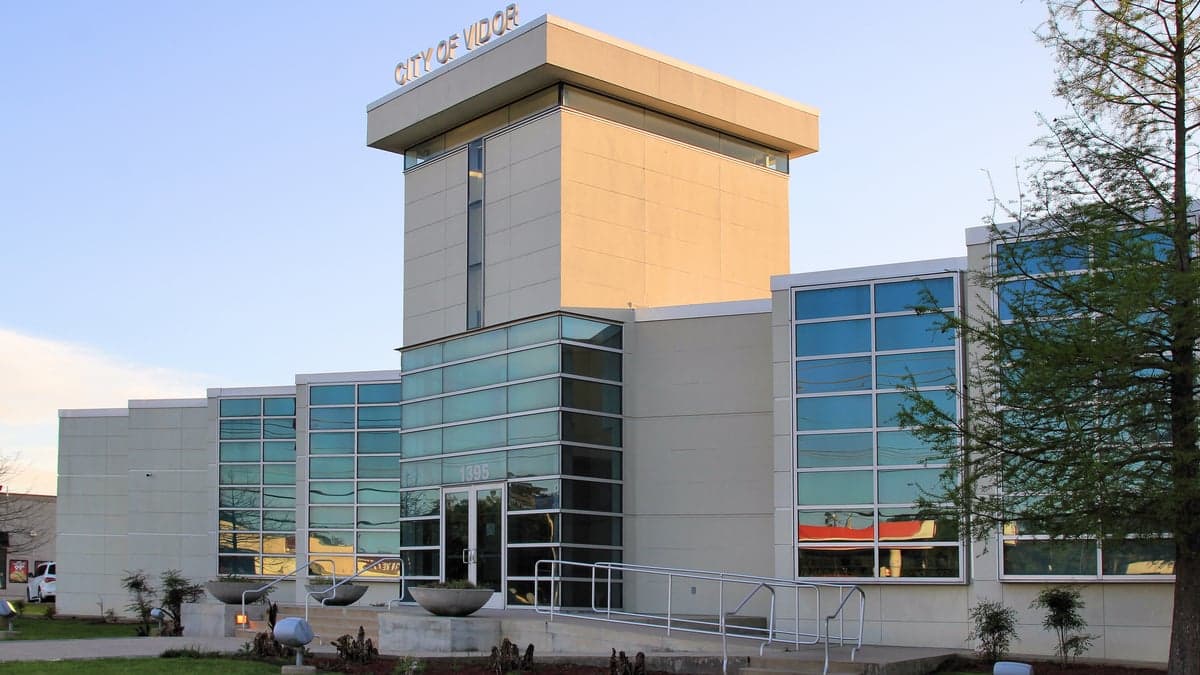
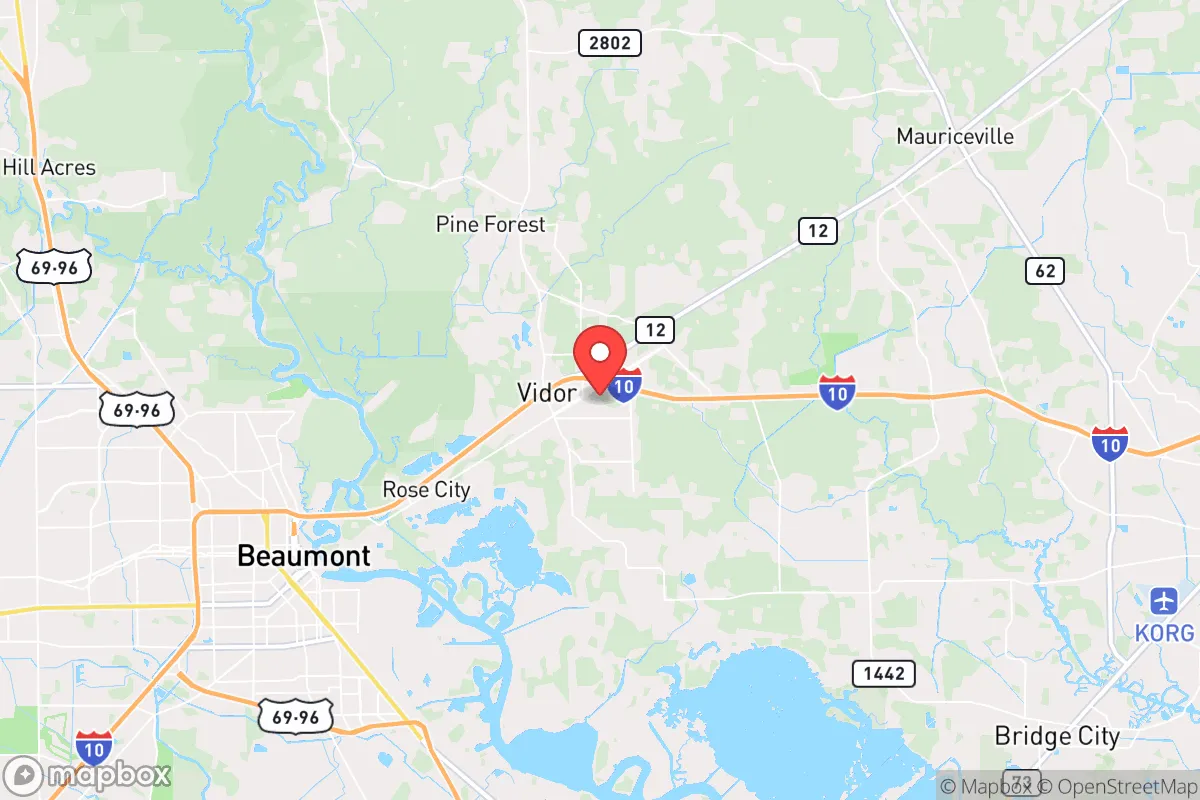
Photo: Wikipedia
Demographics of Vidor, TX
Affluence Level in Vidor, TX
A middle-class area roughly in line with national averages across income, home values, education, and employment.
People of Vidor, TX
The people of Vidor, Texas, today number 9,738, forming one of the most racially and ethnically homogenous communities in the Houston metropolitan area. With a population that is 89.2% white and a foreign-born share of just 0.2%, Vidor retains a distinctive cultural identity rooted in its Deep East Texas timber heritage and a history of deliberate insularity. The city is characterized by a strong sense of local pride, a deeply conservative political culture, and a population density that feels more small-town than suburban, with a notably low college attainment rate of 10.1%.
How the city was settled and grew
Vidor’s human history begins not with Spanish or Mexican land grants, but with the post-Civil War timber boom. The area was originally swampy bottomland along the Neches River, sparsely inhabited until the late 19th century. The arrival of the Gulf, Beaumont and Kansas City Railway in the 1890s opened the virgin pine forests to industrial logging. The town was formally platted in 1898 by Charles Vidor, a railroad executive, and the first wave of settlers were overwhelmingly white, native-born loggers and mill workers from the rural South—primarily from Louisiana, Mississippi, and East Texas. These families built the earliest homes in what is now the Old Town Vidor district, centered around Main Street and the railroad depot. A second, smaller wave of white farmers followed in the 1910s and 1920s, draining the river bottoms for rice and cattle, settling along the North Vidor corridor near what is now Farm-to-Market Road 105. By 1930, Vidor was a company mill town of roughly 1,500 people, almost entirely white and Protestant, with a small number of African American workers living in a separate, unincorporated settlement called Pine Forest to the south—a community that was later absorbed but never integrated into the city proper.
Modern era (post-1965)
The post-1965 period saw Vidor become a destination for white flight from Beaumont and Port Arthur, particularly after the desegregation of schools and the civil rights movement. The city’s population more than doubled between 1970 and 1990, driven by domestic in-migration of white families seeking a racially homogeneous, low-tax, and low-regulation environment. New subdivisions such as Oak Forest and Pinewood Estates were developed in the 1970s and 1980s, attracting working-class and middle-class families employed in the oil refineries and petrochemical plants of the Golden Triangle. This era cemented Vidor’s reputation as a sundown town—a place where African Americans were effectively unwelcome after dark. The 1993 federal court order requiring the city to desegregate its public housing, and the subsequent violent resistance to a single black family moving into the Vidor Housing Authority complex on North Main, became a national story. The modern demographic data reflects this legacy: the Black population remains at just 0.3%, and the Hispanic share of 7.6% is almost entirely concentrated in newer, unincorporated areas along the I-10 corridor south of the city limits, rather than within Vidor’s traditional neighborhoods. The East/Southeast Asian share (0.2%) and Indian subcontinent share (0.1%) are negligible, largely limited to a handful of professionals working at the nearby ExxonMobil and TotalEnergies facilities.
The future
Vidor’s population is projected to remain stable or decline slightly over the next decade, as the aging white population is not being replaced by younger families at the same rate. The city’s extreme homogeneity is a product of both historical reputation and current economic reality: the low college attainment rate limits in-migration of knowledge workers, and the city’s cultural identity continues to deter most non-white residents. The Hispanic share is slowly increasing, but almost entirely in the unincorporated areas outside the city limits, where new subdivisions like Riverbend are attracting a mix of white and Hispanic families from Beaumont. Within the city itself, the Old Town and Oak Forest neighborhoods are aging, with many homes now owned by retirees or rented out. The next 10-20 years will likely see Vidor become slightly more Hispanic, but remain overwhelmingly white and culturally conservative, while the surrounding unincorporated areas diversify more rapidly.
For someone moving in now, Vidor offers a deeply rooted, low-crime, and affordable community with a strong sense of local identity, but one that is also demographically static and culturally resistant to change. The city is not becoming more diverse in any meaningful way; it is becoming a smaller, older, and slightly more Hispanic version of its 1990s self. New residents should expect a place where the past continues to shape the present, and where the population’s future is more about continuity than transformation.

* Values derived from national, state, county, city and local statistics and may differ in a specific area. Last updated: 2026-07-23T02:41:22.000Z
Narrative content on this page is AI-generated and may contain mistakes. Verify any details that matter before acting on them.
ReloMaps may earn a commission from affiliate links at no extra cost to you.

