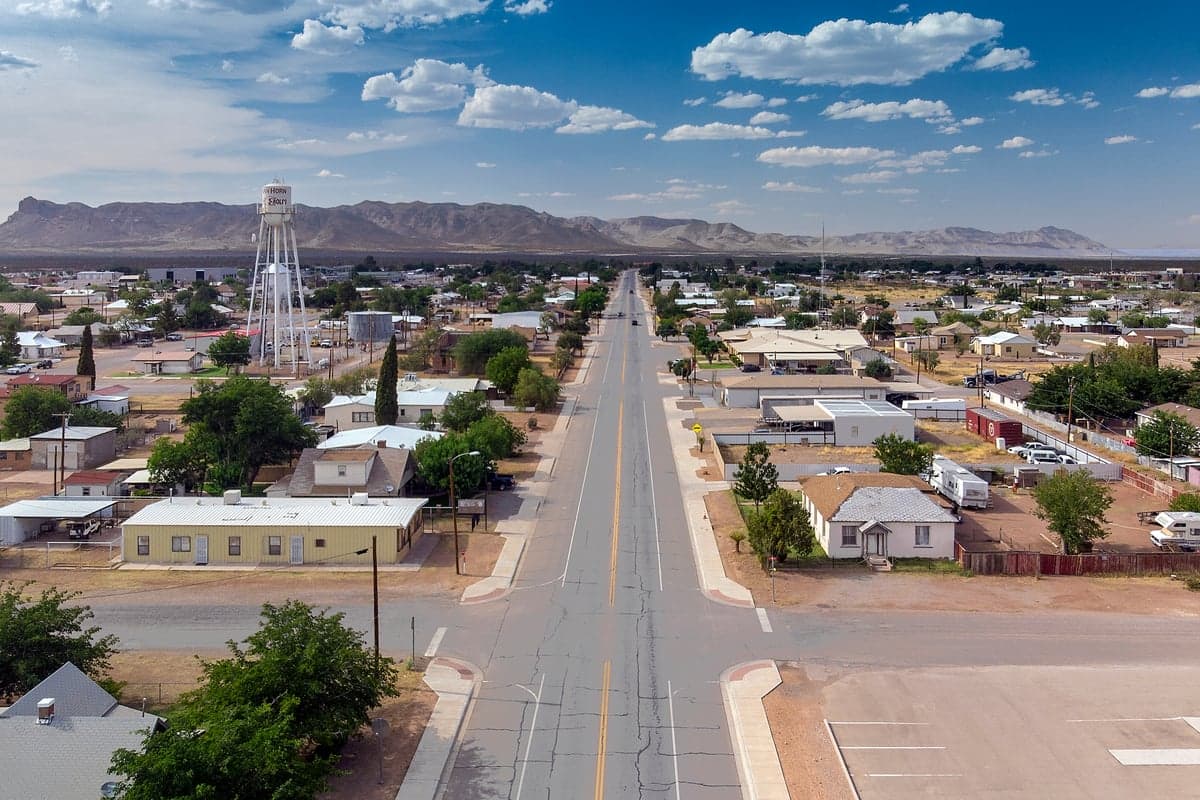
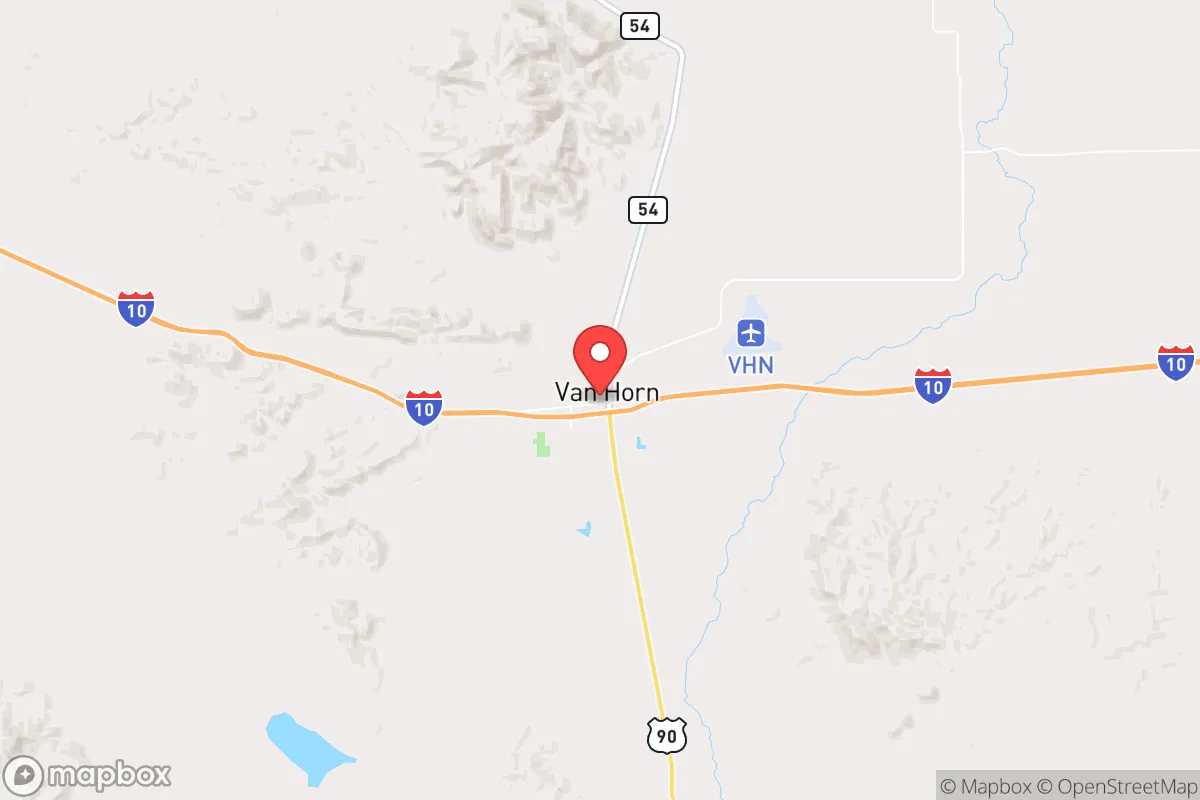

Photo: Wikipedia
Political ClimatePolitical Climate in Van Horn, TX
District shown is the primary district for this city’s centroid. Cities may span multiple districts.
Inherited from parent county — no local data available.
* Lean and PVI are calculated from the surrounding county’s 2020 and 2024 presidential results, Cook-style — a finer measure here than its congressional district (TX-23).
Political rankings in Texas
- Most Conservative Cities in Texas
- Most Liberal Cities in Texas
- Best Liberal-Leaning Towns in the South
- Safest Liberal-Leaning Towns in the South
- Safest Conservative-Leaning Towns in the South
- Affordable Small Towns for Conservatives
- Most Affordable Liberal-Leaning Small Towns in the U.S.
- Safest Conservative-Leaning Cities in the U.S.
- Most Conservative Counties in Texas
- Most Liberal Counties in Texas
Local Political AnalysisPolitical Analysis of Van Horn, TX
Van Horn, Texas, sits in a reliably conservative pocket of the state, with a Cook Partisan Voting Index (PVI) of R+4, meaning the area votes about four points more Republican than the national average. That number feels about right to anyone who’s spent time here—local elections are usually decided in the Republican primary, and Democratic candidates rarely make a serious play for the county. The trajectory has been steady rather than shifting; unlike some fast-growing Texas suburbs that have inched left, Van Horn’s political identity has stayed pretty consistent over the last decade, anchored by a small, stable population and a strong ranching and energy economy.
How it compares
Compared to Texas as a whole, Van Horn is slightly more conservative than the state’s average, though the gap isn’t dramatic. The state’s overall PVI is unknown, but statewide results in recent cycles—like the 2024 presidential race, where Texas went Republican by about 10 points—suggest Van Horn’s R+4 puts it a bit to the right of the state’s center. The real contrast shows up when you look at nearby towns. Head east to Pecos (about 45 miles away), and you’ll find a similar conservative lean, but with a stronger oil-and-gas influence that makes local politics more focused on industry regulation and water rights. Drive west to El Paso (roughly 120 miles), and you’re in a completely different world—a blue stronghold where Democrats dominate at every level, and issues like immigration and border policy are debated from a more progressive angle. Within Culberson County itself, Van Horn is the political hub; the rest of the county is even more sparsely populated and votes even more heavily Republican, with no real organized liberal presence.
What this means for residents
For conservative residents, Van Horn’s lean means their values are reflected in local governance—school board meetings, county commission decisions, and law enforcement priorities all tend to align with traditional Texas conservatism. Gun rights are broadly supported, taxes are kept low, and there’s little appetite for new regulations on businesses or land use. For liberal residents, the reality is more about navigating a minority position. You won’t find many overtly progressive organizations or events, but the small-town culture here is generally live-and-let-live; people are judged more by their character than their bumper stickers. The practical impact is that policy debates are rare—most issues are settled by consensus among a like-minded electorate. National political fights feel distant, and local conversations center on roads, water, and the school system rather than culture-war flashpoints.
One cultural distinction worth noting: Van Horn’s politics are shaped by its geography and economy more than by any ideological purity. The town sits along Interstate 10 and the Southern Pacific rail line, so issues like trucking regulations, border security, and energy development dominate local discourse. You won’t hear much about urban-suburban battles over zoning or school curriculum fights that roil places like Austin or Dallas. Instead, the political climate here is pragmatic—people want the government to stay out of the way, keep the roads paved, and support the industries that keep the lights on. That’s been the case for decades, and there’s no sign it’s changing anytime soon.

State Political ClimatePolitical Climate in Texas
State Political AnalysisPolitical Environment in the State
Texas has been a reliably Republican state for the past three decades, but the margin has been tightening. In 2024, Donald Trump won the state by roughly 9 points, down from 11 points in 2020 and 16 points in 2012. The dominant coalition remains a mix of rural conservatives, suburban moderates, and a growing number of Hispanic voters in the Rio Grande Valley who have shifted right. However, explosive growth in the urban cores of Austin, Dallas, Houston, and San Antonio is steadily pushing the state toward a more competitive two-party dynamic, making it a perennial battleground by the end of the decade.
Urban vs. rural divide
The political map of Texas is a stark checkerboard. The major metros — Harris County (Houston), Dallas County, Bexar County (San Antonio), and Travis County (Austin) — are solidly Democratic, with Travis County delivering over 70% of its vote to Joe Biden in 2020. Meanwhile, the vast rural and exurban counties, like those in the Panhandle (Lubbock, Amarillo) and East Texas (Tyler, Longview), routinely vote 80% Republican. The real action is in the suburbs and the border. Collin County (north of Dallas) and Fort Bend County (southwest of Houston) were once Republican strongholds but are now competitive, with Collin County flipping to Trump by only 5 points in 2024. The Rio Grande Valley, historically a Democratic stronghold, saw a dramatic shift: Hidalgo County (McAllen) went from +40 Democratic in 2012 to +15 Democratic in 2024, driven by working-class Hispanic voters prioritizing the economy and border security. This urban-rural split means that a resident’s political experience depends almost entirely on which zip code they choose.
Policy environment
Texas operates under a low-tax, low-service model that is a major draw for conservative relocators. There is no state income tax, funded instead by high property taxes (averaging 1.6% of home value) and a 6.25% state sales tax (local add-ons push it to 8.25% in many cities). The regulatory posture is famously business-friendly, with no state-level occupational licensing for many trades and a right-to-work law that limits union power. Education policy is decentralized, with school districts funded primarily by local property taxes, leading to wide disparities between wealthy suburbs like Southlake and poorer rural districts. Healthcare policy is notably hands-off: Texas has the highest uninsured rate in the nation (around 17%), having refused Medicaid expansion under the ACA. Election laws have been tightened since 2021 with SB 1, which added ID requirements for mail-in ballots and limited drive-through voting. For a new resident, the practical effect is lower upfront taxes but higher out-of-pocket costs for services like healthcare and education.
Recent policy direction
The last five years have seen a sharp rightward shift in state policy across multiple fronts. On gun rights, Texas became a permitless carry state in 2021 (HB 1927), allowing most adults to carry a handgun without a license. On parental and education rights, the 2023 school choice bill (HB 3) created education savings accounts for special-needs students, with a universal expansion expected in 2025. The state also banned diversity, equity, and inclusion (DEI) programs at public universities (SB 17) and restricted how race and gender can be taught in schools (HB 3979). On speech and privacy, a 2023 law (HB 20) prohibits social media platforms from moderating content based on viewpoint, though it’s tied up in court. Medical and bodily autonomy is heavily restricted: Texas has one of the strictest abortion bans in the nation (SB 8, effective 2021), with no exceptions for rape or incest, and a near-total ban on gender-affirming care for minors (SB 14, 2023). Property rights are strong, with no state-level zoning in unincorporated areas, though cities like Austin impose their own land-use rules. Voting access has been restricted, but early voting remains robust — 14 days of in-person early voting is still the norm. For a relocator, the bottom line is that Texas is actively legislating to maximize individual liberty in economic and self-defense matters while heavily regulating social and medical choices.
Civil unrest & political movements
Texas has seen its share of political flashpoints. The 2020 racial justice protests in Austin, Dallas, and Houston were large and occasionally violent, leading to a lasting political backlash that helped Republicans flip several suburban state house seats in 2022. Immigration politics dominate the border region: Governor Abbott’s Operation Lone Star has bused over 100,000 migrants to Democratic-led cities like New York and Chicago, and the state has installed razor wire and buoys in the Rio Grande, leading to ongoing legal battles with the Biden administration. The “Texit” movement — secession rhetoric — remains a fringe but vocal element, with the Texas Nationalist Movement claiming 500,000 supporters, though no serious political figure endorses it. Election integrity remains a live controversy: the 2020 election saw Trump’s lawsuit to throw out 127,000 drive-through votes in Harris County, and the 2024 cycle featured a high-profile investigation into alleged noncitizen voter registration (which found only a handful of cases). A new resident in a blue city like Austin will see regular protests on the Capitol steps, while a resident in a red suburb like Frisco will encounter more community activism around school board meetings and parental rights. The political temperature is high, but actual violence is rare outside of isolated incidents.
Projection
Over the next 5-10 years, Texas is likely to become a true swing state. The demographic drivers are clear: the state is adding roughly 1,000 new residents per day, most of whom are moving to the Democratic-leaning urban and suburban counties. The Hispanic population, now 40% of the state, is not monolithic — younger, more secular Hispanics lean left, while older, churchgoing ones lean right — but the overall trend is toward a more competitive electorate. The 2024 results suggest that the Republican margin in the Rio Grande Valley may have peaked, while the suburbs of Dallas and Houston are still trending blue. However, the state’s political structure — gerrymandered legislative districts, restrictive voting laws, and a conservative judiciary — will likely keep the legislature in Republican hands for at least another decade, even if the presidential race becomes a toss-up. A relocator moving in now should expect a state that remains culturally conservative at the state level but increasingly divided locally, with blue cities and red suburbs coexisting under a Republican-dominated capitol.
For a new resident, the practical takeaway is that Texas offers a low-tax, high-freedom environment for those who align with its conservative social policies, while liberals will find strong communities in the major cities but face a state government actively working against their preferences. The political climate is polarized but stable — you won’t see civil war, but you will see constant legal battles over abortion, immigration, and education. Choose your city carefully: Austin and El Paso feel like blue islands, while Lubbock and Tyler feel like red fortresses. The state’s trajectory is toward a more competitive future, but for now, the levers of power remain firmly in conservative hands.
* Values derived from national, state, county, city and local statistics and may differ in a specific area. Last updated: 2026-11-11T17:19:33.000Z
Narrative content on this page is AI-generated and may contain mistakes. Verify any details that matter before acting on them.
ReloMaps may earn a commission from affiliate links at no extra cost to you.

