Photo: Wikipedia
Demographics of Van Horn, TX
Affluence Level in Van Horn, TX
A middle-class area roughly in line with national averages across income, home values, education, and employment.
People of Van Horn, TX
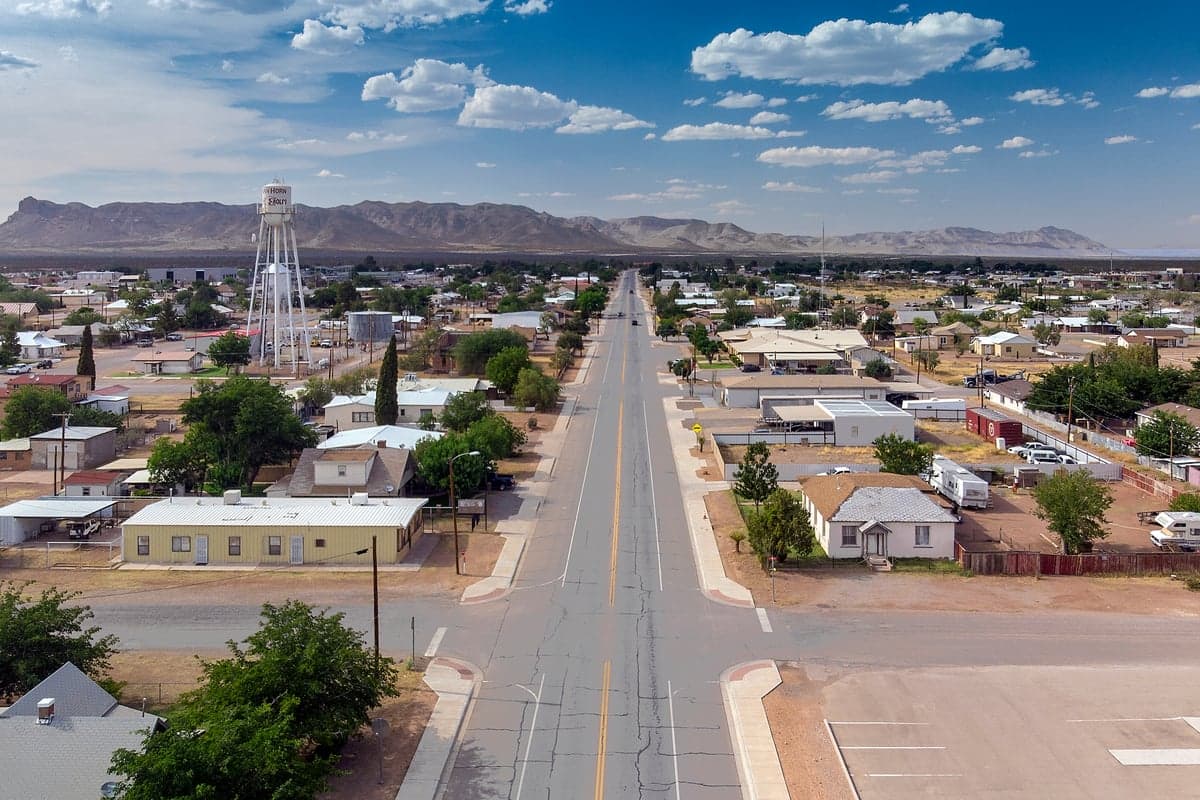
Van Horn, Texas, is a small, predominantly Hispanic community of 1,965 residents, where 89.1% of the population identifies as Hispanic or Latino. The city’s character is shaped by its deep railroad and ranching roots, a tight-knit, family-oriented atmosphere, and a distinct cultural identity that blends West Texas frontier pragmatism with strong Mexican-American heritage. With a foreign-born population of just 2.7%, Van Horn is a community of long-established families rather than recent arrivals, and its low college attainment rate (18.8%) reflects a workforce historically tied to manual labor, transportation, and local services.
How the city was settled and grew
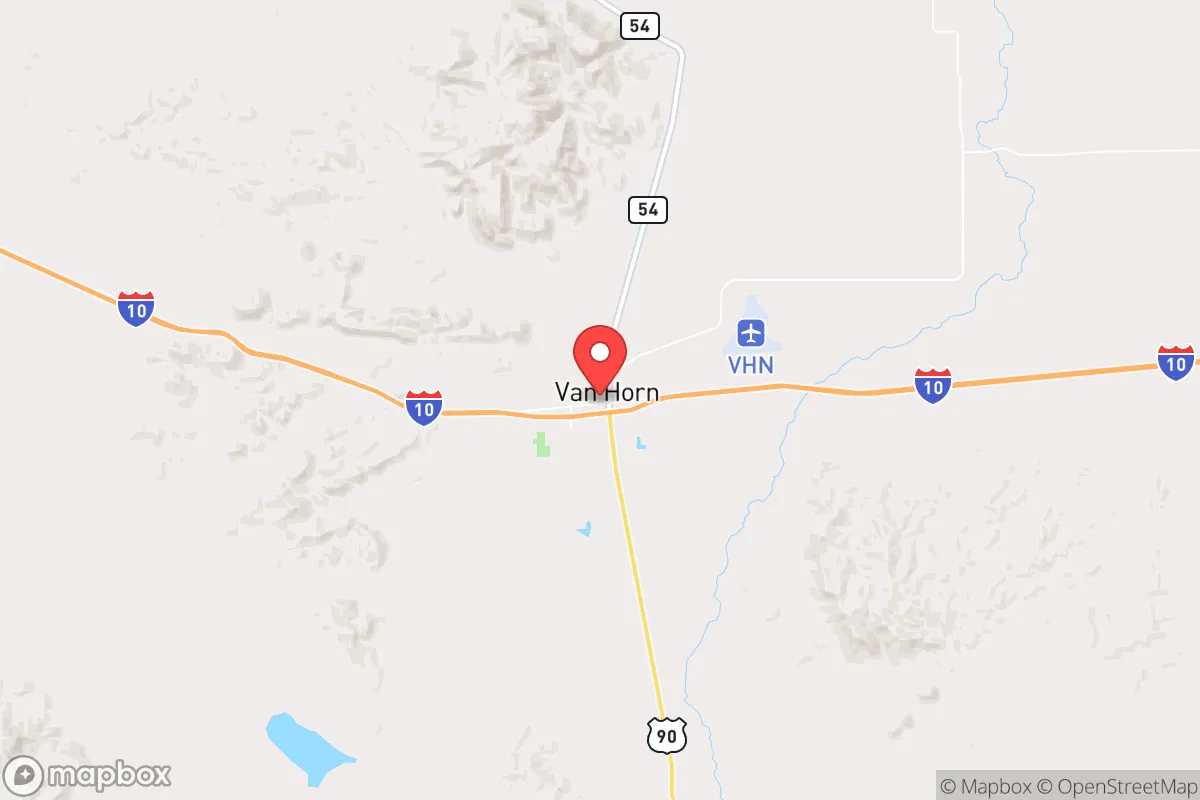
Van Horn’s human history begins not with Spanish colonization but with the railroad. Founded in 1881 as a water stop and railhead for the Texas and Pacific Railway, the town was named after a railroad official, James Judson Van Horn. The original population was a mix of Anglo railroad workers, cowboys, and merchants, but the largest and most enduring wave came from Mexican and Mexican-American laborers who built and maintained the tracks. These families settled in what is still known as Barrio Chihuahua, a historic neighborhood east of the railroad tracks that became the heart of the Hispanic community. By the early 1900s, ranching and farming drew additional Anglo settlers to areas like North Van Horn, where larger lots and ranch-style homes housed the town’s business and professional class. The 1920s and 1930s saw a second wave of Mexican immigrants fleeing the Mexican Revolution, many of whom joined relatives in Barrio Chihuahua or established new households in Southside, a working-class area south of the main highway (U.S. 90). These two neighborhoods—Barrio Chihuahua and Southside—remain the historic anchors of Van Horn’s Hispanic population today.
Modern era (post-1965)
After the 1965 Immigration and Nationality Act, Van Horn did not experience the large-scale Asian or Indian immigration seen in larger Texas cities. Instead, its demographic story is one of domestic consolidation. The Hispanic share of the population grew steadily through natural increase and continued migration from nearby rural areas in West Texas and northern Mexico. By the 1980s, the Anglo population had begun a slow decline, as younger generations left for college or jobs in El Paso, Midland, or Dallas. Today, only 6.5% of residents identify as non-Hispanic White, and the Black population is negligible at 0.2%. The East/Southeast Asian community (1.2%) is a very small, recent addition, likely tied to a handful of families working in local trucking or retail. The Indian-subcontinent population is 0.0%. Newer subdivisions, such as Desert Hills Estates (built in the 1990s on the western edge of town), have attracted a mix of Hispanic families moving up from Barrio Chihuahua and Southside, as well as a few Anglo retirees. However, these newer areas remain overwhelmingly Hispanic, reflecting the broader cultural continuity of the city.
The future
Van Horn’s population is projected to remain stable or decline slightly, mirroring trends across rural West Texas. The city is not becoming more diverse in the traditional sense—its Hispanic share is already near 90%, and the small White and Asian populations are unlikely to grow significantly. The key demographic shift is aging: the median age is rising as younger adults leave for urban centers, and the school district has seen enrollment drop. New residential development is concentrated in Van Horn Estates, a small subdivision near the high school, and along the Broadway corridor, where a few new single-family homes have been built. These areas are attracting a mix of local families and a handful of remote workers drawn by low housing costs, but the overall cultural identity remains deeply rooted in the Hispanic, Catholic, and ranching traditions of the region. The next 10-20 years will likely see a continued slow population decline, with the community becoming older and more reliant on the Interstate 10 corridor for economic survival.
For someone moving in now, Van Horn offers a stable, culturally cohesive community where family ties and local institutions—the church, the school, the county courthouse—remain central. It is not a place of rapid change or new diversity, but rather a town where the past is still present, and where new residents will find a welcoming but insular environment shaped by generations of the same families.

* Values derived from national, state, county, city and local statistics and may differ in a specific area. Last updated: 2026-11-11T17:19:33.000Z
Narrative content on this page is AI-generated and may contain mistakes. Verify any details that matter before acting on them.
ReloMaps may earn a commission from affiliate links at no extra cost to you.

