Photo: Wikipedia
Demographics of Iron County
Affluence Level in Iron County
A middle-class area roughly in line with national averages across income, home values, education, and employment.
People of Iron County
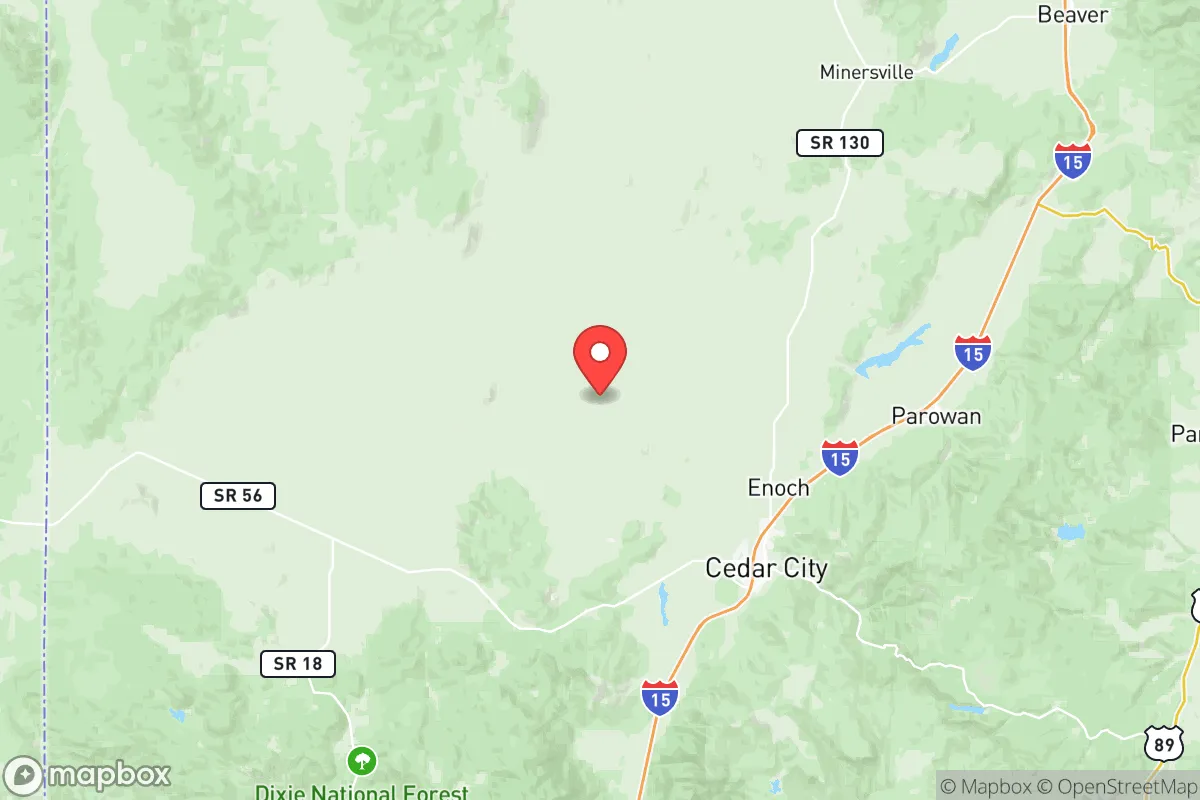
The people of Iron County, Utah, today number roughly 60,000 and are characterized by a predominantly white, native-born population with a strong Latter-day Saint (LDS) cultural foundation, centered in the cities of Cedar City and Parowan. With a foreign-born share of just 1.7% and a Hispanic population of 10.1%, the county remains one of the least ethnically diverse in the state, yet it is experiencing steady growth driven by domestic migration from other parts of Utah and the Intermountain West. The county's identity is shaped by its heritage as an early Mormon settlement outpost, its role as a regional education and healthcare hub anchored by Southern Utah University, and its proximity to outdoor recreation destinations like Brian Head and Bryce Canyon Country. This is a place where traditional family structures, religious community ties, and a rural-to-suburban transition define daily life for most residents.
Settlement & growth (pre-1960)
Before Euro-American settlement, the area now known as Iron County was inhabited by the Southern Paiute people, particularly the Cedar Band, who lived a semi-nomadic lifestyle across the Escalante Desert and the mountain valleys. Spanish and Mexican explorers passed through the region in the 18th and early 19th centuries, but no permanent non-Native settlements were established until the arrival of Mormon pioneers in the 1850s. The first major settlement was Parowan, founded in 1851 as a southern outpost of the Deseret colony, followed quickly by Cedar City in 1851, which was established to exploit local iron deposits—hence the county's name. These early settlers were predominantly members of the Church of Jesus Christ of Latter-day Saints, sent by church leadership to colonize the region and extract natural resources.
The iron industry proved short-lived, but the Mormon agricultural settlements persisted, with families farming small plots and raising livestock in the Parowan Valley and along the Coal Creek drainage. A second wave of settlement came in the 1860s and 1870s as the church encouraged the founding of smaller satellite communities, including Enoch, Kanarraville, and New Harmony, each settled by extended LDS family networks. These communities remained overwhelmingly homogenous—white, English-speaking, and LDS—through the early 20th century. The arrival of the Union Pacific Railroad in the 1920s brought some outside influence, but Iron County's population grew slowly, reaching only about 10,000 by 1950. The establishment of the Branch Agricultural College (now Southern Utah University) in Cedar City in 1897 began to diversify the local economy beyond agriculture and ranching, though the student body and faculty remained almost entirely LDS and white until the late 20th century.
Modern era (post-1965)
The post-1965 period brought modest demographic change to Iron County, far less dramatic than in Utah's urban Wasatch Front counties. The 1965 Hart-Cellar Act had minimal direct impact here because the county's economy—centered on education, healthcare, and tourism—did not attract large numbers of international immigrants. The foreign-born population remains very low at 1.7%, with the largest non-native groups being Hispanic/Latino (10.1% of the total population) and small numbers of East/Southeast Asian residents (0.8%) and Indian-subcontinent residents (0.2%). Most Hispanic residents are of Mexican descent, many working in construction, hospitality, and agriculture, and they are dispersed across Cedar City and the smaller towns rather than concentrated in a single ethnic enclave.
Domestic migration has been the primary driver of population change since the 1970s. The expansion of Southern Utah University drew students and faculty from across the Intermountain West, while the development of the Brian Head ski resort and the nearby national parks attracted retirees and second-home buyers from California, Nevada, and Arizona. The county's population more than doubled between 1970 and 2000, from about 12,000 to over 30,000, and has since doubled again to 60,201. Suburbanization has been most visible in Cedar City, where new housing developments have spread south and east of the historic downtown, and in Enoch, which has transformed from a rural farming community into a fast-growing bedroom suburb. The Black population remains tiny at 0.6%, and the county has not experienced the significant African American or Asian immigration seen in Salt Lake County or Utah County.
The future
Iron County's population is projected to continue growing at a steady pace, likely reaching 80,000 to 90,000 by 2040, driven by natural increase among the predominantly LDS population and continued domestic in-migration from other parts of Utah and the West. The county is becoming slightly more diverse: the Hispanic share is expected to rise from 10.1% toward 15-18% over the next two decades, as younger Hispanic families have higher birth rates and as service-sector employment grows. The East/Southeast Asian and Indian-subcontinent populations will likely remain small, though the expansion of Southern Utah University's international student programs could bring modest growth. New residential development is concentrating in Cedar City's southern and eastern fringe, in Enoch, and along the I-15 corridor near Parowan, while the more remote settlements like New Harmony and Kanarraville are likely to see slower growth due to limited infrastructure and employment.
Culturally, Iron County is becoming less insular but remains deeply rooted in LDS traditions and conservative values. The influx of out-of-state retirees and remote workers is gradually increasing the share of non-LDS residents, particularly in the Brian Head area and the newer subdivisions of Cedar City, but the county's political and social character is unlikely to shift dramatically. For someone moving in now, Iron County offers a community that is growing but still small enough to maintain strong local ties, with a population that is overwhelmingly native-born, family-oriented, and anchored by the university and the outdoors economy. The county's future is one of moderate, managed growth—more diverse than its past, but still one of the most culturally homogeneous places in the United States.

* Values derived from national, state, county, city and local statistics and may differ in a specific area. Last updated: 2026-07-24T22:25:59.000Z
Narrative content on this page is AI-generated and may contain mistakes. Verify any details that matter before acting on them.
ReloMaps may earn a commission from affiliate links at no extra cost to you.

