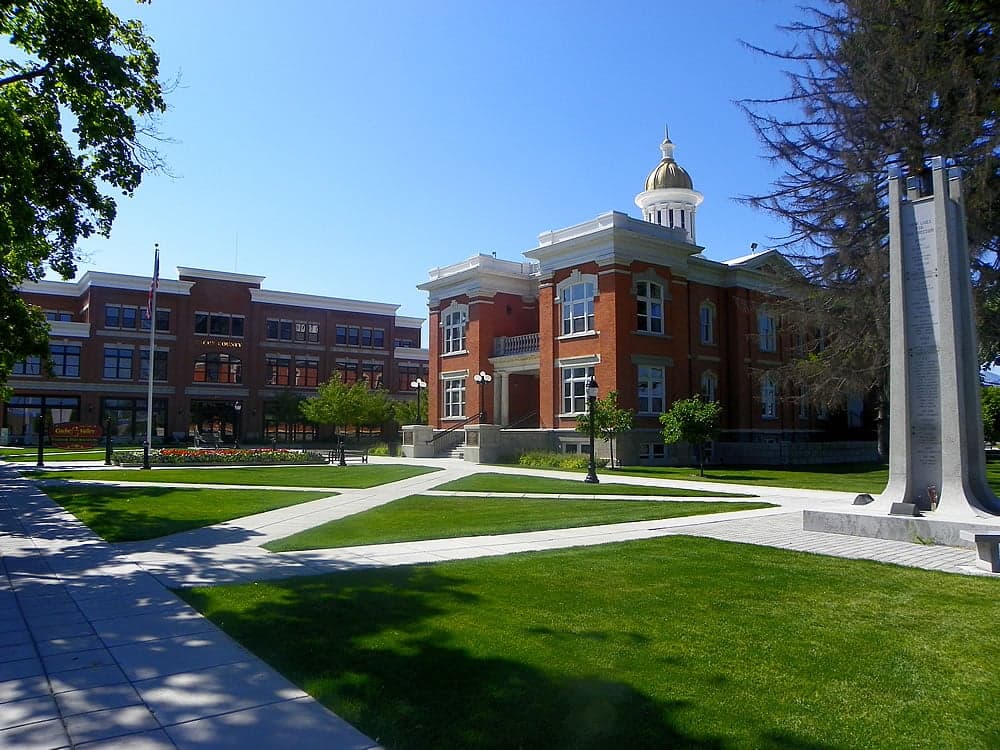
Photo: Wikipedia
Political ClimatePolitical Climate in Cache County
Showing district-level results — no local-only data available.
Local Political AnalysisPolitical Analysis of Cache County
Cache County leans solidly Republican, with a Cook PVI of R+10 that puts it just a shade to the left of Utah as a whole (R+11), but don't let that one-point difference fool you—this is still deep-red territory. The county has been reliably conservative for decades, though the political energy here is more nuanced than a single number suggests. Logan, the county seat and home to Utah State University, introduces a noticeable liberal streak that you won't find in the more rural, deeply conservative towns like Hyrum, Smithfield, or Richmond. The real story is the growing divide between the university precincts in Logan—which have trended bluer in recent cycles—and the rest of the county, which remains firmly in the GOP column.
How it compares
Utah's R+11 statewide rating means Cache County is essentially in lockstep with the state's overall conservative bent, but the internal variation is what makes it interesting. In the 2020 presidential election, precincts around Utah State University's campus—think the blocks near 700 North and 800 East—flipped for Joe Biden, while precincts in Nibley and Millville delivered margins of 70% or more for Donald Trump. That's a stark contrast you don't see in more uniformly red counties like Utah County (R+18) or Washington County (R+22). Compared to the state, Cache County's politics are tempered by the university's influence, making it a slightly more moderate version of Utah's conservative baseline. The county's Republican lean is still overwhelming, but the presence of a sizable student and faculty population means local elections—especially for city council and school board—can be genuinely competitive in Logan, whereas in the rest of the state those races are often decided in the GOP primary.
What this means for residents
For conservative residents, Cache County feels like home: Republican candidates win easily, the local culture aligns with traditional values, and policy debates tend to center on how to manage growth and preserve agricultural land rather than on fundamental ideological battles. For liberal residents, life is more complicated but far from hostile. Logan provides a reliable blue bubble where progressive candidates can win local seats—the city council has had left-leaning members in recent years—and the university community offers a social and intellectual counterweight to the surrounding rural conservatism. That said, statewide policies on issues like abortion, gun rights, and education funding are set in Salt Lake City, and Cache County's representatives in the state legislature are almost uniformly conservative. The practical effect is that liberals here learn to engage locally—neighborhood issues, land use, and school board decisions—while accepting that statewide elections will rarely go their way. The county's strong LDS (Church of Jesus Christ of Latter-day Saints) influence also shapes the political culture, with many residents prioritizing community cohesion and family policy over partisan combat, which can make day-to-day interactions less polarized than the voting numbers might suggest.
A distinctive feature of Cache County's political climate is the way the university town of Logan interacts with the agricultural communities that surround it. You'll find a pragmatic, live-and-let-live attitude in many local businesses and civic groups, even as the voting patterns remain sharply divided. The county's growth—Logan's population has increased by roughly 15% over the past decade—is slowly shifting the political center of gravity, as new arrivals from more liberal parts of the country settle near the university. Longtime residents I've talked to say the change is noticeable but gradual, and they expect Cache County to remain a reliably Republican area for the foreseeable future, albeit with a more visible and vocal liberal minority than you'd find in most of Utah's other rural counties.

State Political ClimatePolitical Climate in Utah
State Political AnalysisPolitical Environment in the State
Utah is a deeply Republican state with a Cook PVI of R+11, meaning it votes roughly 11 points more Republican than the national average in presidential elections. The dominant political coalition is a blend of The Church of Jesus Christ of Latter-day Saints (LDS)-influenced social conservatism and a strong libertarian streak on land use and fiscal matters. Over the last 10-20 years, the state has become more reliably Republican at the presidential level, but the real story is the growing tension between the Wasatch Front establishment and a more populist, anti-establishment wing of the GOP, fueled by rapid in-migration and a booming economy.
Urban vs. rural divide
The political map of Utah is starkly divided between the urban Wasatch Front and the rest of the state. Salt Lake County, home to over a million people, is the state's only competitive county, often voting within a few points of the national average and occasionally flipping to Democrats in local races. Utah County (Provo, Orem) is the conservative heartland, reliably voting 20-30 points more Republican than the nation, driven by the massive Brigham Young University population and LDS culture. Davis and Weber counties north of Salt Lake are solidly red but with a more moderate, suburban flavor. The rural areas—San Juan County in the southeast, Cache Valley (Logan) in the north, and the entire Uintah Basin—are among the most Republican places in America, often voting 40-50 points to the right. The only notable blue dot outside Salt Lake City is Park City (Summit County), a wealthy ski resort town that votes Democratic by wide margins due to its affluent, outdoorsy, and non-LDS population.
Policy environment
Utah's policy environment is defined by low taxes, limited regulation, and a strong emphasis on family and religious values. The state has a flat income tax rate of 4.65% (down from 5% in recent years) and a relatively low sales tax. There is no state-level property tax on vehicles, and property taxes are among the lowest in the West. The regulatory posture is business-friendly, with a right-to-work law and a strong tort reform environment. Education policy is a major battleground: the state has a robust school choice program, including a new universal school voucher system (the Utah Fits All Scholarship) passed in 2023, but also funds public schools at below-average levels per pupil. Healthcare policy is conservative, with no Medicaid expansion under the Affordable Care Act until a 2018 ballot initiative forced it, and even then, the legislature added work requirements. Election laws are moderately restrictive: voter ID is required, same-day registration is not available, and mail-in voting is universal but with signature verification. The state has a unique caucus-convention system for primary elections, which tends to empower more ideological candidates.
Recent policy direction
Recent legislation in Utah shows a clear trend toward expanding individual liberties in some areas while tightening them in others. On gun and self-defense law, Utah is a constitutional carry state (permitless carry for adults 21+) and has a strong "stand your ground" law. The 2023 legislative session saw the passage of HB 227, which prohibits state and local law enforcement from enforcing federal gun laws that violate the state constitution. On parental and education rights, the state passed HB 261 in 2024, which bans diversity, equity, and inclusion (DEI) programs at public universities and restricts "critical race theory" in K-12 classrooms. The Utah Fits All Scholarship (2023) provides up to $8,000 per year for private school tuition or homeschooling expenses. On speech and privacy, Utah passed one of the nation's strongest social media age-verification laws (SB 152, 2023), requiring parental consent for minors under 18 to use platforms like TikTok and Instagram. On medical and bodily autonomy, the state has a near-total abortion ban (trigger law effective 2022) with exceptions for rape, incest, and life of the mother. On property rights, the state has strong eminent domain protections and a recent law (HB 166, 2023) limiting homeowners association (HOA) authority over xeriscaping and water-efficient landscaping. On taxation, the trend is toward reduction: the flat income tax rate was cut from 4.85% to 4.65% in 2023, and the state is phasing out the state portion of the sales tax on food. On voting and ballot access, the legislature passed SB 54 (2014) to allow a dual-track primary system (caucus vs. signature gathering), but recent efforts to restrict signature-gathering have been defeated.
Civil unrest & political movements
Utah has a relatively low level of visible civil unrest compared to coastal states, but there are active political movements on both sides. The most visible flashpoint in recent years was the 2020-2021 anti-mask and anti-vaccine mandate protests, which drew thousands to the Utah State Capitol and were notably organized by a coalition of libertarian and conservative groups. The John Birch Society has a historic presence in Utah, and the state has a strong constitutional sheriff movement, with several sheriffs publicly refusing to enforce federal gun laws. On the left, the Utah Poor People's Campaign and Mormon Women for Ethical Government are active, but protests are generally small and orderly. Immigration politics are relatively calm: Utah was one of the first states to pass a "compact" approach to immigration (HB 116, 2011), allowing undocumented residents to apply for a state driving privilege card. There is no sanctuary city policy, and Salt Lake City has a "welcoming city" ordinance but does not actively obstruct federal immigration enforcement. Election integrity controversies are muted compared to swing states, though the 2020 election saw some local GOP figures question results, and the legislature passed HB 12 (2021) to require post-election audits. The Utah State Legislature has a supermajority of Republicans (roughly 80% in both chambers), so most political conflict happens within the GOP primary process rather than between parties.
Projection
Over the next 5-10 years, Utah will likely remain solidly Republican but with increasing internal friction. The state is growing fast—adding about 50,000 new residents per year—and the newcomers are a mixed bag: many are conservative refugees from California and the Pacific Northwest, but a significant number are secular, tech-oriented professionals who are less aligned with LDS social conservatism. The Wasatch Front will continue to moderate, with Salt Lake County potentially becoming a swing county in state-level races. The rural-urban divide will widen, as rural areas become even more Republican while the urban core diversifies. The biggest wild card is the LDS Church's influence: as the share of LDS members in the state declines (from roughly 70% in 2000 to around 60% today), the cultural conservatism that has defined Utah politics may soften. Expect continued battles over education funding, water rights, and housing policy, but the overall direction will remain center-right, with a focus on economic growth and family policy.
For a new resident, the bottom line is this: if you are a conservative, you will find Utah deeply aligned with your values on taxes, guns, education, and religious freedom. If you are a liberal, you will find a functional, safe, and well-run state, but you will be in a clear political minority—especially outside of Salt Lake City and Park City. The practical takeaway is that Utah's politics are stable, predictable, and generally focused on governance rather than spectacle, which is a rare commodity in 2026 America. Just be prepared for the dominance of the LDS culture in everyday life, especially in Utah County and rural areas, and understand that the state's "freedom" is defined more by economic and religious liberty than by personal autonomy in areas like reproductive rights or drug policy.
* Values derived from national, state, county, city and local statistics and may differ in a specific area. Last updated: 2026-07-02T19:42:15.000Z
Narrative content on this page is AI-generated and may contain mistakes. Verify any details that matter before acting on them.
ReloMaps may earn a commission from affiliate links at no extra cost to you.

