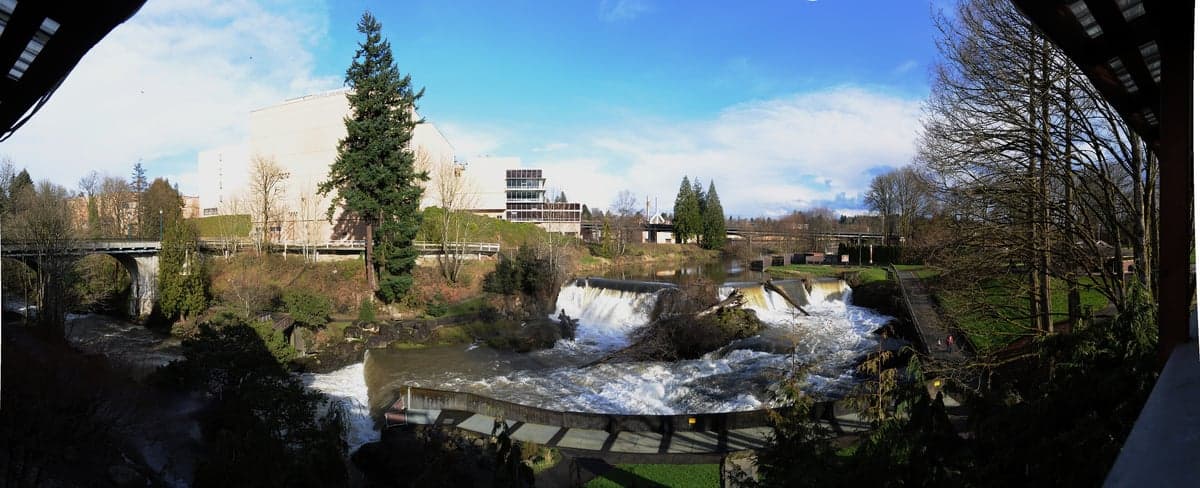
Photo: Wikipedia
Personal Sovereignty in Tumwater, WA
Viable for self-reliance. Generally workable, though some barriers may limit total independence.
What does Personal Sovereignty tell us?
Personal Sovereignty measures your capacity for self-reliance and independence with minimal government friction. Higher scores mean fewer barriers between you and the way you want to live... but it assumes you have the space you need and good neighbors.
What does this tell us?
Personal Sovereignty measures your capacity for self-reliance and independence with minimal government friction. Higher scores mean fewer barriers between you and the way you want to live... but it assumes you have the space you need and good neighbors.
State Policy
Energy independence: Importer (55% of energy produced in-state)
Personal Liberty
Homesteading

Personal Liberty Analysis
Tumwater, Washington, presents a mixed picture for those prioritizing personal sovereignty, where the state's progressive regulatory framework often clashes with the region's more independent-minded, working-class character. As the oldest Anglo-American settlement in the state, Tumwater retains a frontier practicality, but residents must navigate Washington's relatively high tax burden, restrictive gun laws, and expanding government oversight. For the autonomy-minded individual or family, the key question is whether the area's natural advantages—affordable land, access to resources, and a less dense population—outweigh the constraints imposed by Olympia and Thurston County.
Tax burden and regulatory posture in Thurston County
Washington State's tax structure is a double-edged sword for Tumwater residents. There is no state income tax, which benefits high earners and business owners, but the state relies heavily on a regressive sales tax (6.5% state rate, plus local rates totaling roughly 8.9% in Tumwater) and high property taxes. The effective property tax rate in Thurston County is approximately 1.0% of assessed value, which is moderate nationally but higher than many Western states. The regulatory environment is decidedly heavy-touch. Washington has some of the nation's strictest environmental regulations, including the Growth Management Act, which tightly controls land use and development in Thurston County. This means that building a new home, starting a business, or even clearing land for a garden can require multiple permits and lengthy review processes. The state's energy code is among the most stringent in the country, adding significant cost to new construction and major renovations. For the self-reliant individual, the permitting bureaucracy can feel like a constant friction point, particularly when compared to states like Idaho or Texas.
Self-defense and gun law specifics in Washington State
For those who view the right to self-defense as a core component of personal sovereignty, Washington's legal landscape has shifted dramatically in recent years. The state now has a comprehensive background check system for all firearm sales, including private transactions, and a 10-day waiting period for all firearm purchases. In 2023, the legislature passed a ban on many semi-automatic firearms commonly referred to as "assault weapons," as well as a ban on high-capacity magazines (over 10 rounds). Open carry is generally legal but restricted in certain public places, and concealed carry requires a permit, which is shall-issue but subject to training requirements. Magazine capacity restrictions are actively enforced in Thurston County. The legal environment for self-defense outside the home is more restrictive than in many other states, and residents should be aware that the use of deadly force in self-defense is subject to a "reasonable belief" standard, with no explicit "stand your ground" statute. For the sovereignty-minded individual, these laws represent a significant limitation on the traditional American understanding of the right to keep and bear arms.
Self-reliance and homesteading viability in Tumwater
Tumwater offers moderate potential for self-reliance and homesteading, though it is not a frontier. The city's zoning allows for residential lots of varying sizes, with many single-family homes sitting on quarter-acre to half-acre parcels. In unincorporated Thurston County, larger parcels (1-5 acres) are available, particularly in areas like the Black Lake or Delphi Road corridors. Keeping chickens, goats, and other small livestock is generally permitted on residential lots with proper setbacks, though a permit is required for larger animals. The climate is favorable for year-round gardening, with ample rainfall and a long growing season. However, off-grid living is effectively impossible within city limits and difficult in the county. Washington's building codes require connection to the electrical grid for new construction, and the state's strict water rights laws make independent well drilling a complex and regulated process. Rainwater collection is legal but subject to restrictions. Composting toilets and alternative waste systems require rigorous permitting. For those seeking true self-sufficiency, the regulatory hurdles are substantial, though the region's natural abundance—salmon runs, shellfish, forests, and fertile soil—provides a strong foundation for those willing to work within the system.
Personal liberties: parental rights, medical autonomy, speech, and property
Washington State generally takes a progressive stance on social issues, which has implications for personal liberties. Parental rights in education have been a contentious topic, with the state mandating curriculum that includes LGBTQ+ topics and comprehensive sex education, which some parents view as an infringement on their authority to guide their children's moral development. Medical autonomy is similarly constrained: Washington has a state-run health insurance exchange, mandates vaccination for school attendance (with limited exemptions), and has a robust public health apparatus that can impose restrictions during health emergencies. Free speech is protected under the state constitution, but the state has enacted laws restricting "hate speech" and certain forms of political expression on public property. Property rights are significantly limited by the Growth Management Act, which restricts what landowners can do with their land, particularly in rural areas. The state's strong environmental regulations can also impact property use, with restrictions on logging, clearing, and development near waterways. For the individual who values maximum personal autonomy, these constraints represent a significant trade-off compared to states with a more libertarian legal framework.
Overall, Tumwater offers a moderate level of personal sovereignty relative to other areas in the Pacific Northwest, but it falls well short of the autonomy found in states like Idaho, Montana, or Wyoming. The area's natural resources and relatively affordable land provide a foundation for self-reliance, but the state's heavy regulatory hand, restrictive gun laws, and progressive social policies create a constant tension for those who prioritize personal freedom. For the sovereignty-minded individual, Tumwater is a place where one can carve out a degree of independence, but only by actively navigating and working within a system that is not designed to maximize personal autonomy. It is a compromise location—offering more freedom than Seattle or Portland, but less than the rural interior West.

* Values derived from national, state, county, city and local statistics and may differ in a specific area. Last updated: 2026-10-11T16:28:51.000Z
Narrative content on this page is AI-generated and may contain mistakes. Verify any details that matter before acting on them.
ReloMaps may earn a commission from affiliate links at no extra cost to you.

