Photo: Wikipedia
Demographics of Tumwater, WA
Affluence Level in Tumwater, WA
A middle-class area roughly in line with national averages across income, home values, education, and employment.
People of Tumwater, WA
The people of Tumwater, Washington, today number 26,519, forming a predominantly white (71.2%) community with a notably small foreign-born population of just 2.0%. The city carries a distinctive identity as the historic "birthplace of Washington" while functioning as a quieter, family-oriented satellite of Olympia, with a higher-than-average college attainment rate of 41.6% reflecting its professional and state-government-adjacent workforce. Its population is less diverse than neighboring Lacey or Olympia, with Hispanic (9.1%), East/Southeast Asian (3.7%), Black (3.6%), and Indian subcontinent (0.6%) residents making up the largest minority groups.
How the city was settled and grew
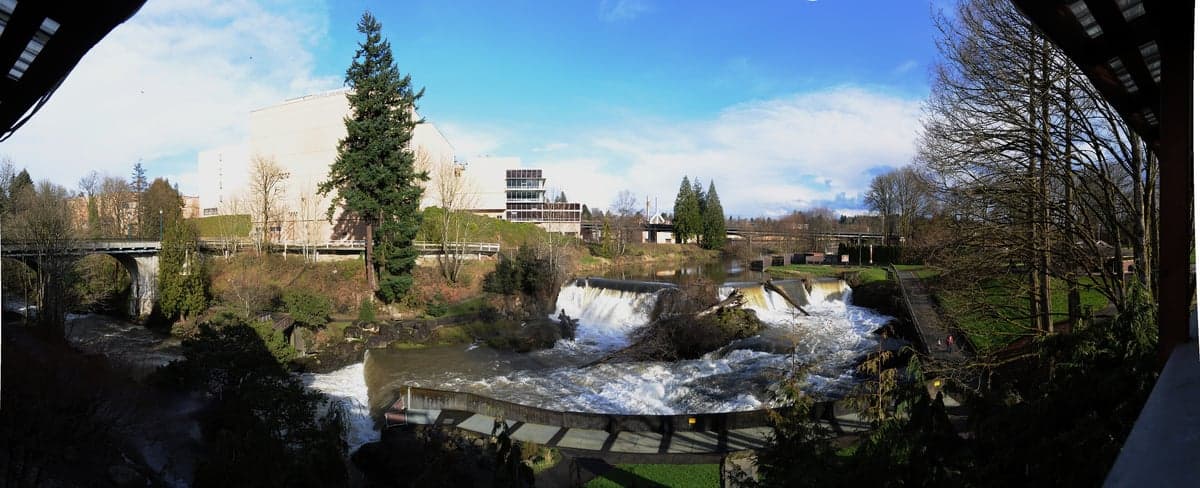
Tumwater's human history begins with the arrival of American settlers in 1845, when the Simmons Party—a group of five families from the Midwest—claimed land at the falls of the Deschutes River, establishing the first permanent American settlement north of the Columbia River. These early settlers were primarily farmers, millwrights, and tradesmen drawn by the water power potential of the falls, and they founded the core of what is now the Historic Tumwater District, where the original New England-style homes and the restored Crosby House still stand. The establishment of the Olympia Brewing Company in 1896 by the Schmidt family created a major industrial anchor, drawing waves of German and Scandinavian immigrants who settled in the Brewery District and the adjacent Tumwater Hill neighborhood, building the working-class housing stock that still defines those areas. Through the early and mid-20th century, the population remained overwhelmingly white and native-born, with the brewery and local timber mills providing stable employment that kept the community insular and family-centered.
Modern era (post-1965)
The post-1965 period brought modest demographic shifts, though Tumwater remained less affected by immigration-driven change than many Puget Sound communities. The expansion of Washington state government in Olympia during the 1970s and 1980s drew domestic in-migrants—primarily white professionals from other parts of the Pacific Northwest and California—who settled in newer subdivisions like Black Lake Meadows and the Littlerock Road corridor, areas characterized by larger single-family homes and lower density. The Hispanic population, now 9.1%, grew steadily from the 1990s onward as agricultural and construction workers moved into the area, with a notable concentration in the East Tumwater neighborhoods near the industrial zones along Interstate 5. The East/Southeast Asian community (3.7%) and Indian subcontinent community (0.6%) are smaller and more dispersed, with no single ethnic enclave, reflecting a pattern of professional migration tied to state government and the nearby Providence St. Peter Hospital in Olympia rather than chain migration. The Black population (3.6%) similarly lacks a concentrated neighborhood, instead integrating across the city's newer housing stock in the Tumwater South area near the city limits with Lacey.
The future
Tumwater's population is projected to grow modestly, with the Washington State Office of Financial Management estimating the city could reach approximately 30,000 residents by 2035, driven primarily by infill development and the build-out of the Tumwater Town Center master-planned area near the former brewery site. The population is becoming slightly more diverse, though at a slower pace than Thurston County as a whole, as new residents are more likely to be Hispanic or Asian than the existing base. The foreign-born share, while still very low at 2.0%, is expected to inch upward as the city attracts tech-adjacent workers priced out of Olympia and Lacey, though Tumwater's limited rental stock and higher home prices relative to nearby cities will likely keep diversity gains incremental. The cultural identity is evolving from a blue-collar brewery town toward a bedroom community for state workers and remote professionals, a shift that may accelerate as the redevelopment of the brewery site brings mixed-use housing and commercial space.
For someone moving in now, Tumwater offers a stable, low-crime, and family-oriented environment with a population that is slowly diversifying but remains predominantly white and native-born. The city is becoming more suburban and professional in character, but its small-town feel, historic core, and lack of major ethnic enclaves mean it will likely remain a quieter, more homogeneous alternative to Olympia or Lacey for the foreseeable future.

* Values derived from national, state, county, city and local statistics and may differ in a specific area. Last updated: 2026-10-11T16:28:51.000Z
Narrative content on this page is AI-generated and may contain mistakes. Verify any details that matter before acting on them.
ReloMaps may earn a commission from affiliate links at no extra cost to you.

