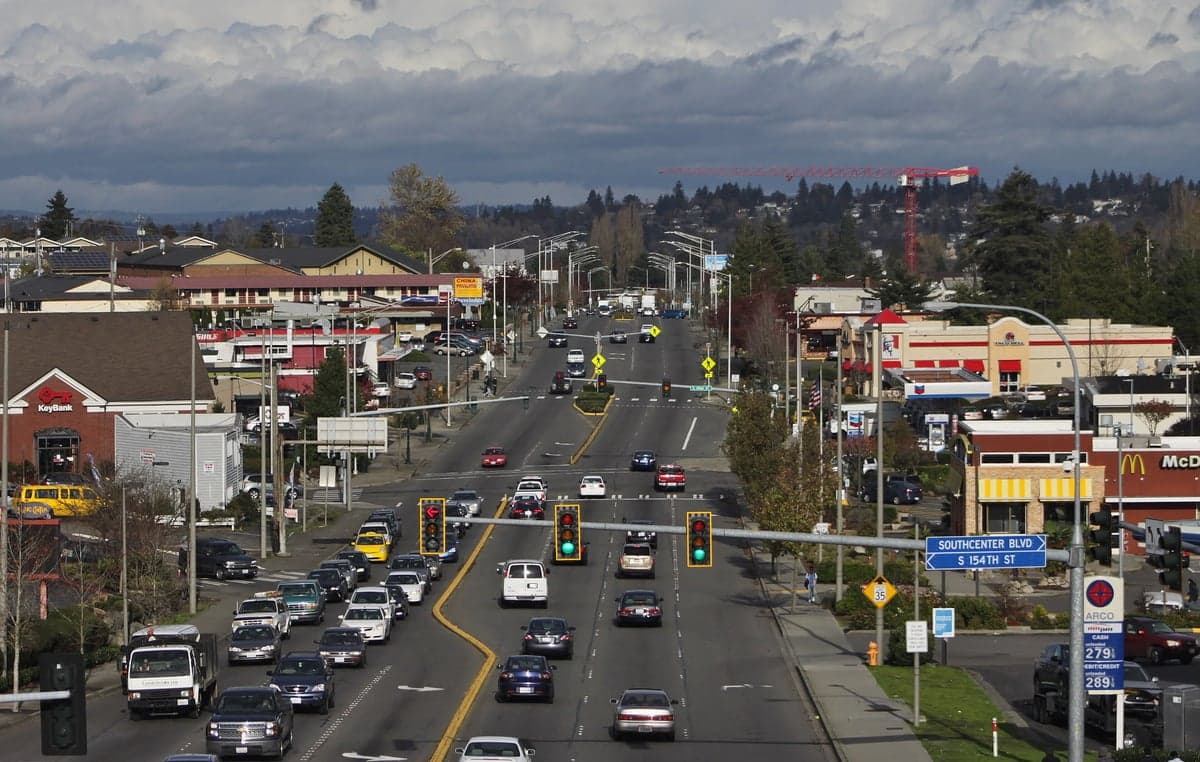
Photo: Wikipedia
Demographics of Tukwila, WA
Affluence Level in Tukwila, WA
A middle-class area roughly in line with national averages across income, home values, education, and employment.
People of Tukwila, WA
The people of Tukwila, Washington, form one of the most ethnically diverse communities in the Pacific Northwest, a compact city of 21,479 residents where no single racial or ethnic group holds a majority. The city is characterized by its dense, working-class neighborhoods, a high foreign-born population of 18.5%, and a distinctive identity as a landing pad for new immigrants and refugees. Today, Tukwila’s population is a mosaic of White (27.9%), Hispanic (23.4%), East and Southeast Asian (21.0%), Black (17.4%), and Indian subcontinent (1.9%) communities, creating a cultural texture far removed from the region’s historic demographics.
How the city was settled and grew
Tukwila’s human history begins with the Duwamish people, who lived along the Duwamish River for millennia before European settlement. The first non-Native settlers arrived in the 1850s, drawn by the Donation Land Claim Act, which granted 320 acres to married couples. These early homesteaders—primarily of English, Irish, and German stock—established farms along the river bottomlands. The arrival of the Seattle & Walla Walla Railroad in the 1870s transformed the area into a shipping hub for hops, timber, and produce. The original settlement clustered around what is now Old Town Tukwila, the historic core near the river, where the first general store and post office served a population of a few hundred. By the early 20th century, the city’s economy shifted toward manufacturing, with the Boeing Company opening a major plant in nearby Renton in the 1940s. This drew a wave of domestic migrants from the Midwest and South, many of whom settled in the Foster neighborhood, a working-class area of modest single-family homes built during the postwar boom. Tukwila incorporated as a city in 1908, but its population remained small—under 2,000—through the 1950s, as the city’s identity was shaped by its industrial base and its role as a transportation corridor between Seattle and Tacoma.
Modern era (post-1965)
The 1965 Hart-Cellar Immigration Act fundamentally reshaped Tukwila’s population. The city’s affordable housing stock, proximity to Seattle’s service economy, and location along the Interstate 5 corridor made it a magnet for new immigrants. The first major post-1965 wave came from East and Southeast Asia, particularly Vietnamese and Filipino refugees after the fall of Saigon in 1975. These communities concentrated in the Southcenter area, near the sprawling Southcenter Mall, where apartment complexes and duplexes offered cheap rents and access to transit. By the 1990s, a second wave brought Hispanic immigrants from Mexico and Central America, drawn by construction and warehouse jobs. They settled heavily in the Allentown neighborhood, a historically industrial district along the Duwamish River, where older homes and mobile home parks provided entry-level housing. The 2000s saw an influx of Black families, many from East African nations such as Somalia and Ethiopia, who joined an existing African American community that had grown since the 1970s. These groups clustered in the Riverbend area, a collection of mid-century apartment complexes near the Green River. The Indian subcontinent community, though smaller at 1.9%, established a presence in the Thornton Creek area, drawn by tech-adjacent jobs in Seattle and Bellevue. By 2020, Tukwila’s White population had fallen to 27.9%, while the foreign-born share reached 18.5%, reflecting a city where nearly one in five residents was born outside the United States.
The future
Tukwila’s population is becoming more diverse, not less. Projections from the Washington State Office of Financial Management suggest the city will continue to see growth from Hispanic and East/Southeast Asian communities, while the White share is expected to decline further. The city’s affordable housing—median home values remain below $500,000, roughly half of Seattle’s—will likely sustain its role as a gateway for new immigrants. However, redevelopment pressures are reshaping neighborhoods. The Southcenter district is seeing luxury apartment construction and a new light rail station (opening 2026), which may attract higher-income residents and accelerate displacement of older immigrant communities. The Allentown area faces similar pressures from industrial rezoning and warehouse expansion. Culturally, Tukwila is evolving from a purely working-class immigrant hub into a more stratified city, where new arrivals and long-term residents coexist alongside a growing professional class drawn by transit access. The next 10–20 years will likely see a stabilization of diversity, with the city maintaining its majority-minority status but experiencing internal shifts as younger, U.S.-born children of immigrants move outward to suburbs like Kent or Des Moines.
For someone moving to Tukwila today, the city offers a rare blend of affordability and genuine multiculturalism in a region increasingly dominated by high costs and demographic homogeneity. It is a place where a Vietnamese grocery store sits next to a Salvadoran bakery, where a Somali mosque shares a block with a Mexican tienda. The population is stable in size but dynamic in composition, and the city’s future hinges on whether it can preserve its role as a welcoming entry point without being priced out by the very development that makes it accessible.

* Values derived from national, state, county, city and local statistics and may differ in a specific area. Last updated: 2026-09-03T05:16:51.000Z
Narrative content on this page is AI-generated and may contain mistakes. Verify any details that matter before acting on them.
ReloMaps may earn a commission from affiliate links at no extra cost to you.

