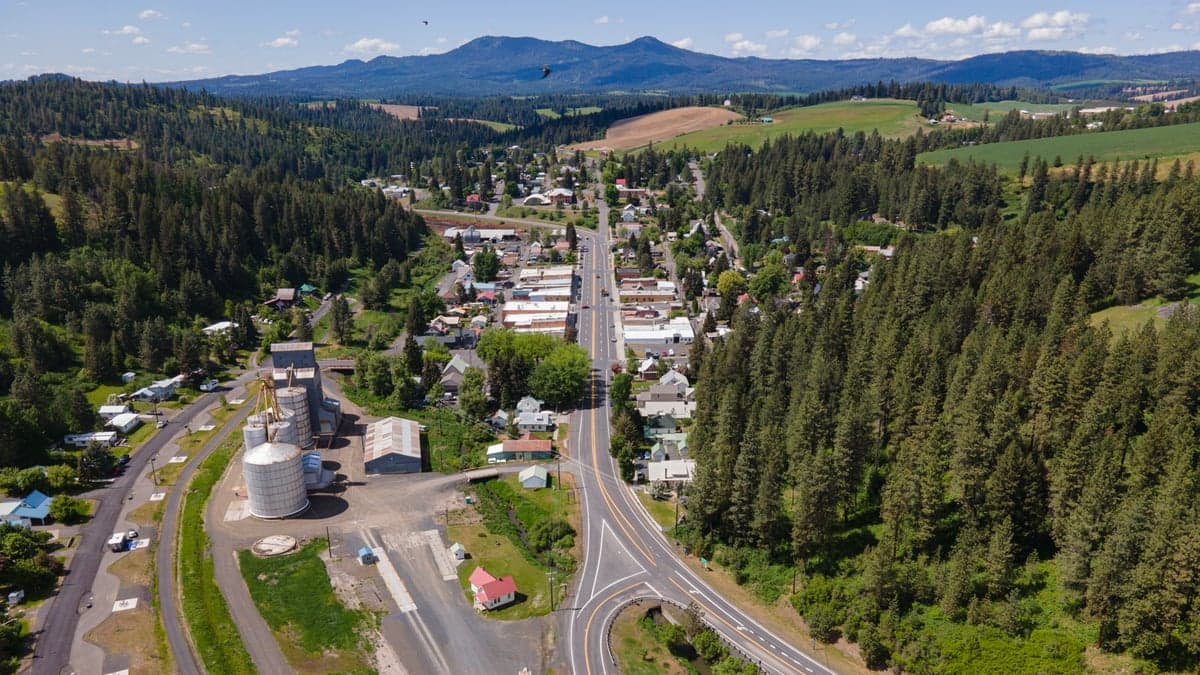
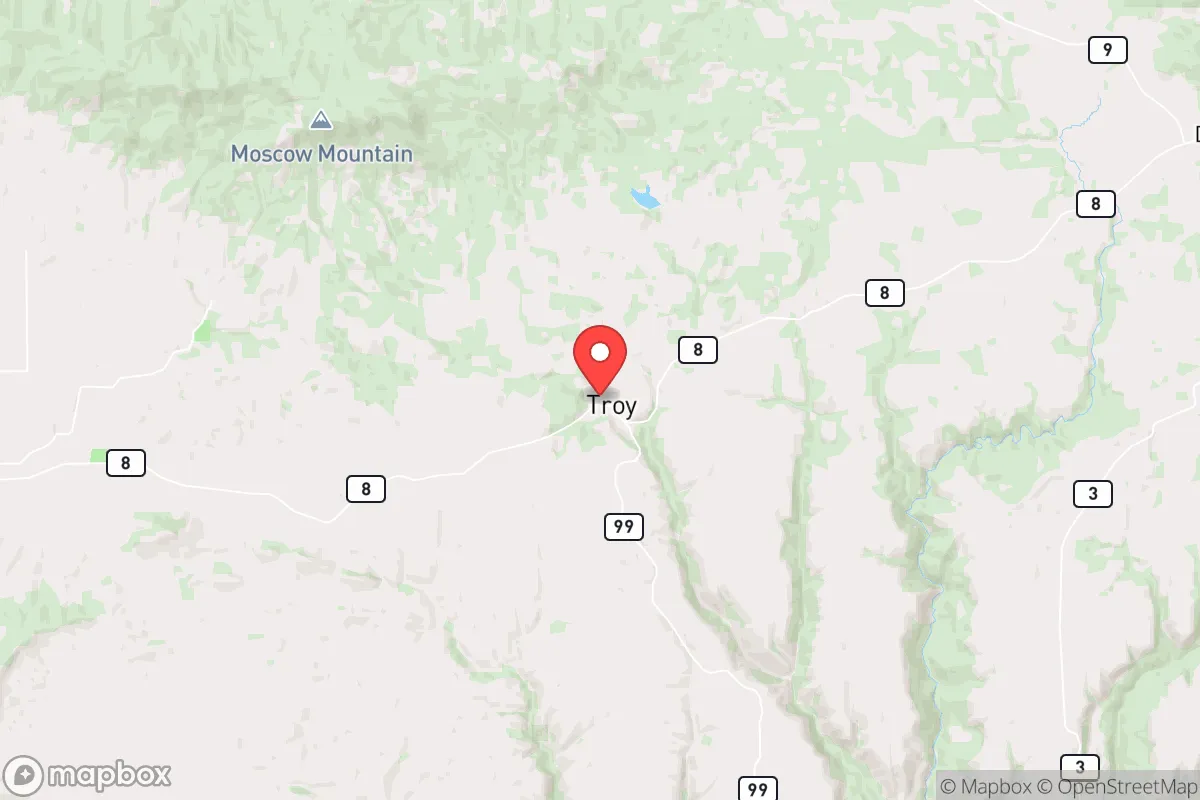
Photo: Wikipedia
Political ClimatePolitical Climate in Troy, ID
District shown is the primary district for this city’s centroid. Cities may span multiple districts.
Local Political AnalysisPolitical Analysis of Troy, ID
Troy, Idaho, is one of the most reliably Republican corners of an already deeply red state. The town sits in Latah County, which as a whole has a Cook Partisan Voting Index (PVI) of R+22, meaning it votes about 22 points more Republican than the national average. That’s a solid four points redder than the state of Idaho’s overall R+18 rating, which already makes Idaho one of the most conservative states in the country. In practice, this means Troy hasn’t gone for a Democratic presidential candidate since the 1960s, and local elections are almost always decided in the GOP primary. The trajectory here is steady: if anything, the area has been drifting slightly further right over the past decade, as new residents—many from California and the Pacific Northwest—arrive specifically seeking a more conservative, rural lifestyle.
How it compares
Compared to the rest of Idaho, Troy is a bit of an outlier within its own county. Latah County is home to the University of Idaho in Moscow, which pulls the county’s overall politics slightly leftward—Moscow itself has a noticeable liberal minority and even elected a Democratic mayor as recently as 2021. But Troy, just 12 miles east of Moscow, feels like a different world. The contrast is sharp: Moscow has coffee shops, a farmers market, and a vocal progressive community, while Troy is a farming and logging town where the biggest local employer is the school district and the main gathering spots are the feed store and the American Legion hall. Drive 20 minutes south to Kendrick or Juliaetta, and you’ll find similar deep-red politics. Head north to Potlatch, and it’s the same story. So while Idaho as a whole is reliably conservative, Troy is a pocket of even stronger Republican sentiment, insulated from the moderating influence of the university town just down the highway.
What this means for residents
For conservative residents, Troy is about as comfortable as it gets. Local government, school board meetings, and community events all operate within a broadly conservative framework. You’ll see Trump flags on pickup trucks, and the local churches are active in civic life. There’s little political friction day-to-day because nearly everyone shares the same basic assumptions about taxes, gun rights, and the role of government. For liberal residents, the reality is more isolating. While you won’t face outright hostility, you’ll likely be in a small minority. Progressive viewpoints are rarely voiced in public forums, and the nearest organized Democratic group is in Moscow. That said, most people here are neighborly and pragmatic—politics doesn’t dominate conversations the way it does in more polarized places. The unspoken rule is: keep your head down, help your neighbor, and don’t make a scene.
One cultural distinction worth noting is Troy’s strong sense of local identity. The town has its own school district, its own small businesses, and a fierce independence from Moscow. There’s a quiet pride in being “the real Idaho” compared to the college town down the road. This translates into policy preferences: Troy residents tend to favor local control over state mandates, whether that’s about land use, school funding, or public health. The area’s deep Republican lean means that state-level policies—like Idaho’s near-total abortion ban, permitless carry law, and low property taxes—are broadly popular here. But don’t expect much political activism either way. Most folks in Troy are too busy with work, family, and the seasons to spend much time arguing about politics. It’s a place where the political climate is stable, predictable, and, for the vast majority of residents, exactly what they want.

State Political ClimatePolitical Climate in Idaho
State Political AnalysisPolitical Environment in the State
Idaho is one of the most reliably Republican states in the country, with a Cook Partisan Voting Index of R+18, meaning it votes about 18 points more Republican than the national average. The state has not voted for a Democratic presidential candidate since 1964, and the GOP holds every statewide office, supermajorities in both legislative chambers, and both U.S. Senate seats. Over the past 20 years, the state has shifted further right, driven by explosive growth in the conservative-leaning Treasure Valley (Boise, Meridian, Nampa) and an influx of out-of-state transplants who often cite lower taxes and less regulation as their primary motivation for moving.
Urban vs. rural divide
The political map of Idaho is starkly divided between a handful of blue-leaning urban islands and a deep-red rural expanse. Ada County (Boise) is the state’s largest and most politically competitive county — it voted for Joe Biden in 2020 by a narrow margin, making it the only county in the state to go blue, but it flipped back to Trump in 2024. The city of Boise itself is a Democratic stronghold, with its downtown and North End precincts regularly delivering 70%+ for Democratic candidates. Suburban Meridian and Eagle lean Republican but are more moderate than the rest of the state. The other notable blue pocket is Blaine County (Sun Valley/Ketchum), a wealthy resort area that votes reliably Democratic. Meanwhile, the rest of the state — from the conservative farming communities of the Magic Valley (Twin Falls, Jerome) to the mining and timber towns of the Panhandle (Coeur d’Alene, Sandpoint, Moscow) — votes overwhelmingly Republican. The University of Idaho in Moscow and Idaho State University in Pocatello create small liberal enclaves, but they are surrounded by deeply conservative rural counties. The divide is not just urban vs. rural; it’s also a cultural split between the fast-growing, more diverse Treasure Valley and the older, whiter, and more insular rural areas.
Policy environment
Idaho’s policy environment is shaped by a strong small-government, low-tax ethos. The state has a flat income tax rate of 5.8% (reduced from 6% in 2023) and a corporate income tax rate of 5.8%. Property taxes are relatively low, though they vary by county, and there is no state-level sales tax on groceries. The state’s regulatory posture is business-friendly, with minimal occupational licensing requirements and a right-to-work law. Education policy is a flashpoint: the state has one of the lowest per-pupil spending levels in the nation, and the legislature has passed multiple school choice bills, including a 2023 law creating education savings accounts (ESAs) for families. Healthcare policy is conservative — Idaho has not expanded Medicaid via the Affordable Care Act (though voters approved a ballot initiative in 2018, and the legislature later implemented it with restrictions), and the state has some of the most restrictive abortion laws in the country, banning the procedure at all stages of pregnancy with narrow exceptions. Election laws are moderately restrictive: voter ID is required, same-day registration is not available, and mail-in voting is limited to those with an approved excuse. The state also has a strict photo ID law for voting.
Recent policy direction
Over the past five years, Idaho has moved aggressively to the right on a broad range of issues. On gun and self-defense law, the state passed constitutional carry in 2016 and has since added preemption laws that prevent local governments from enacting stricter gun ordinances. In 2023, the legislature passed a law allowing permitless carry of concealed firearms. On parental and education rights, the state enacted a “Parents’ Bill of Rights” in 2022, requiring schools to notify parents of any curriculum involving sexuality or gender identity, and a 2023 law banned transgender girls from participating in girls’ sports. Speech and privacy laws have tightened: the state passed a law in 2023 requiring social media platforms to verify the ages of users and obtain parental consent for minors. On medical and bodily autonomy, the state passed a near-total abortion ban in 2020 (triggered by the Dobbs decision in 2022), and in 2023 banned gender-affirming care for minors. Property rights are strongly protected, with a 2021 law limiting the use of eminent domain for economic development. Taxation has been cut repeatedly: the flat income tax rate was reduced from 6.5% to 5.8% in 2023, and the corporate rate was cut from 6.5% to 5.8%. Voting and ballot access have been tightened: the state passed a law in 2023 requiring proof of citizenship to register to vote, and a 2024 law banned ballot drop boxes.
Civil unrest & political movements
Idaho has a history of far-right activism, though it has been largely contained to small, fringe groups. The state was home to the Aryan Nations in the 1980s and 1990s, but that group has since been dismantled. Today, the most visible political movements are the anti-government “constitutionalist” and “sovereign citizen” movements, which have a presence in rural areas like North Idaho (Bonner County, Boundary County). There have been periodic protests at the state capitol in Boise over COVID-19 restrictions (2020-2021), abortion rights (2022), and transgender rights (2023). Immigration politics are relatively quiet, as Idaho has a small foreign-born population (about 6%), but there have been local controversies over sanctuary city policies — in 2023, the legislature passed a law banning sanctuary cities and requiring local law enforcement to cooperate with federal immigration authorities. Election integrity has been a major topic since 2020, with the legislature passing multiple bills to tighten voting procedures, though there have been no major fraud cases. A new resident would notice a general lack of visible political conflict in daily life — most people keep their politics private, and the state’s homogeneity means there are few flashpoints in public spaces.
Projection
Over the next 5-10 years, Idaho is likely to remain deeply Republican, but the nature of that Republicanism is shifting. The influx of out-of-state transplants — many from California, Washington, and Oregon — is changing the political demographics of the Treasure Valley. These newcomers tend to be more moderate on social issues (they support legal marijuana, for instance) but remain fiscally conservative. This is creating a tension between the old-guard, culturally conservative rural Republicans and the newer, more libertarian-leaning suburban Republicans. The state’s population is projected to grow by 20-30% by 2035, with most of that growth concentrated in Ada and Canyon counties. This will likely make the Treasure Valley more competitive for Democrats in state legislative races, but the rural areas will remain overwhelmingly Republican. The state’s political trajectory is toward a more moderate, suburban conservatism on social issues, while maintaining its low-tax, low-regulation economic posture. A new resident moving in now should expect to find a state that is politically stable but undergoing a slow cultural shift, with the Treasure Valley becoming more diverse and politically competitive, while the rural areas remain deeply conservative.
For a new resident, the bottom line is this: Idaho offers a stable, predictable political environment dominated by conservative governance, with low taxes, minimal regulation, and strong protections for gun rights and parental authority. Liberal residents will find themselves in a clear minority, especially outside of Boise and Sun Valley, and may face frustration on issues like abortion access, LGBTQ+ rights, and public school funding. Conservative residents will find a state that largely aligns with their values, though they should be aware of the growing cultural divide between the Treasure Valley and the rest of the state. The practical takeaway is that Idaho is a place where politics is not a daily source of friction for most people, but the state’s direction is firmly conservative, and that is unlikely to change in the near future.
* Values derived from national, state, county, city and local statistics and may differ in a specific area. Last updated: 2026-07-30T14:47:14.000Z
Narrative content on this page is AI-generated and may contain mistakes. Verify any details that matter before acting on them.
ReloMaps may earn a commission from affiliate links at no extra cost to you.

