Photo: Wikipedia
Political ClimatePolitical Climate in Thompson's Station, TN
District shown is the primary district for this city’s centroid. Cities may span multiple districts.
Inherited from parent county — no local data available.
Political rankings in Tennessee
- Most Conservative Cities in Tennessee
- Most Liberal Cities in Tennessee
- Best Liberal-Leaning Towns in the South
- Best Liberal-Leaning Towns in Appalachia
- Safest Liberal-Leaning Towns in the South
- Safest Conservative-Leaning Towns in the South
- Affordable Small Towns for Conservatives
- Safest Conservative-Leaning Cities in the U.S.
- Most Conservative Counties in Tennessee
- Most Liberal Counties in Tennessee
Local Political AnalysisPolitical Analysis of Thompson's Station, TN
Thompson’s Station leans solidly Republican, with a Cook PVI of R+8, but it’s noticeably less conservative than the rest of Tennessee, which sits at R+13. That five-point gap might not sound huge, but it reflects a real shift happening here—this town is getting more moderate as new folks move in from places like Nashville and Franklin. Back in the early 2000s, this was mostly farmland and a few subdivisions, and the politics were deep red. Now, you’ll see a mix of longtime locals and transplants, and that’s changing how people talk about things at the coffee shop and the ballot box.
How it compares
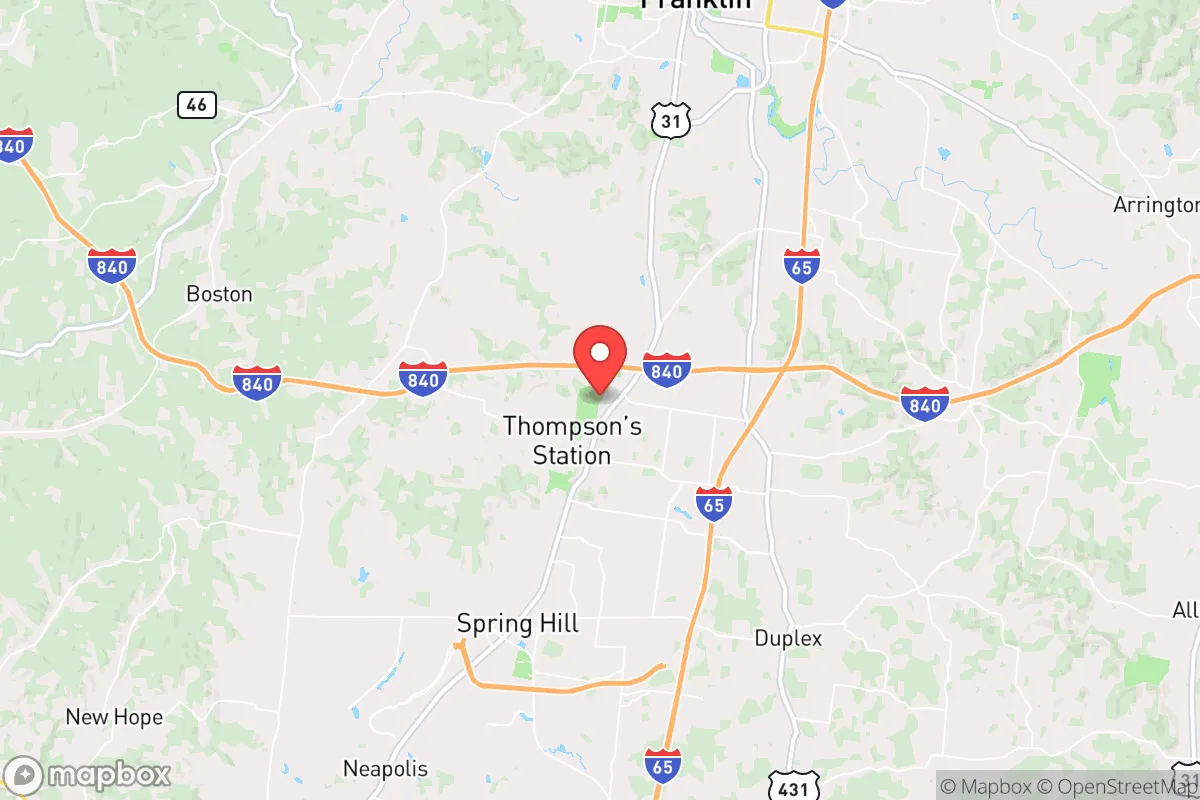
Compared to Tennessee as a whole, Thompson’s Station is a bit of a purple-ish pocket in a reliably red state. The state’s R+13 PVI means statewide races—like for governor or U.S. Senate—usually go Republican by double digits. Here in Thompson’s Station, the margin is tighter. For example, in the 2024 presidential race, Williamson County (where Thompson’s Station sits) voted about 58% Republican, while the state overall was closer to 65%. That’s not a blue wave, but it’s a meaningful difference. Drive 20 minutes south to Spring Hill or Columbia, and you’ll find a more conservative vibe, especially in Maury County, which leans R+12. Head north to Franklin or Brentwood, and you’ll see a similar moderate trend, though still safely red. The contrast is sharpest if you go east to Nashville, which is deep blue (D+18), but that’s a whole different world—urban, dense, and politically energized. Here in Thompson’s Station, the politics are more about growth management, school funding, and keeping the rural character intact, rather than the culture-war flashpoints you see in state-level debates.
What this means for residents
For conservative residents, this is still a comfortable place to live. You’ll find plenty of like-minded neighbors, local GOP events, and a school board that leans traditional. The town council tends to prioritize low taxes and smart growth, which aligns with conservative values. But you won’t feel like you’re in a bubble—there’s a growing number of moderate and even a few liberal voices, especially among younger families and remote workers. For liberal residents, it’s not hostile, but it’s not home turf either. You’ll find your people at community events or through local Facebook groups, but you won’t see many yard signs for Democratic candidates. The practical effect is that policy debates here are less polarized than in the state legislature. For instance, when the town was debating a new park bond a few years back, the conversation was about cost and usage, not ideology. That’s the Thompson’s Station way—pragmatic, neighborly, and a little bit slower than the rest of Tennessee.
One cultural distinction worth noting: Thompson’s Station has a strong sense of local identity that sometimes overrides party lines. The annual Christmas parade and the farmers market are non-political events where everyone shows up. The town’s growth—population nearly doubled from 2010 to 2020—has brought new energy, but also some tension over traffic and development. That’s where you’ll see the real divide: not between red and blue, but between “keep it small” and “let it grow.” In the long run, as more people move here from bluer areas, the political center of gravity will likely keep shifting toward the middle. But for now, Thompson’s Station is a place where you can be conservative without being extreme, and liberal without feeling isolated—a rare balance in Tennessee.

State Political ClimatePolitical Climate in Tennessee
State Political AnalysisPolitical Environment in the State
Tennessee has been a reliably red state for decades, with a Cook Partisan Voting Index of R+13, meaning it votes about 13 points more Republican than the national average. The state’s political trajectory over the last 20 years has been a steady march rightward, driven by the out-migration of rural Democrats and the in-migration of conservative-leaning families from blue states, particularly to the Nashville and Knoxville suburbs. While Democrats once held a competitive edge in state and local races as recently as the early 2000s, Republicans now hold supermajorities in both chambers of the General Assembly and control every statewide office, making Tennessee one of the most solidly conservative states in the country.
Urban vs. rural divide
The political map of Tennessee is a textbook study in the urban-rural split. The major Democratic strongholds are the state’s three largest cities: Nashville (Davidson County), Memphis (Shelby County), and Chattanooga (Hamilton County, though the county itself is more competitive). Nashville and Memphis are deeply blue, often delivering 60-70% of their votes to Democratic presidential candidates. In contrast, the vast rural and exurban areas—places like Jackson, Cookeville, Johnson City, and Clarksville—vote overwhelmingly Republican. The suburbs around Nashville, such as Franklin and Brentwood in Williamson County, are among the most conservative in the nation, routinely voting 70%+ Republican. The Knoxville metro area, anchored by the University of Tennessee, leans red but has a small, growing blue pocket in the city proper. The real story is the Nashville exurbs: counties like Wilson, Rutherford, and Sumner have flipped from competitive to solid red over the past decade as new arrivals from California and Illinois have reinforced the conservative tilt.
Policy environment
Tennessee’s policy environment is defined by its low-tax, low-regulation posture. There is no state income tax on wages—the state relies on a 7% sales tax (among the highest in the nation) and a flat 6.5% corporate tax. Property taxes are low, especially in rural and suburban counties, though they are higher in Nashville and Memphis. The state has a right-to-work law and is a “stand your ground” state with permitless carry of handguns for adults 21 and older. Education policy is dominated by school choice: Tennessee has a robust charter school sector, a voucher-like Education Savings Account program (currently limited to Nashville and Memphis), and a strong homeschooling community. On healthcare, Tennessee has not expanded Medicaid under the Affordable Care Act, leaving a coverage gap for low-income adults. Election laws are restrictive by national standards: voter ID is required, early voting is available but limited, and the state has purged inactive voters aggressively. The state also has a near-total abortion ban, with exceptions only for rape, incest, and to save the mother’s life, enacted after the Dobbs decision.
Recent policy direction
The last five years have seen Tennessee accelerate its conservative agenda. In 2023, the legislature passed a near-total abortion ban (SB 1257), with no exceptions for fetal anomalies. On gun rights, the state enacted permitless carry in 2021 (SB 765) and has repeatedly blocked local governments from enacting their own gun restrictions. On education, the state passed a “Parents’ Bill of Rights” (SB 795) in 2022, requiring schools to notify parents of any changes to a student’s health or well-being, and a law banning instruction on sexual orientation and gender identity in K-8 classrooms (HB 1233). On speech and privacy, the state has targeted drag shows and “adult-oriented” performances (SB 3) and passed a law requiring age verification for pornographic websites. On property rights, Tennessee has a strong eminent domain protection law, but also allows for aggressive annexation by cities. On voting, the state passed a law in 2023 (SB 1240) that makes it a crime for election officials to send unsolicited absentee ballot applications. The overall direction is toward maximizing individual liberty on guns, education, and taxes, while restricting it on abortion, LGBTQ+ expression, and voting access.
Civil unrest & political movements
Tennessee has seen its share of political flashpoints. In 2023, the expulsion of two Black Democratic state representatives from the House for leading a gun control protest on the floor drew national attention and sparked protests in Nashville. The state has a visible but small progressive activist scene in Nashville and Memphis, focused on gun control, racial justice, and LGBTQ+ rights. On the right, the Tennessee Firearms Association and local Second Amendment groups are highly active, and the state has seen a rise in “constitutional sheriff” movements in rural counties. Immigration politics are less heated than in border states, but there is a vocal minority pushing for stricter enforcement, and some counties have passed symbolic “sanctuary city” bans. There is no serious secessionist movement, but “nullification” rhetoric around federal gun laws occasionally surfaces in local GOP resolutions. The most visible flashpoint for a new resident would be the Nashville Christmas Day bombing in 2020, which was an act of domestic terrorism by a lone individual, but did not lead to broader unrest. Overall, political violence is rare, but the state’s politics are polarized and occasionally theatrical.
Projection
Over the next 5-10 years, Tennessee is likely to become even more Republican, but with a subtle shift in the flavor of that conservatism. The in-migration from California, Illinois, and New York is bringing a more “business-friendly, culturally libertarian” conservative to the Nashville suburbs, while rural areas remain deeply traditional. This could create internal GOP tensions over issues like school vouchers (rural districts fear losing funding) and property taxes (new arrivals often push for higher services). The Democratic Party will remain competitive only in Nashville and Memphis, and possibly in Chattanooga if the city continues to grow. The state’s demographics are aging and whitening relative to the nation, which reinforces the red lean. A new resident moving in now should expect a state that is solidly conservative for the foreseeable future, with no realistic path to becoming a swing state. The policy environment will likely continue to push on school choice, gun rights, and tax cuts, while further restricting abortion and LGBTQ+ rights.
For a new resident, the bottom line is this: if you are conservative, you will find a state that largely aligns with your values on taxes, guns, and education, with a government that is responsive to your concerns. If you are liberal, you will find yourself in a political minority, but with two vibrant blue cities (Nashville and Memphis) where you can find community and local representation. The state’s low taxes and low regulation are a draw for many, but the trade-off is limited public services and a political environment that can feel hostile to progressive priorities. Tennessee is not a place of political ambiguity—it is a red state that knows what it is, and it is not changing anytime soon.
* Values derived from national, state, county, city and local statistics and may differ in a specific area. Last updated: 2026-11-14T05:58:22.000Z
Narrative content on this page is AI-generated and may contain mistakes. Verify any details that matter before acting on them.
ReloMaps may earn a commission from affiliate links at no extra cost to you.

