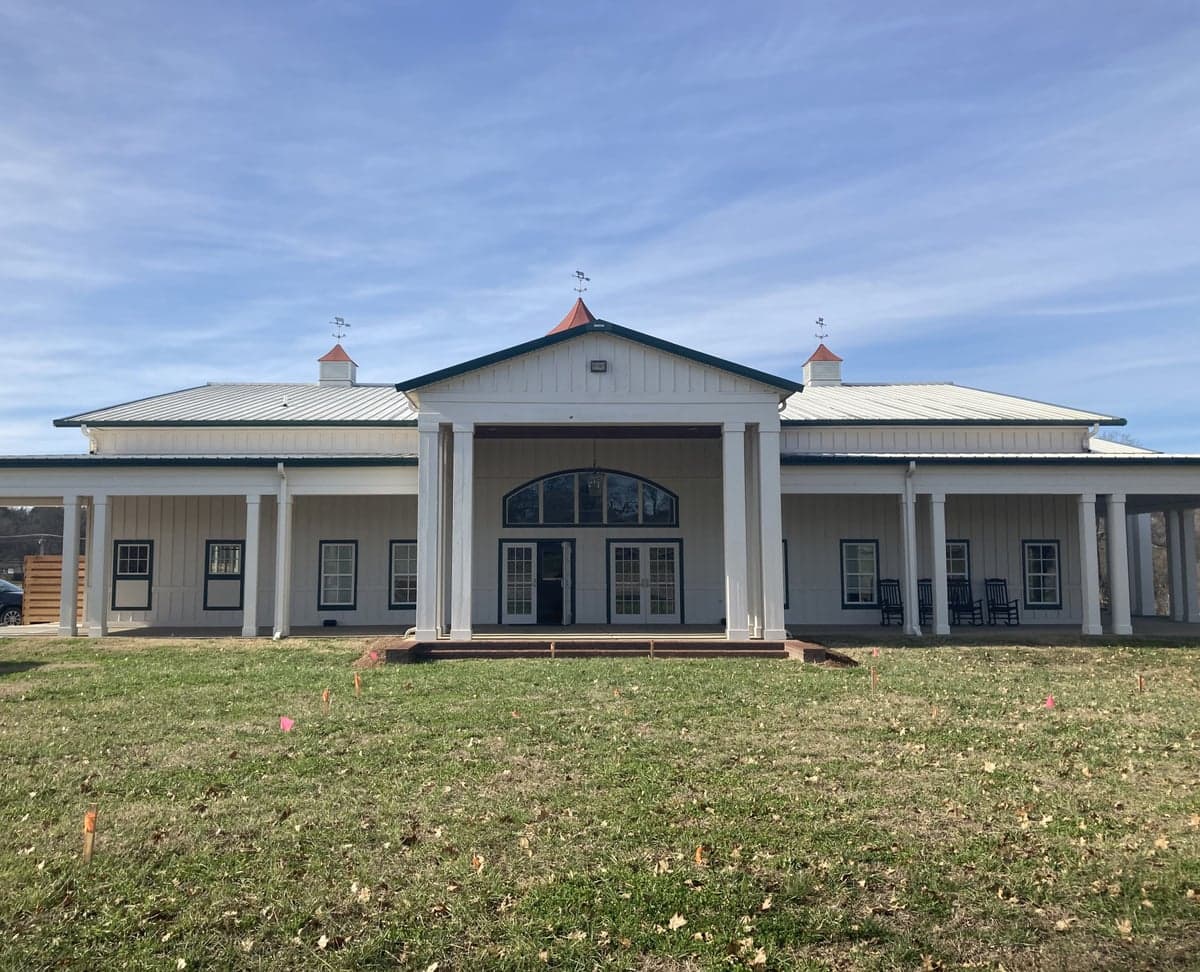
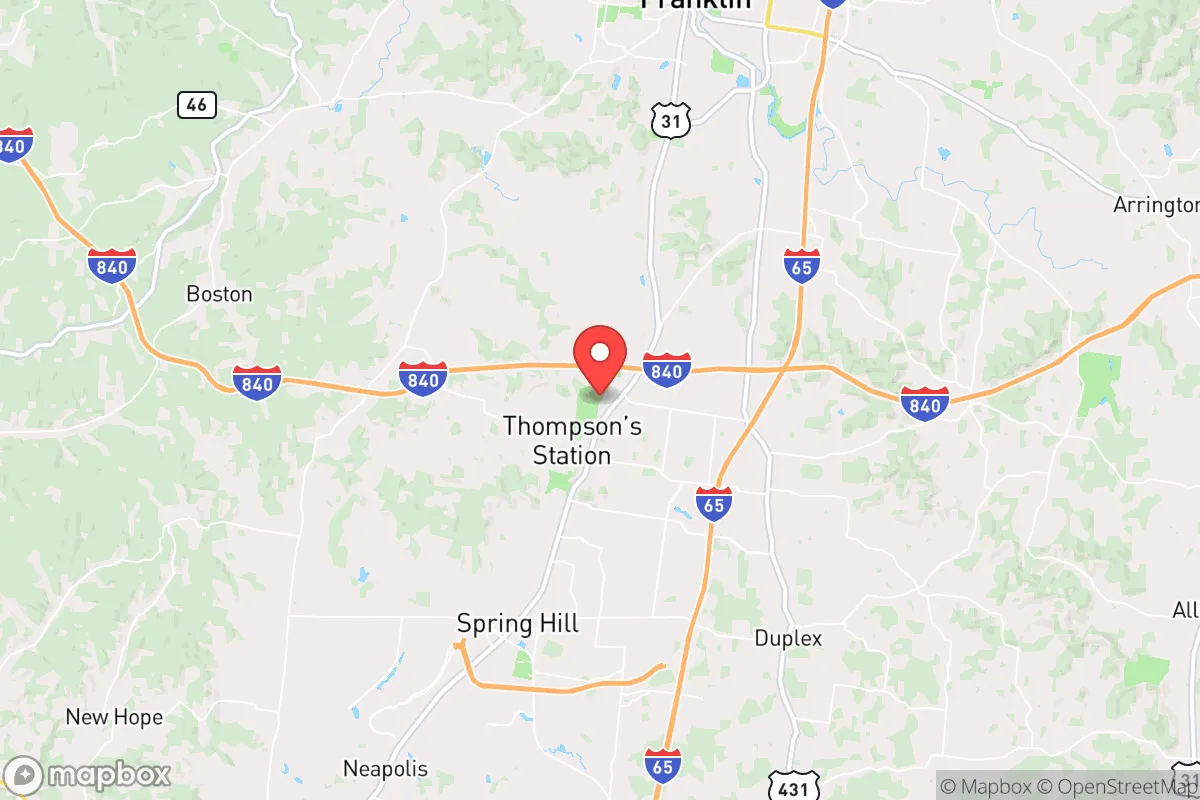
Photo: Wikipedia
Demographics of Thompson's Station, TN
Affluence Level in Thompson's Station, TN
An upper-middle-class area. Household wealth, education levels, and homeownership run ahead of national benchmarks.
People of Thompson's Station, TN
Thompson’s Station, Tennessee, is a fast-growing, predominantly white, highly educated bedroom community of roughly 7,855 residents, where 60.6% of adults hold a college degree and the foreign-born share sits at just 2.5%. The city’s character is defined by its rural-meets-suburban identity: large-lot homes, working equestrian farms, and a strong sense of local governance that has resisted dense development. Its population skews conservative and family-oriented, with a median age in the mid-30s and a notable concentration of Indian-subcontinent professionals (3.3%) working in Nashville’s health-care and tech sectors, while East/Southeast Asian residents (0.8%), Hispanic residents (4.0%), and Black residents (0.2%) form much smaller communities.
How the city was settled and grew
Thompson’s Station was originally a 19th-century railroad stop on the Nashville & Decatur line, named for the Thompson family who owned the surrounding farmland. The first permanent settlers were Scots-Irish and English farmers who arrived in the 1810s–1830s, drawn by land grants from the North Carolina and Tennessee state governments. These families built the area’s earliest homesteads along what is now Thompson’s Station Road and around the historic Thompson’s Station Depot (built 1855), which served as a cotton and livestock shipping point. Through the Civil War and into the early 1900s, the population remained small and almost entirely white, with a handful of Black tenant farmers working the land. The Old Highway 31 corridor became the spine of the community, where general stores, a blacksmith, and a one-room school served the scattered farm families. By 1950, the population was still under 500, and the area’s identity was purely agricultural—no subdivisions, no commuters, just a quiet crossroads.
Modern era (post-1965)
The 1965 Hart-Cellar Act had little direct effect on Thompson’s Station, as the city remained a tiny, overwhelmingly white farming community into the 1980s. The real transformation began in the late 1990s and accelerated after 2000, when Nashville’s suburban sprawl pushed south along I-65. Developers targeted Thompson’s Station for its low land costs, rolling hills, and Williamson County’s top-ranked public schools. The first major master-planned subdivision, Bridgemore, broke ground in 2002, attracting middle- and upper-middle-class white families from Davidson County and other suburban rings. It was followed by Westhaven (a 1,600-home traditional neighborhood development, opened 2004), which became the city’s demographic anchor: overwhelmingly white, college-educated, and politically conservative. The Indian-subcontinent population—mostly software engineers, physicians, and business owners—began arriving in the mid-2010s, drawn by tech jobs in Nashville and Franklin. They concentrated in Westhaven and the newer Bristol Park subdivision, where homes range from $500,000 to $1 million. East/Southeast Asian and Hispanic families are present in very small numbers, scattered across Bridgemore and Westhaven without forming ethnic enclaves. The Black population remains minimal (0.2%), reflecting both the area’s historic demographics and the high cost of entry—median home prices exceed $700,000. The city incorporated in 2011 specifically to control growth, a move that reinforced its character as a low-density, high-income community.
The future
Thompson’s Station is projected to grow to roughly 12,000–14,000 residents by 2040, driven by continued spillover from Nashville and Franklin. The population is likely to become slightly more diverse, but the pace will be slow: the Indian-subcontinent share may rise to 5–6% as more tech and health-care professionals seek Williamson County schools, while Hispanic and East/Southeast Asian shares will likely remain in the low single digits. The white share, currently 81.5%, will edge downward but stay above 75% for the foreseeable future. New development is concentrating in the Thompson’s Station Village mixed-use district (approved 2022) and along the Burgess Road corridor, where several 200–400 home subdivisions are under review. These areas will absorb most new residents, while older neighborhoods like Bridgemore and Westhaven are largely built out. The city’s cultural identity—conservative, family-focused, equestrian-friendly—is unlikely to shift dramatically, as zoning rules favor large lots and limit apartment construction. The biggest demographic wildcard is whether Williamson County’s school district can maintain its reputation as housing costs rise; if affordability worsens, growth could slow.
For someone moving in now, Thompson’s Station offers a stable, low-crime, high-amenity environment where the population is overwhelmingly white and college-educated, with a small but growing Indian-subcontinent professional class. It is not a place of rapid ethnic diversification or urban energy; it is a carefully managed suburb where the people who live there have chosen it for schools, space, and a shared sense of order. Newcomers will find a community that is welcoming to families who fit that mold, but less so to renters, singles, or those seeking racial or economic diversity.

* Values derived from national, state, county, city and local statistics and may differ in a specific area. Last updated: 2026-11-14T05:58:22.000Z
Narrative content on this page is AI-generated and may contain mistakes. Verify any details that matter before acting on them.
ReloMaps may earn a commission from affiliate links at no extra cost to you.

