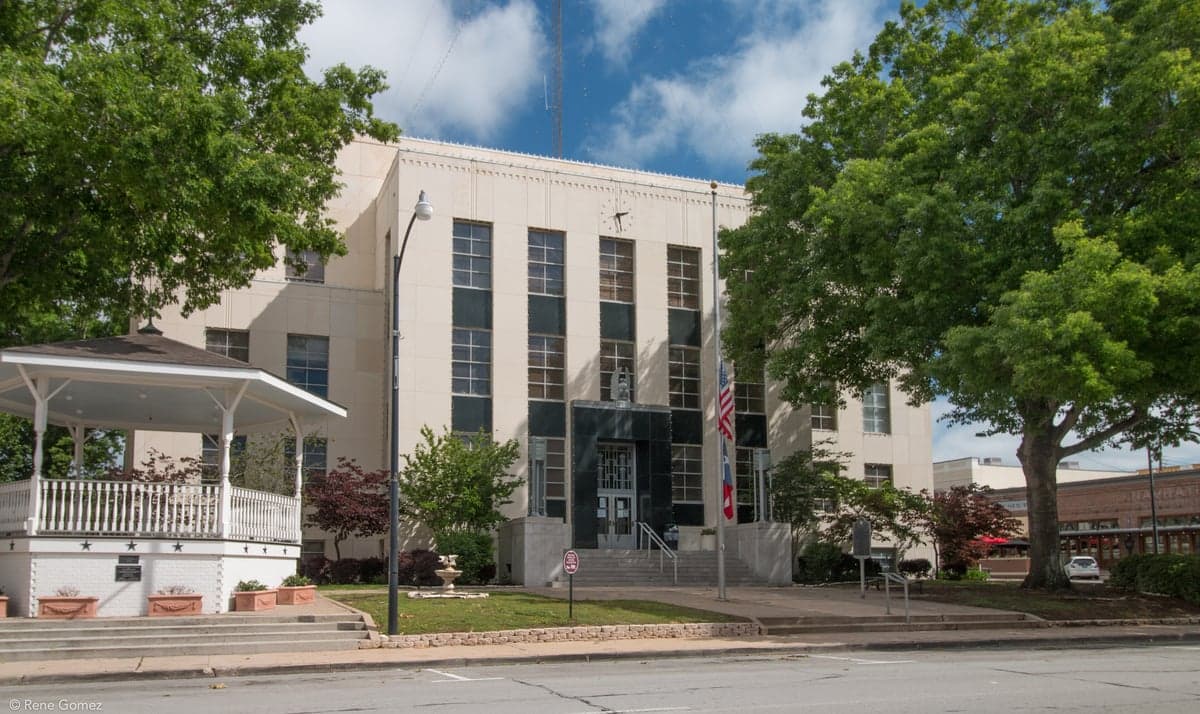
Photo: Wikipedia
Political ClimatePolitical Climate in Washington County
Showing county-level results — no local-only data available.
Lean and PVI are calculated from this county’s 2020 and 2024 presidential results, Cook-style.
Political rankings in Texas
- Most Conservative Cities in Texas
- Most Liberal Cities in Texas
- Best Liberal-Leaning Towns in the South
- Safest Liberal-Leaning Towns in the South
- Safest Conservative-Leaning Towns in the South
- Affordable Small Towns for Conservatives
- Most Affordable Liberal-Leaning Small Towns in the U.S.
- Safest Conservative-Leaning Cities in the U.S.
- Most Conservative Counties in Texas
- Most Liberal Counties in Texas
Local Political AnalysisPolitical Analysis of Washington County
Washington County, Texas, is a reliably Republican stronghold with a Cook Partisan Voting Index of R+14, meaning it votes about 14 points more Republican than the national average. The county has trended steadily redder over the past decade, driven by population growth in its more conservative rural areas and a shift among moderate voters in the county seat, Brenham. While statewide Texas has no official Cook PVI, its overall lean is roughly R+5 to R+6, making Washington County significantly more conservative than the state as a whole.
How it compares
Compared to Texas at large, Washington County is a deeper shade of red. In the 2024 presidential election, the county gave Donald Trump about 72% of the vote, while statewide he received roughly 56%. The difference is most visible in the county's small towns and unincorporated areas. Burton and Chappell Hill are among the most conservative precincts, routinely voting 80%+ Republican. In contrast, Brenham's city precincts show a noticeable blue tint, with some wards near Blinn College and the downtown core voting 55-60% Democratic in recent cycles. The swing precincts are the suburban fringe around Brenham, particularly along Highway 290 toward Chappell Hill, where growth from Houston exurbs has brought a mix of conservative transplants and a few moderate Democrats. Statewide, Texas has seen a slow leftward drift in urban and suburban areas, but Washington County's rural character and strong agricultural base have insulated it from that trend.
What this means for residents
For conservative residents, the political climate is comfortable and affirming. Local offices—county commissioners, school board members, and judges—are almost uniformly Republican, and policy debates tend to center on tax rates, road maintenance, and agricultural regulations rather than culture-war issues. Conservative voters can expect their values to be reflected in local governance, from the county's stance on Second Amendment rights to its approach to land use. For liberal residents, the reality is more nuanced. While they are a clear minority, they are not invisible. Brenham's city council has occasionally seen progressive candidates, and the presence of Blinn College and a growing arts scene provides a small but active liberal community. Liberal residents often find their voice most effective on local issues like downtown development, historic preservation, and public library funding, where bipartisan coalitions can form. The county's strong Republican lean means that statewide Democratic candidates rarely campaign here, but local races can be competitive in Brenham's city limits.
Cultural and policy distinctions
Washington County's political identity is deeply tied to its agricultural heritage and small-town ethos. The county is a dry county by default, though Brenham and a few other areas have voted to allow alcohol sales—a perennial local issue that splits along religious and economic lines. The county's strong Baptist and Lutheran roots shape its social conservatism, visible in everything from Sunday blue laws to school board decisions on curriculum. Property taxes are a perennial hot-button issue, with the county's tax rate among the highest in the region due to limited commercial development outside of Brenham. Unlike more urbanized parts of Texas, Washington County has resisted major zoning changes, preserving its rural character. For newcomers, the political climate means a slower pace of change, a focus on local control, and a community where personal relationships often matter more than party labels—at least until a statewide election rolls around.

State Political ClimatePolitical Climate in Texas
State Political AnalysisPolitical Environment in the State
Texas has been a reliably Republican state for the past three decades, but the margin has been shrinking. In 2024, Donald Trump won the state by roughly 9 points, down from 11 points in 2020 and 16 points in 2012. The dominant coalition is still a mix of rural conservatives, suburban moderates, and evangelical voters, but a rapidly growing urban and suburban population—especially around Austin, Dallas-Fort Worth, and Houston—is pulling the state toward competitive territory. The long arc is a slow but steady shift from deep red to lean red, with the possibility of a toss-up within a decade.
Urban vs. rural divide
The political map of Texas is a study in contrasts. The major metros—Houston, Dallas, San Antonio, and Austin—are Democratic strongholds. Harris County (Houston) went for Biden by 13 points in 2020, and Travis County (Austin) by a staggering 50 points. Meanwhile, rural West Texas and the Panhandle are deeply Republican: Lubbock and its surrounding counties routinely vote 75-80% Republican. The suburbs are the battleground. Collin County (north of Dallas) was once a GOP fortress but has shifted from +30 R in 2012 to +15 R in 2024, driven by an influx of tech workers and young families. Fort Bend County (southwest of Houston) flipped from red to blue between 2016 and 2020, becoming a majority-minority suburban bellwether. The Rio Grande Valley, historically Democratic, has swung toward Republicans in recent cycles, with Zapata County flipping to Trump in 2020—a sign that Hispanic voters are becoming more competitive.
Policy environment
Texas operates under a conservative policy framework that has been largely stable for decades. There is no state income tax, funded instead by high property taxes and a 6.25% state sales tax (local add-ons can push it to 8.25%). The regulatory posture is business-friendly: no state-level minimum wage above the federal $7.25, weak union protections, and streamlined permitting for energy and construction. Education policy is dominated by school choice debates—the 2023 legislative session saw a major push for education savings accounts (ESAs), which failed but will return. Healthcare is a flashpoint: Texas has the highest uninsured rate in the nation at roughly 17%, having refused Medicaid expansion under the ACA. Election laws were tightened in 2021 with SB 1, which added ID requirements for mail-in ballots, limited drive-through voting, and banned 24-hour polling places. Abortion is effectively banned after six weeks under SB 8 (2021) and a trigger law that took effect in 2022, with no exceptions for rape or incest.
Recent policy direction
The last few legislative sessions have pushed Texas further into a specific vision of liberty that prioritizes gun rights, parental control, and property rights over privacy, medical autonomy, and voting access. On gun and self-defense law, Texas became a permitless carry state in 2021 (HB 1927), allowing most adults to carry a handgun without a license. On parental and education rights, the 2023 session passed HB 900, which requires book vendors to rate materials for "sexual content" before schools can purchase them—a law currently blocked by a federal judge. On speech, a 2021 law (HB 20) restricts social media platforms from moderating content based on viewpoint, though it's been tied up in court. On privacy and surveillance, Texas passed a data privacy law (HB 4390) in 2023 giving residents the right to opt out of data collection, but it's weaker than California's. On medical and bodily autonomy, the near-total abortion ban is the headline, but the state also restricted gender-affirming care for minors in 2023 (SB 14). On property rights, eminent domain protections for landowners were strengthened in 2021 (SB 421). On taxation, property tax relief was a major theme in 2023, with a $18 billion package (SB 2) that raised the homestead exemption and compressed school tax rates. On voting and ballot access, SB 1 (2021) made it harder to vote by mail and banned mobile voting units, while also expanding early voting hours in some counties.
Civil unrest & political movements
Texas has seen its share of political flashpoints. The 2020 protests in Austin over George Floyd's death were among the largest in the country, leading to a city council vote to defund the police by $150 million—a decision partially reversed after backlash. The "constitutional carry" movement was a decade-long push that culminated in 2021, driven by groups like the Texas State Rifle Association. On immigration, Governor Greg Abbott's Operation Lone Star (2021) deployed state troopers and National Guard to the border, busing migrants to New York City, Chicago, and Washington, D.C.—a move that drew both praise and lawsuits. Secession rhetoric flares up periodically, with the Texas Nationalist Movement claiming 500,000 supporters, but it remains a fringe position. Election integrity controversies have been persistent: the 2020 election saw a lawsuit from Texas Attorney General Ken Paxton challenging results in four swing states, and the 2022 primary saw a purge of 1.1 million voter registrations under a new citizenship review law (SB 1). A new resident would notice the "Don't Mess with Texas" bumper stickers and the occasional "Keep Austin Weird" counter-slogan, but daily life is generally calm—the political heat is mostly in the legislature and on cable news.
Projection
Over the next 5-10 years, Texas will continue to trend purple, but it won't flip overnight. The key driver is in-migration: roughly 1,000 people move to Texas every day, and they're disproportionately young, diverse, and college-educated—the demographic that leans Democratic. The suburbs of Dallas, Houston, and San Antonio are the battlegrounds; if Collin County and Fort Bend County continue their leftward drift, the state could be competitive at the presidential level by 2032. However, the rural vote is not shrinking fast enough to offset this, and the state's Republican-controlled legislature is likely to continue drawing congressional maps that lock in a 24-14 GOP advantage. The policy direction will remain conservative but may moderate on some issues: property tax relief will continue, school choice will eventually pass, and the abortion ban may see carve-outs for rape and incest if public opinion shifts. A new resident moving in now should expect a state that is still red, but where every election feels closer than the last, and where the political conversation is dominated by the tension between a growing, diverse urban population and a shrinking, aging rural base.
For a new resident, the bottom line is this: Texas offers a low-tax, business-friendly environment with strong gun rights and a conservative social agenda, but the political winds are shifting. If you're a conservative, you'll find a state that largely aligns with your values, though you'll need to watch for the slow creep of suburban moderation. If you're a liberal, you'll find deep-blue cities like Austin and El Paso where you can live comfortably, but you'll be fighting uphill battles on state policy. The practical takeaway is that Texas is a big, diverse state where your experience depends heavily on where you live—choose your county carefully, because the politics of Lubbock and Houston are worlds apart.
* Values derived from national, state, county, city and local statistics and may differ in a specific area. Last updated: 2026-10-24T19:48:10.000Z
Narrative content on this page is AI-generated and may contain mistakes. Verify any details that matter before acting on them.
ReloMaps may earn a commission from affiliate links at no extra cost to you.

