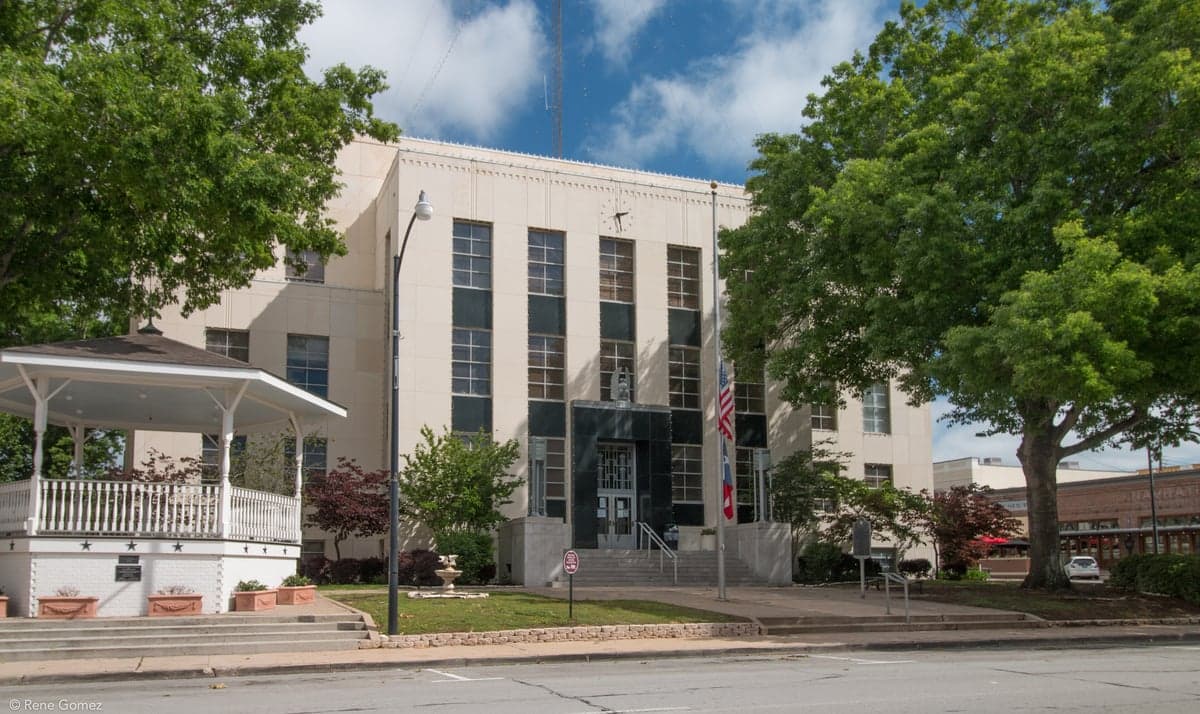
Photo: Wikipedia
Demographics of Washington County
Affluence Level in Washington County
A middle-class area roughly in line with national averages across income, home values, education, and employment.
People of Washington County
The people of Washington County, Texas, today number 36,156 and are defined by a deep-rooted, predominantly rural character, with a population that is 61.7% White, 18.1% Hispanic, and 15.1% Black. The county seat, Brenham, anchors a region where a strong sense of local history, agricultural heritage, and conservative values remain central to daily life. With a foreign-born population of just 3.8% and a college attainment rate of 31.0%, the county is less diverse and less highly educated than the state average, reflecting its identity as a stable, family-oriented community where generational ties run deep.
Settlement & growth (pre-1960)
Long before European arrival, the area that is now Washington County was home to the Bidai, Akokisa, and Tonkawa peoples, who lived along the Brazos River and its tributaries. Spanish and Mexican land grants in the early 1800s drew the first Anglo settlers, but the defining moment came in 1821 when Stephen F. Austin’s Old Three Hundred colony brought the first wave of American families into the region. These settlers, primarily of English, Scots-Irish, and Welsh descent, established the town of Washington-on-the-Brazos in the 1830s, which became the site of the 1836 Texas Declaration of Independence. The county, created in 1836 and named for George Washington, quickly became a political and economic hub of the Republic of Texas.
Through the mid-19th century, cotton and slavery drove the economy, and the population grew with planters and enslaved African Americans from the Upper South. After the Civil War and Emancipation, many freedmen remained in the county, establishing communities like Independence and Chappell Hill, where they farmed small plots and built schools and churches. The arrival of the Houston and Texas Central Railway in the 1860s spurred the growth of Brenham as the county’s commercial center, attracting German and Czech immigrants who brought dairy farming and brewing traditions. By 1900, the county’s population had swelled to over 30,000, with a mix of Anglo, Black, and German-Czech residents living in a rural, agricultural economy.
The early 20th century saw a gradual decline in population as the boll weevil devastated cotton crops and the Great Depression pushed families toward urban areas. The discovery of oil in neighboring counties brought some economic diversification, but Washington County remained primarily agricultural, with dairy and beef cattle replacing cotton as the mainstays. The post-World War II era saw a modest suburbanization around Brenham, but the county’s population growth lagged behind the booming cities of Houston and Austin, preserving its small-town character.
Modern era (post-1965)
The 1965 Hart-Cellar Act had a limited direct impact on Washington County, as the foreign-born population remains low at 3.8%. However, the broader demographic shifts in Texas have reshaped the county indirectly. The most significant change has been the growth of the Hispanic population, which rose from a small fraction in 1970 to 18.1% today. This growth is driven by domestic migration from South Texas and Mexico, with many families settling in Brenham and Burton to work in agriculture, construction, and the expanding service sector. The Hispanic community has become an integral part of the local economy, particularly in dairy farming and food processing.
The Black population, at 15.1%, remains a stable and historically significant presence, concentrated in Brenham and rural communities like Washington and Independence. Unlike many parts of the South, Washington County did not experience a large out-migration of Black residents during the Great Migration, and many families trace their roots back to the 19th century. The East/Southeast Asian population, at 1.2%, and the Indian subcontinent population, at 0.2%, are small and primarily composed of professionals and business owners in Brenham, often connected to the county’s healthcare and education sectors.
Domestic migration from the Rust Belt and coastal states has been modest, with most newcomers drawn by the county’s low cost of living, slower pace of life, and proximity to Houston and Austin. Suburbanization has been limited, with new housing developments concentrated on the outskirts of Brenham and along the Highway 290 corridor. The county’s population has grown slowly but steadily, from 30,373 in 2000 to 36,156 in 2024, a rate of about 0.5% annually.
The future
Washington County is projected to become slightly more diverse over the next 10-20 years, driven primarily by the continued growth of the Hispanic population, which could approach 25% by 2040. The White population, while still the majority, will likely decline as a share, while the Black population is expected to remain stable. The East/Southeast Asian and Indian populations will likely grow slowly, as Brenham’s healthcare and education sectors attract professionals, but the county is unlikely to see the rapid diversification of larger Texas metros.
New residential development is expected to concentrate in Brenham and along the Highway 290 corridor toward Chappell Hill, as commuters from Houston and Austin seek more affordable housing. The county’s cultural identity will likely remain rooted in its agricultural heritage and conservative values, but the growing Hispanic community will bring new traditions, festivals, and businesses. The challenge for the county will be balancing growth with preservation of its rural character and historic communities.
For someone moving in now, Washington County offers a stable, family-oriented environment with a strong sense of place and community. The population is becoming more diverse, but slowly, and the county’s identity as a conservative, agricultural, and historically rich part of Texas is unlikely to change dramatically. New residents will find a place where the past is still very much present, and where the future is being shaped by the same values that have defined it for nearly two centuries.

* Values derived from national, state, county, city and local statistics and may differ in a specific area. Last updated: 2026-10-24T19:48:10.000Z
Narrative content on this page is AI-generated and may contain mistakes. Verify any details that matter before acting on them.
ReloMaps may earn a commission from affiliate links at no extra cost to you.

