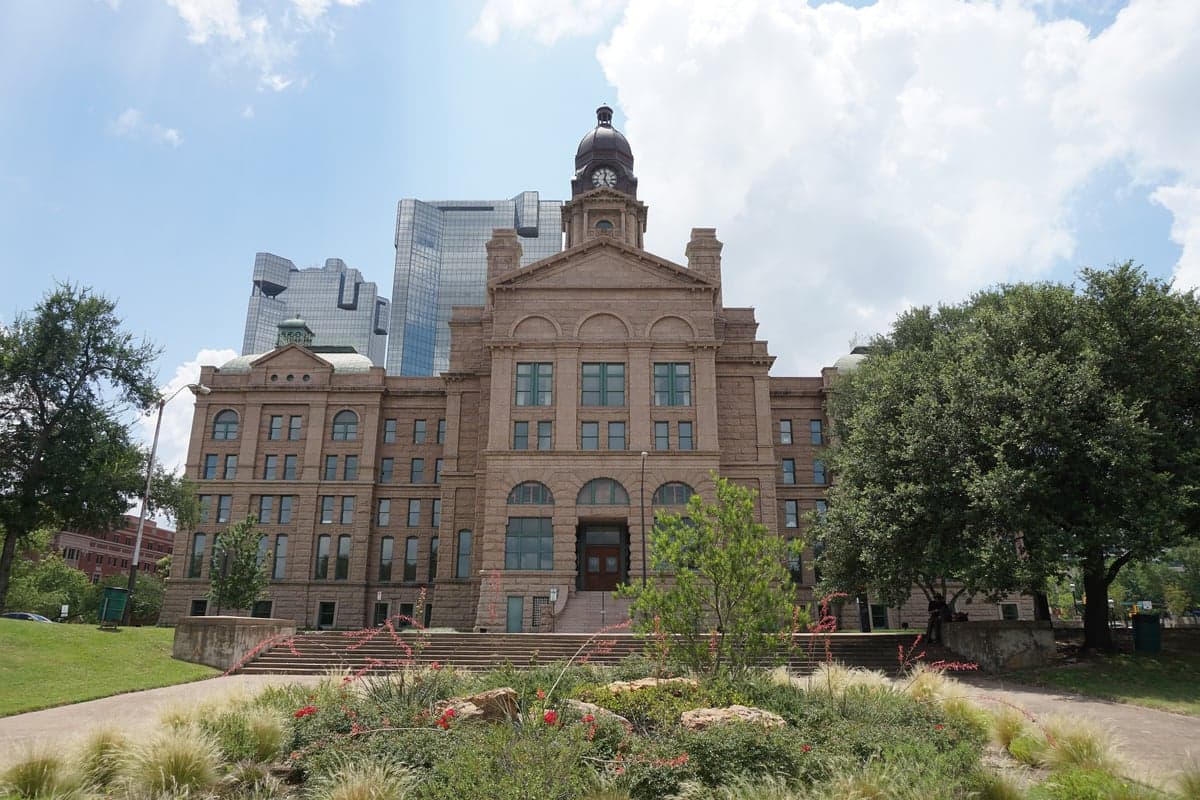
Photo: Wikipedia
Personal Sovereignty in Tarrant County
Strong independent fundamentals that actively favor personal liberty and low regulation.
What does Personal Sovereignty tell us?
Personal Sovereignty measures your capacity for self-reliance and independence with minimal government friction. Higher scores mean fewer barriers between you and the way you want to live... but it assumes you have the space you need and good neighbors.
What does this tell us?
Personal Sovereignty measures your capacity for self-reliance and independence with minimal government friction. Higher scores mean fewer barriers between you and the way you want to live... but it assumes you have the space you need and good neighbors.
State Policy
Energy independence: Net exporter (220% of energy produced in-state)
Personal Liberty
Homesteading

Personal Liberty Analysis
Tarrant County offers a notably stronger environment for personal sovereignty than most urbanized Texas counties, but it is not a libertarian free zone. The county’s political geography creates a patchwork of autonomy: the western and northern exurbs—places like Aledo, Azle, and Springtown—operate with a distinctly hands-off, rural ethos, while the urban core of Fort Worth and the southeastern suburbs near Arlington and Mansfield carry more municipal oversight and higher tax burdens. For the individual or family seeking to minimize government entanglement in daily life—whether through taxation, regulation, or restrictions on self-defense and medical choice—Tarrant County presents a viable but location-dependent option. The key is knowing where to plant your flag and what trade-offs each pocket demands.
Tax burden and regulatory posture across Tarrant County
Texas has no state income tax, which is the foundation of any sovereignty analysis here, but property taxes in Tarrant County are not uniform. The county’s overall effective property tax rate hovers around 2.1% to 2.3% of assessed value, which is moderate for the Dallas-Fort Worth metroplex but higher than rural counties to the west like Parker or Palo Pinto. Inside Fort Worth city limits, you face a combined city-county-school district rate that can push toward 2.6% or higher, especially in the Fort Worth Independent School District. Move west to Aledo (Aledo ISD) or north to Keller (Keller ISD), and the rates drop slightly—around 2.0% to 2.2%—because those districts have higher property values and lower debt loads. Regulatory posture follows a similar gradient: unincorporated areas of Tarrant County (mostly in the western and northern fringes) have fewer building codes, no city permitting delays, and minimal zoning restrictions. The city of Azle, straddling the Tarrant-Parker county line, is a prime example of a low-regulation enclave where you can build a shop, park a fifth-wheel, or keep livestock without navigating a thicket of municipal bureaucracy. By contrast, Southlake and Colleyville in the northeast have strict HOA covenants and city ordinances that govern everything from fence height to grass length—fine for some, but a constraint on personal autonomy.
Self-defense and gun law specifics in Tarrant County
Texas is a permitless carry state, and Tarrant County law enforcement generally respects that right. The sheriff’s office and local police departments in the western cities—Aledo, Azle, Springtown—are known for a pro-Second Amendment culture where open carry and lawful concealed carry are met with indifference rather than suspicion. The county does not have any local ordinances that restrict magazine capacity, firearm types, or storage requirements beyond state law. However, the urban centers of Fort Worth and Arlington have seen more progressive city council proposals in recent years—such as "safe storage" resolutions or calls for red flag laws—though none have passed as binding ordinances as of 2026. The practical reality is that if you live in unincorporated Tarrant County or a small western town, you can keep firearms in your vehicle, carry on your person, and defend your home with a firearm under the Castle Doctrine without worrying about municipal overreach. The Springtown area, in particular, is a stronghold for gun owners, with multiple local ranges and a community where firearm training is a normal part of family life. For the prepper mindset, this is a critical factor: Tarrant County is not a jurisdiction where you will be disarmed by local fiat, but staying outside the Fort Worth city limits reduces the risk of future encroachment.
Self-reliance and homesteading viability: lot sizes, zoning, and off-grid feasibility
Homesteading and off-grid living are not uniformly possible across Tarrant County. The eastern and southern suburbs—Arlington, Mansfield, Burleson—are largely platted with standard suburban lots of one-quarter to one-half acre, with HOAs that prohibit chickens, rainwater collection systems, or solar panels visible from the street. The western and northern fringes tell a different story. In Aledo, you can find acreage parcels of 1 to 5 acres where zoning is minimal and county health department rules are the primary constraint. Azle and Springtown offer even more flexibility: lots of 5 to 20 acres are common, and many properties already have septic systems, private wells, and agricultural exemptions. Off-grid feasibility is highest in the far western reaches near the Parker County line, where you can install solar panels, collect rainwater (Texas law permits it, but some municipalities restrict it), and keep livestock without city interference. The county does require permits for septic systems and wells, but these are straightforward and not onerous. For the serious prepper, the Springtown area is the sweet spot: low population density, minimal zoning, and a culture where neighbors mind their own business. The trade-off is that you are 30-40 minutes from Fort Worth for supplies and medical care, but that distance is exactly what sovereignty-minded individuals often seek.
Personal liberties: parental rights, medical autonomy, speech, and property
Parental rights in Tarrant County are strong by default, thanks to Texas state law that prohibits local school districts from mandating vaccines or enforcing mask mandates without parental consent. The school boards in Aledo ISD and Springtown ISD have been consistently conservative on these issues, with policies that defer to parents on medical decisions and curriculum objections. Fort Worth ISD, by contrast, has a more progressive board that has occasionally pushed for broader health mandates, though state preemption limits their reach. Medical autonomy is similarly protected: Texas law prohibits local governments from banning ivermectin, hydroxychloroquine, or other off-label treatments, and Tarrant County has no local health ordinances that override that. Free speech is robust—there are no local hate speech ordinances or permit requirements for public assembly outside of standard parade permits. Property rights are the most variable: in unincorporated areas, you can build a workshop, store equipment, or run a small home-based business without a conditional use permit. In Southlake or Colleyville, HOAs and city zoning can restrict everything from the color of your front door to the number of vehicles parked in your driveway. For the individual who values maximum control over their own property, the western exurbs are the clear choice.
Overall, Tarrant County offers a solid but uneven foundation for personal sovereignty relative to other Texas counties. It is far more freedom-friendly than Travis or Dallas counties, where municipal overreach is more aggressive, but it does not match the near-total autonomy of rural counties like Palo Pinto or Jack County to the west. The strategic relocation decision comes down to this: if you want proximity to urban jobs and infrastructure while maintaining a high degree of personal control, the western and northern fringes of Tarrant County—Aledo, Azle, Springtown—are among the best options in the metroplex. If you prioritize maximum off-grid capability and minimal government presence, you will need to go further west. But for the prepper or conservative family who wants a buffer zone without total isolation, Tarrant County’s western tier is a defensible, practical choice.

* Values derived from national, state, county, city and local statistics and may differ in a specific area. Last updated: 2026-04-13T02:41:30.000Z
Narrative content on this page is AI-generated and may contain mistakes. Verify any details that matter before acting on them.
ReloMaps may earn a commission from affiliate links at no extra cost to you.

