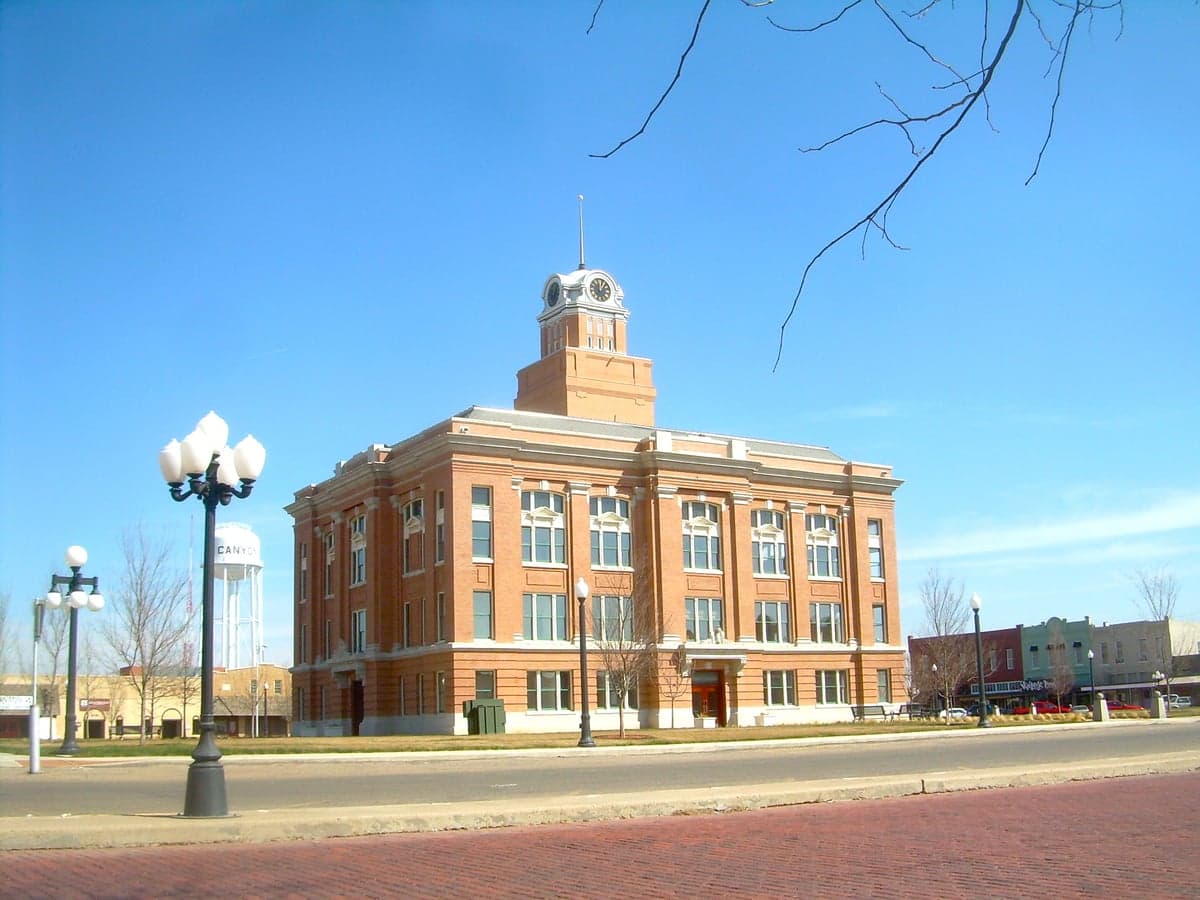
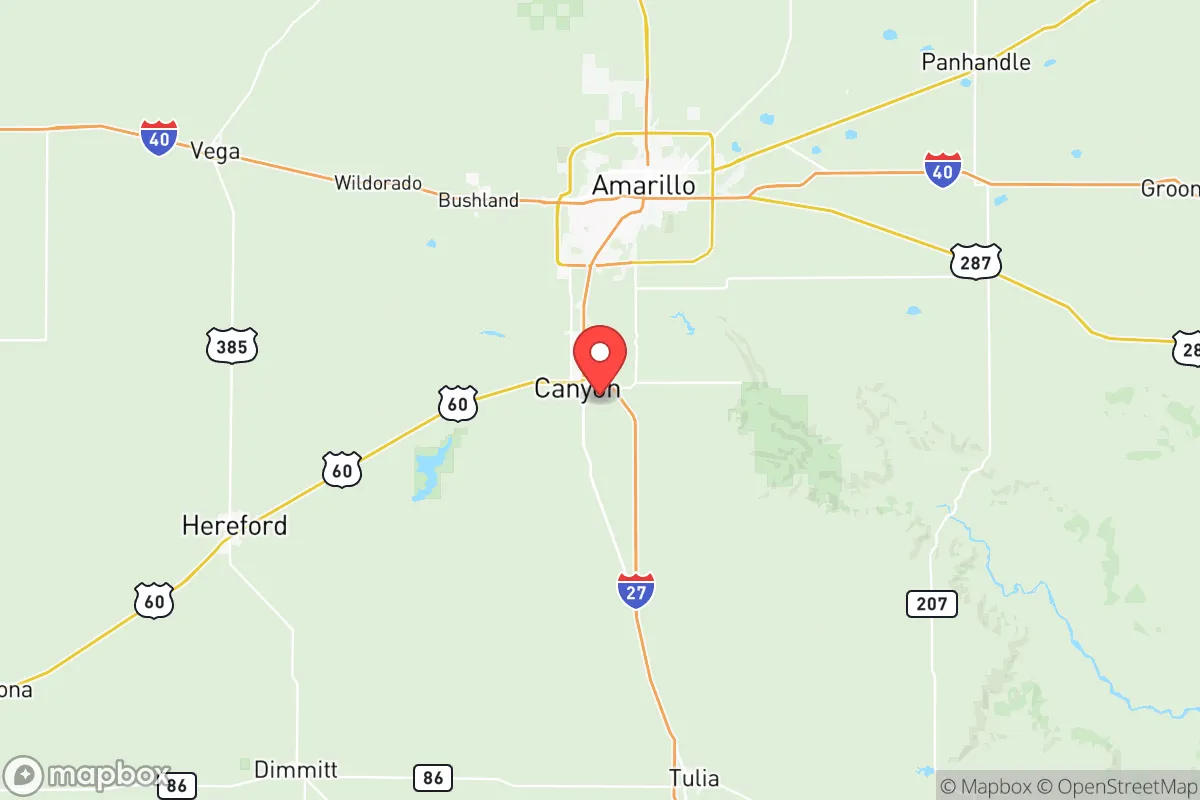
Photo: Wikipedia
Political ClimatePolitical Climate in Randall County
Showing district-level results — no local-only data available.
Local Political AnalysisPolitical Analysis of Randall County
Randall County is one of the most reliably Republican counties in Texas, anchored by a Cook Partisan Voting Index of R+24, meaning it votes about 24 points more Republican than the national average. This isn't a recent shift—the county has voted for the GOP presidential candidate by margins of 70% or more in every election since 2000, with Donald Trump pulling 77% in 2020. The real story is how that dominance is distributed internally: the city of Canyon, home to West Texas A&M University, is the only place where you'll find a noticeable Democratic presence, with precincts near campus occasionally breaking 40% for Democratic candidates. Meanwhile, the sprawling suburban precincts south of Amarillo—places like Timbercreek Canyon and the unincorporated areas around Lake Tanglewood—routinely deliver 80-85% Republican votes. The county's trajectory is actually hardening: as the rural agricultural base shrinks and the suburban population grows, the political center of gravity is moving further right, not moderating.
How it compares
Compared to Texas as a whole, Randall County is significantly more conservative. The state's overall Cook PVI is not officially calculated, but based on 2024 results, Texas leans roughly R+5 to R+6—meaning Randall County is about 18-19 points more Republican than the state average. That gap is even wider when you look at specific policy areas. In the 2022 gubernatorial race, Greg Abbott won Randall County with 79% of the vote, compared to 55% statewide. The county's Republican primary turnout consistently exceeds 35% of registered voters, while in many urban Texas counties it hovers around 15-20%. This isn't a purple county trending red; it's a deep red county that's getting redder. The only counterweight is the student population at West Texas A&M, which introduces a small but consistent liberal vote in Canyon precincts, but those students are heavily outvoted by the surrounding permanent residents.
What this means for residents
For conservative residents, Randall County offers a political environment where their values are the default. Local government, school boards, and county commissions are uniformly Republican, and policy debates tend to focus on how conservative to be, not whether to be conservative. For liberal residents, the reality is more isolating. There is no organized Democratic Party infrastructure in the county—the local party office in Amarillo (Potter County) is the closest resource. Socially, political discussions at work or in community settings can be tense for those who don't share the majority view, though most residents report that personal relationships generally transcend politics. The practical effect is that progressive candidates rarely appear on the ballot for county-level offices, and when they do, they typically receive under 25% of the vote. National issues like abortion and gun rights are essentially settled questions in local politics, with the county government consistently supporting the most conservative positions.
Culturally, Randall County's political climate manifests in distinct ways. The county is a stronghold for the Texas Panhandle's evangelical Christian community, and church attendance correlates closely with political engagement. You'll see "In God We Trust" displays in county buildings and prayer before commission meetings as a matter of course. The county's approach to growth is notably pro-development and low-regulation, with minimal zoning in unincorporated areas and a strong preference for private property rights over land-use planning. This creates a lived environment where the political consensus shapes everything from school curriculum debates to how quickly new housing subdivisions get approved. For newcomers, the key takeaway is straightforward: Randall County is not a place where political change is coming soon—it's a place where the current direction is accelerating, and both conservatives and liberals should understand that reality before moving here.

State Political ClimatePolitical Climate in Texas
State Political AnalysisPolitical Environment in the State
Texas has been a reliably Republican state for the past three decades, but the margin has been shrinking. In 2024, Donald Trump won Texas by roughly 9 points, down from 11 points in 2020 and 16 points in 2016. The state’s dominant coalition is a mix of rural conservatives, suburban moderates, and a growing number of Hispanic voters who lean right on economic issues but are less predictable on social ones. Over the last 10-20 years, the trajectory has been a slow but steady shift toward competitiveness, driven by explosive growth in the urban crescent from Dallas-Fort Worth down to San Antonio and Houston, where Democratic votes have piled up faster than Republican ones in the exurbs.
Urban vs. rural divide
The political map of Texas is a stark checkerboard. The big metros — Austin, Dallas, Houston, San Antonio, and El Paso — are solidly Democratic, with Austin’s Travis County voting +50 points for Biden in 2020 and El Paso’s county going +36. These cities drive the state’s blue shift, fueled by young professionals, tech transplants, and a diverse working class. In contrast, the vast rural and small-town areas — the Panhandle around Lubbock, the Piney Woods near Tyler, and the Hill Country west of San Antonio — vote Republican by 30-50 points. The real battleground is the suburbs: places like Collin County (north of Dallas) and Fort Bend County (southwest of Houston) have flipped from deep red to purple or even blue in the last decade. Collin County voted for Trump by only 4 points in 2024, down from 16 points in 2016. Meanwhile, the Rio Grande Valley, once a Democratic stronghold, has shifted right — Zapata County, which went for Hillary Clinton by 33 points in 2016, flipped to Trump by 5 points in 2024.
Policy environment
Texas has no state income tax, which is the single biggest policy draw for relocators. Property taxes are high to compensate — the average effective rate is about 1.6%, among the highest in the U.S. — but there’s no tax on wages or retirement income. The regulatory posture is famously business-friendly: no state-level minimum wage above the federal $7.25, weak union protections, and a “right-to-work” law that makes organizing difficult. On education, the state funds schools through a complex Robin Hood system that redistributes property tax revenue from wealthy districts to poor ones, but per-pupil spending remains below the national average. School choice is a live issue: in 2023, the legislature passed a limited education savings account program for special-needs students, but a broader voucher bill failed. Healthcare policy is conservative: Texas did not expand Medicaid under the ACA, leaving roughly 1.5 million uninsured adults in the “coverage gap.” Election laws have tightened: SB 1 (2021) banned 24-hour and drive-thru voting, added ID requirements for mail ballots, and gave partisan poll watchers more access. The state also has some of the nation’s strictest abortion laws (trigger ban effective 2022, with no exceptions for rape or incest) and a permitless carry law for handguns (2021).
Recent policy direction
The last few legislative sessions have pushed Texas further right on a broad set of liberties. On gun and self-defense law, the 2021 permitless carry law (HB 1927) allows most adults to carry a handgun without a license or training, though the state still bans carry in certain places like schools and bars. On parental and education rights, the 2023 “Parental Bill of Rights” (SB 1515) requires schools to get parental consent before providing any health care or counseling to a minor, and the 2021 “Critical Race Theory” law (HB 3979) restricts how teachers can discuss race and current events. On speech, the state has targeted social media platforms with HB 20 (2021), which bars them from moderating content based on viewpoint — a law currently tied up in court. On privacy and surveillance, Texas passed a biometric privacy law (CUBI) in 2023 that requires companies to get consent before collecting facial recognition or fingerprint data. On medical and bodily autonomy, the abortion ban is total, and the state has also restricted gender-affirming care for minors (SB 14, 2023). On property rights, eminent domain reform has been a recurring issue, with recent bills limiting how much land can be taken for private development. On taxation, the 2023 session cut property taxes by roughly $18 billion through a combination of higher homestead exemptions and a compression of school tax rates. On voting and ballot access, SB 1 remains the baseline, but the legislature has also added stricter signature verification for mail ballots and banned the distribution of unsolicited mail-in ballot applications.
Civil unrest & political movements
Texas has seen its share of political flashpoints. The 2020 protests in Austin and Houston over George Floyd’s murder were large and occasionally violent, leading to a state law (HB 9, 2021) that enhanced penalties for rioting and made it a crime to bail out protesters. On the right, the “constitutional carry” movement was a major force behind the 2021 permitless carry law, and the “school choice” coalition has been steadily gaining ground. Immigration politics are a constant: Governor Greg Abbott’s Operation Lone Star (2021-present) has deployed state troopers and National Guard to the border, bused migrants to Democratic-led cities, and installed razor wire and buoys in the Rio Grande — all of which have been challenged in court. Sanctuary city policies are banned statewide (SB 4, 2017), but some cities like Austin and Dallas have passed local resolutions limiting cooperation with federal immigration enforcement, leading to legal fights. Secession rhetoric flares up periodically — the Texas Nationalist Movement has some grassroots support, but it’s a fringe position with no serious legislative traction. Election integrity controversies have been quieter since 2020, but the state’s 2022 audit of four counties (including Harris County) found no evidence of widespread fraud, despite Republican claims.
Projection
Over the next 5-10 years, Texas will likely remain Republican but with a narrower margin. The key demographic driver is in-migration: roughly 1,000 people move to Texas every day, mostly from California and other blue states. These newcomers tend to be younger, more diverse, and more moderate — they’re not all liberals, but they’re less culturally conservative than native-born Texans. The suburbs will continue to shift left, while rural areas will stay deep red. The Hispanic vote is the wildcard: if the trend in the Rio Grande Valley holds, Republicans could offset some losses in the suburbs. On policy, expect more school choice battles, continued property tax compression, and a hardening of the state’s border posture. The abortion ban is unlikely to be repealed, but exceptions for rape or incest could be added if public pressure builds. A new resident moving in now should expect a state that is politically competitive at the presidential level within a decade, but where state government remains firmly in Republican hands for the foreseeable future.
For a new resident, the bottom line is that Texas offers a low-tax, low-regulation environment with a conservative social bent, but the political reality is increasingly split. If you’re conservative, you’ll find a state government that largely shares your values, especially on guns, taxes, and education. If you’re liberal, you’ll find strong communities in the cities and a growing political counterweight, but you’ll also face state laws that restrict abortion, voting, and local control. The practical takeaway is that where you live within Texas matters more than ever — a family in Southlake will experience a very different political climate than one in Austin, even though both are in the same state. Choose your county carefully, because that’s where the rubber meets the road on schools, taxes, and local governance.
* Values derived from national, state, county, city and local statistics and may differ in a specific area. Last updated: 2026-10-18T00:37:53.000Z
Narrative content on this page is AI-generated and may contain mistakes. Verify any details that matter before acting on them.
ReloMaps may earn a commission from affiliate links at no extra cost to you.

