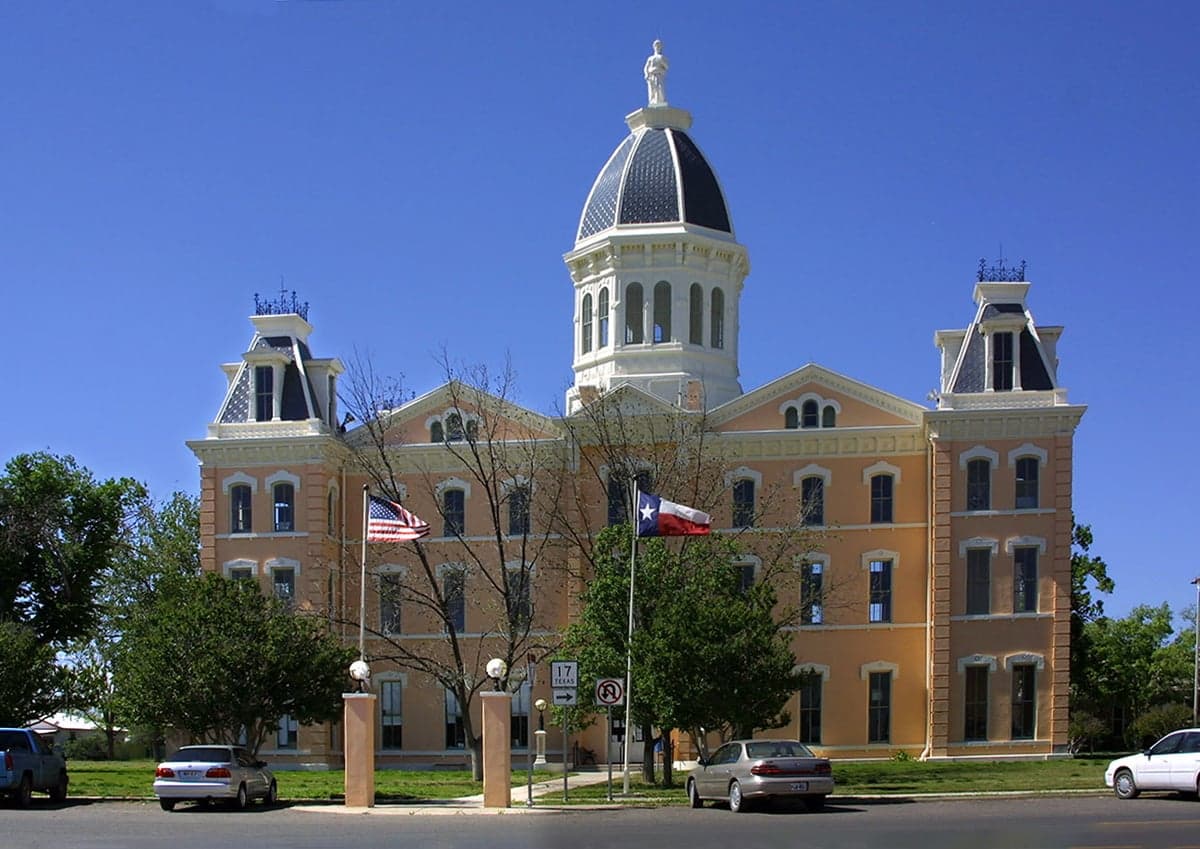
Photo: Wikipedia
Demographics of Presidio County
Affluence Level in Presidio County
A low-income area with significant economic hardship. Household wealth and educational attainment are well below national averages.
People of Presidio County
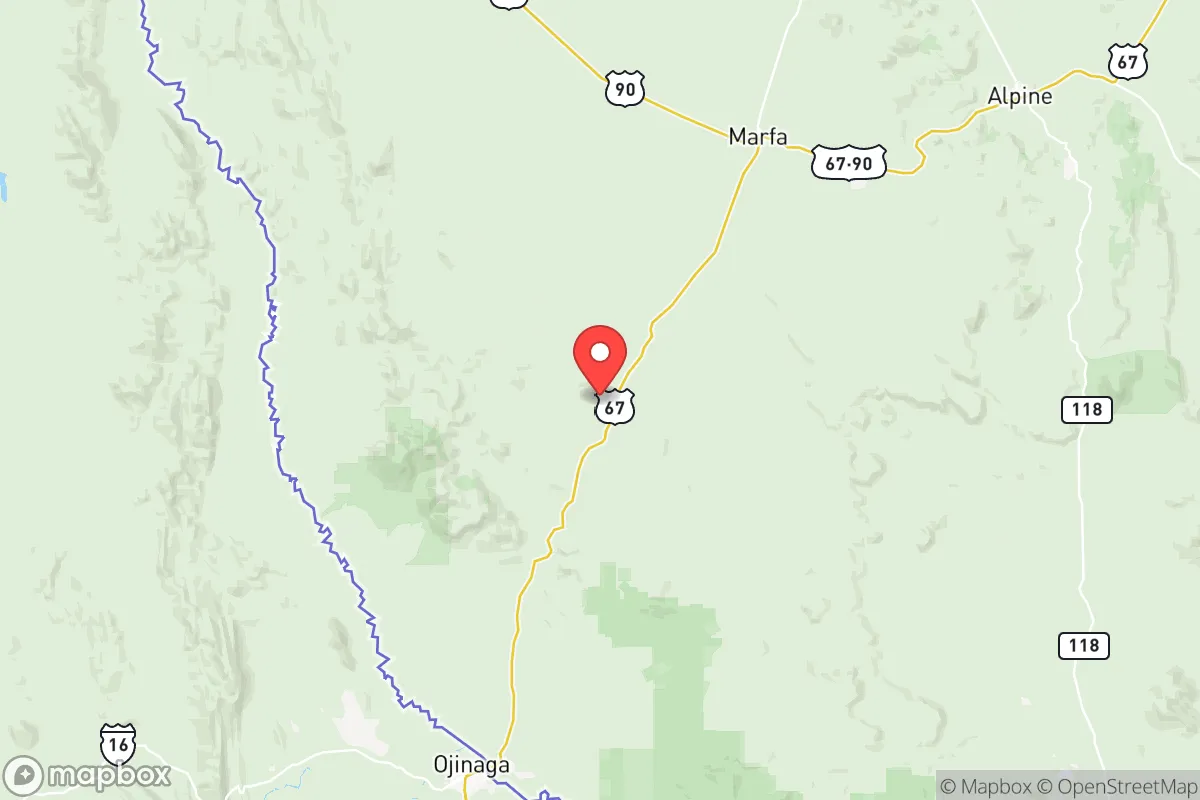
Presidio County, Texas, is a remote, sparsely populated border county where 76.5% of its 6,043 residents identify as Hispanic, a figure that reflects centuries of continuous settlement by Spanish, Mexican, and Tejano families along the Rio Grande. The county's population density is among the lowest in Texas, with most people concentrated in the county seat of Marfa and the border town of Presidio, while vast stretches of the Big Bend region remain nearly empty. A distinctive cultural marker is the county's deep-rooted ranching heritage, combined with a small but influential Anglo-American arts community that has grown around Marfa's minimalist art scene since the 1970s. With only 20.2% of adults holding a college degree and a foreign-born population of 15.9%, Presidio County remains a working-class, predominantly Hispanic region that is both geographically isolated and culturally distinct from the rest of Texas.
Settlement & growth (pre-1960)
Long before European contact, the land that is now Presidio County was home to semi-nomadic Native American groups, including the Jumano and later the Apache and Comanche, who traversed the region's arid mountains and river valleys. The first permanent European settlement in the area was Presidio del Norte, established by Spanish colonists in the late 17th century on the south bank of the Rio Grande (in present-day Mexico), with a small outpost on the north bank that would eventually become the town of Presidio, Texas. This Spanish colonial presence created a foundational Hispanic population that has remained the demographic majority for over 300 years, with families like the Baca and Ontiveros clans tracing their roots to the original land grants.
The United States took formal control of the region after the Mexican-American War (1846–1848), but Anglo-American settlement was slow due to the area's extreme aridity, remoteness, and ongoing Apache and Comanche raids. The first significant Anglo influx came with the establishment of Fort Davis (just north of Presidio County) in 1854 and the subsequent founding of Marfa in 1883 as a railroad water stop on the Galveston, Harrisburg & San Antonio Railway. The railroad brought a wave of Anglo-American ranchers, merchants, and railroad workers, many of whom were of German, Irish, and English descent, but they remained a small minority relative to the long-established Hispanic ranching population. The town of Shafter, founded in 1883 after the discovery of silver, briefly boomed with a multi-ethnic mining workforce that included Mexican laborers and Anglo engineers, but the mine's closure by the 1940s left it a near-ghost town.
Throughout the early 20th century, Presidio County's population remained overwhelmingly Hispanic and rural, with the majority of residents living in small farming and ranching communities along the Rio Grande, such as Ruidosa and Candelaria. The Mexican Revolution (1910–1920) drove a wave of refugees north across the border, reinforcing the county's Hispanic character. By 1960, the county's population had reached roughly 5,000, with Presidio serving as a border crossing and agricultural hub for cotton and livestock, while Marfa functioned as the county's commercial and administrative center. The Anglo-American population, though small, controlled most of the county's political and economic institutions through the mid-20th century.
Modern era (post-1965)
The 1965 Hart-Cellar Act did not dramatically reshape Presidio County's demographics, as the region had no history of large-scale immigration from Asia, Africa, or the Middle East. Instead, the county's modern demographic story is one of Hispanic population consolidation and Anglo-American in-migration driven by tourism and the arts. The most transformative event was artist Donald Judd's relocation to Marfa in the 1970s, which attracted a wave of artists, writers, and wealthy patrons from coastal cities, many of them Anglo-Americans from the Northeast and West Coast. This influx created a small but economically influential Anglo-American enclave in Marfa, centered around the Chinati Foundation and the town's gallery scene, while the rest of the county remained overwhelmingly Hispanic and working-class.
Domestic migration patterns since the 1990s have been shaped by two opposing forces: the steady out-migration of younger Hispanic residents seeking jobs in larger Texas cities like El Paso, San Antonio, and Dallas, and the in-migration of affluent Anglo-Americans and international tourists drawn to Marfa's cultural cachet. The town of Presidio, by contrast, has seen little new development and remains a predominantly low-income Hispanic border community, with many residents commuting across the bridge to Ojinaga, Chihuahua for work and family ties. The county's foreign-born population of 15.9% is almost entirely Mexican-born, with no significant East/Southeast Asian, Indian, or Black populations recorded in the data.
Suburbanization has not occurred in Presidio County due to its extreme remoteness and lack of major highways or employment centers. The county's population has remained stagnant or declined slightly since its peak of roughly 7,000 in the 1980s, with the 2020 census recording 6,043 residents. The Anglo-American share of the population has grown modestly in Marfa but remains a small fraction of the county total, while the Hispanic share has held steady at over three-quarters of the population. The county's college-educated population of 20.2% is concentrated almost entirely in Marfa, where the arts economy has attracted a disproportionately educated workforce.
The future
Presidio County's population is likely to remain small and predominantly Hispanic for the foreseeable future, with modest growth concentrated in Marfa and continued stagnation or decline in Presidio and the rural communities. The county's Hispanic share may increase slightly as younger Anglo-American arrivals tend to be older and less likely to have children, while Hispanic families in Presidio and the surrounding areas maintain higher birth rates. The county is not becoming more diverse in the conventional sense — there is no significant Asian, Indian, or Black population growth — but it is becoming more culturally bifurcated between the arts-driven Anglo-American enclave in Marfa and the traditional Hispanic border communities.
The next 10–20 years will likely see continued pressure on housing affordability in Marfa, as wealthy second-home buyers and short-term rental investors drive up property values, potentially displacing some long-term Hispanic residents. Meanwhile, Presidio may see modest growth from cross-border trade and nearshoring of manufacturing to Ojinaga, but the county lacks the infrastructure to support rapid expansion. The county's cultural identity will remain a blend of deep Hispanic ranching traditions and a small, internationally connected arts scene, with little integration between the two groups. For someone moving in now, Presidio County offers a unique, isolated lifestyle with a strong sense of place, but limited economic opportunity outside of tourism, ranching, or remote work.
Presidio County is becoming a place of stark contrasts: a centuries-old Hispanic border culture coexisting with a tiny, affluent Anglo-American arts colony, with little demographic change beyond those two poles. For a conservative-leaning family or individual seeking a quiet, rural life with a strong community identity and low cost of living outside of Marfa, the county offers genuine authenticity and space, but also limited services, extreme heat, and a long drive to any major city. The county's future is one of slow, selective growth — not a boom, but a steady continuation of its role as one of Texas's most remote and culturally distinct borderlands.

* Values derived from national, state, county, city and local statistics and may differ in a specific area. Last updated: 2026-07-12T15:21:18.000Z
Narrative content on this page is AI-generated and may contain mistakes. Verify any details that matter before acting on them.
ReloMaps may earn a commission from affiliate links at no extra cost to you.

