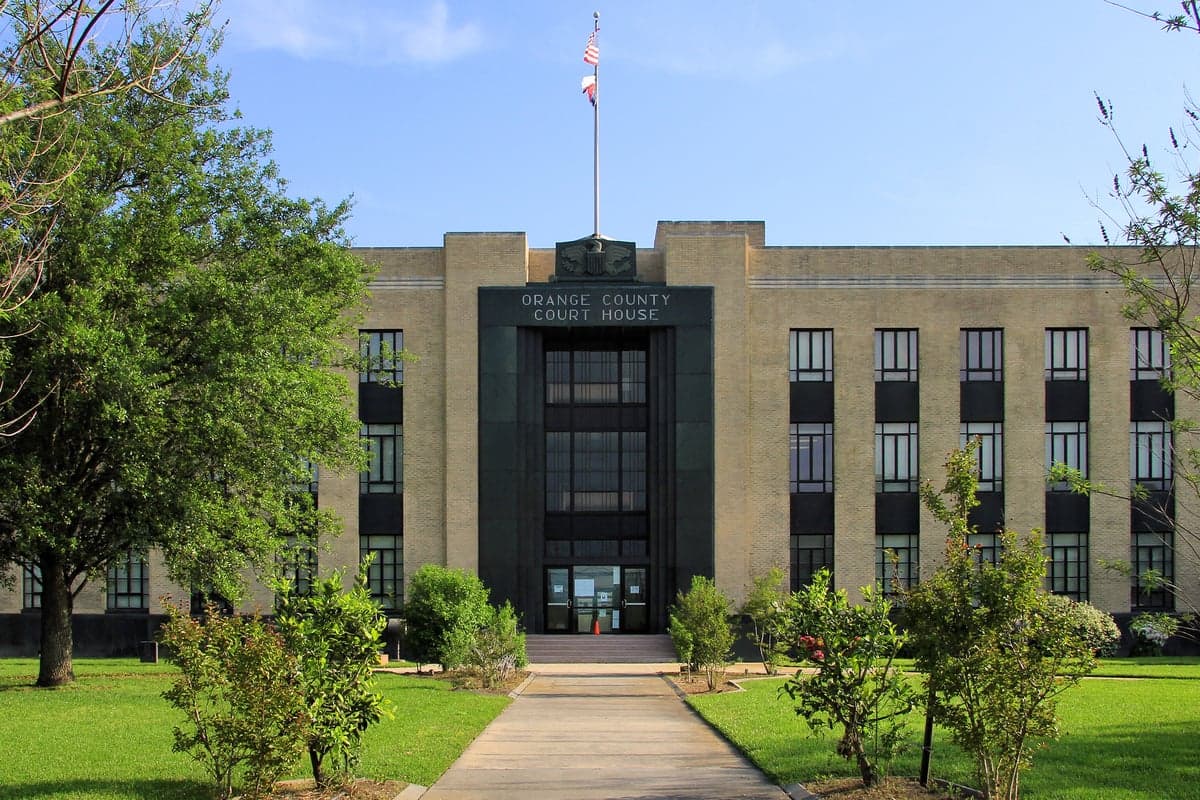
Photo: Wikipedia
Political ClimatePolitical Climate in Orange County
Showing district-level results — no local-only data available.
Local Political AnalysisPolitical Analysis of Orange County
Orange County, Texas, is one of the most reliably Republican strongholds in the entire state, carrying a Cook Partisan Voting Index (PVI) of R+17. That’s a full 13 points more conservative than Texas as a whole, which sits at R+4. This isn’t a recent shift — the county has been voting red for generations, and the margins have only widened in the last two cycles. In 2024, Donald Trump won Orange County with over 78% of the vote, a number that would have been unthinkable even in neighboring Jefferson County. The political DNA here is deeply tied to the petrochemical industry, the Piney Woods culture, and a strong sense of local independence that predates the modern partisan divide.
How it compares
Compared to Texas at large, Orange County is a political outlier. While the state has been trending purple — especially in the suburban rings of Dallas, Houston, and San Antonio — Orange County has moved in the opposite direction. The county’s R+17 PVI is closer to the Texas Panhandle than to the Gulf Coast. Inside the county, the political geography is surprisingly varied. Bridge City and West Orange are the deepest red, routinely delivering 80-85% of the vote to Republican candidates. Vidor is similarly conservative, though its precincts show slightly more variation in down-ballot races. The city of Orange itself is the only place where Democrats can be competitive. Precincts around the downtown core and near Lamar State College Orange occasionally break 40% for Democratic candidates, though they still lose the city overall by double digits. Pinehurst and Mauriceville are swing-adjacent — they vote red, but with softer margins, often in the high 60s rather than the 80s. There are no blue precincts in Orange County, but the city of Orange is where the political conversation is least one-sided.
What this means for residents
For conservative residents, Orange County is about as comfortable as it gets. Local elected offices — from the county judge to the school board — are held by Republicans, and policy debates tend to center on tax rates, infrastructure, and coastal management rather than culture war flashpoints. For liberal residents, the reality is more isolating. There is no organized Democratic Party infrastructure in the county, and progressive candidates rarely file to run. That said, the city of Orange provides a relative haven. The presence of the college and a small but active arts community means that left-leaning residents can find like-minded people, even if they have no electoral power. What this means in practice is that political disagreement here is personal, not institutional. You don’t see the kind of performative partisan conflict you might in a swing county — instead, politics is something people mostly keep to themselves outside of election season.
Culturally, Orange County stands apart from the rest of Texas in a few notable ways. The county’s proximity to Louisiana gives it a distinct Cajun-Creole influence that you won’t find in most of the state. Crawfish boils, zydeco music, and a slower pace of life are the norm. Policy-wise, the county has been aggressive in opposing state-level environmental regulations on the petrochemical industry, which is the economic backbone of the region. There is also a strong strain of libertarian thinking here — residents tend to support the Second Amendment and low taxes with an intensity that goes beyond typical Texas conservatism. If you’re moving to Orange County, the political climate is straightforward: it’s deeply red, it’s getting redder, and the only real variation is how loudly people express it. For conservatives, that’s a feature. For liberals, it’s a fact of life that requires a thick skin and a willingness to engage on personal terms rather than political ones.

State Political ClimatePolitical Climate in Texas
State Political AnalysisPolitical Environment in the State
Texas has been a reliably Republican state for the past three decades, with a Cook Partisan Voting Index of R+4, but that label masks a dramatic and ongoing transformation. The state’s dominant coalition has historically been built on rural and suburban conservatives, but explosive growth in the major metros — especially Houston, Dallas-Fort Worth, San Antonio, and Austin — has been steadily shifting the ground beneath that coalition. Over the last 10 to 20 years, the statewide Republican advantage has narrowed from double-digit margins to single-digit ones, and in 2024, Donald Trump won Texas by roughly 9 points, down from 11 points in 2020 and 16 points in 2012. The story of Texas politics today is a tug-of-war between a deeply entrenched conservative state government and a rapidly diversifying, urbanizing electorate that is pulling the state closer to purple with every census cycle.
Urban vs. rural divide
The political map of Texas is a study in stark contrasts. The state’s four largest metro areas — Houston (Harris County), Dallas-Fort Worth (Dallas and Tarrant Counties), San Antonio (Bexar County), and Austin (Travis County) — are all Democratic strongholds. Harris County, the third-most populous county in the nation, has voted blue in every presidential election since 2008, and Travis County routinely delivers margins of 70% or more for Democratic candidates. Meanwhile, rural West Texas, the Panhandle, and much of East Texas vote Republican by similarly lopsided margins. The real battleground has been the fast-growing suburban and exurban counties that ring these metros. Collin County (north of Dallas) and Denton County (northwest of Dallas) were reliably red for decades, but both have shifted significantly leftward in recent cycles, with Collin County voting for Trump by only 8 points in 2024 after giving him 18 points in 2016. Similarly, Fort Bend County (southwest of Houston) flipped from red to blue in 2018 and has stayed there. The cities of El Paso and Laredo, both heavily Hispanic and Democratic, anchor the border region, while Lubbock and Midland-Odessa remain deeply conservative oil-patch strongholds. The divide isn’t just urban versus rural — it’s also generational, with younger voters in suburbs like Frisco and Round Rock trending blue even as their older neighbors stay red.
Policy environment
Texas has no state income tax, which is the single most powerful policy lever attracting relocators from high-tax states like California and New York. The trade-off is relatively high property taxes — averaging around 1.6% of assessed value — and a reliance on sales tax and local fees. The regulatory posture is famously business-friendly: Texas is a right-to-work state, meaning union membership is optional and union power is limited, and there is no state-level occupational licensing for many trades. On education, the state funds public schools through a complex Robin Hood system that redistributes property tax revenue from wealthier districts to poorer ones, but per-pupil spending remains below the national average. School choice is a live issue: the 2023 legislative session saw a major push for education savings accounts (vouchers), which passed the Senate but stalled in the House. On healthcare, Texas has not expanded Medicaid under the Affordable Care Act, leaving roughly 1.5 million low-income adults in the coverage gap. Election laws have been tightened: Senate Bill 1 (2021) added ID requirements for mail-in ballots, limited drive-through and 24-hour voting, and gave partisan poll watchers more access. The state also has some of the nation’s strictest abortion laws, with a near-total ban (trigger law) in effect since the Dobbs decision, and no exceptions for rape or incest.
Recent policy direction
The 2023 and 2025 legislative sessions have pushed Texas decisively in a conservative direction across multiple fronts. On gun rights, Texas became a permitless carry state in 2021 (HB 1927), allowing most adults to carry a handgun without a license or training. On parental and education rights, the 2023 session passed HB 900, which restricts what sexually explicit content can be in school libraries, and expanded the state’s ban on certain medical treatments for transgender minors (SB 14). On speech and privacy, the state passed a law (HB 20) in 2023 that prohibits social media platforms from moderating content based on viewpoint — though it has been tied up in court. On medical and bodily autonomy, the near-total abortion ban has no exceptions for rape or incest, and the state has also restricted gender-affirming care for minors. Property rights remain strong: Texas has no state-level zoning in many cities (Houston famously has none), and eminent domain protections were strengthened in 2023. On taxation, there have been modest property tax relief measures, including a 2023 law that increased the homestead exemption and compressed school tax rates. Voting access remains a flashpoint: in addition to SB 1, the 2025 session is expected to consider further restrictions on ballot harvesting and voter registration drives. On immigration, Governor Greg Abbott’s Operation Lone Star has deployed state troopers and National Guard to the border, and the state has bused thousands of migrants to Democratic-led cities like New York and Chicago, a policy that has drawn both praise and legal challenges.
Civil unrest & political movements
Texas has seen its share of political flashpoints in recent years. The 2020 George Floyd protests in Austin, Dallas, and Houston were large and occasionally violent, leading to property damage and a lasting debate over police funding and reform. On the right, the “constitutional sheriff” movement has gained traction in rural counties, with some sheriffs refusing to enforce certain state or federal gun laws. Immigration politics are the most visible daily flashpoint: border communities like El Paso and Brownsville have seen periodic surges in migrant crossings, while Abbott’s busing program has kept the issue in national headlines. Secession rhetoric, often called “Texit,” has been a recurring fringe movement, with the Texas Nationalist Movement pushing for a referendum on independence, but it has never gained mainstream political traction — a 2023 poll found only about 20% of Texans support it. Election integrity controversies have been persistent: after the 2020 election, some Republican county officials called for audits, and the 2022 primary saw a few county-level election officials resign amid harassment. A new resident in a blue city like Austin will see progressive activism on housing, climate, and police reform, while a resident in a red suburb like Keller or a rural county like Gillespie will see conservative activism focused on school boards, library content, and property rights. The state’s political culture is loud, engaged, and polarized, but it rarely spills into the kind of sustained civil unrest seen in some other states.
Projection
Over the next 5 to 10 years, Texas is likely to continue its slow drift toward competitiveness, but it will not flip blue overnight. The key demographic drivers are clear: the state is adding roughly 1,000 new residents per day, most of them moving to the urban and suburban counties that lean Democratic. The Hispanic population, which makes up about 40% of the state, is growing and becoming more politically engaged, though it is not monolithic — Hispanic voters in the Rio Grande Valley have shown some movement toward Republicans in recent cycles. If current trends hold, Texas could be a true swing state by the early 2030s, with presidential margins in the low single digits. However, the state’s Republican-controlled legislature is likely to continue drawing congressional and state legislative maps that protect incumbents, and the state’s voter ID and mail-in ballot restrictions may dampen Democratic turnout. A relocator moving to Texas now should expect a decade of intense political competition, with the state government remaining conservative but the electorate becoming more divided. The practical implication is that local politics will matter more than ever: a move to a blue city like Austin or a red suburb like Southlake will feel like living in two different political universes, even though they share the same state laws.
For a new resident, the bottom line is that Texas offers a low-tax, business-friendly environment with strong property rights and a conservative state government that is actively shaping policy on abortion, guns, education, and immigration. If you lean conservative, you will find a state government that largely reflects your values, especially on fiscal and cultural issues. If you lean liberal, you will find vibrant blue cities and suburbs where your vote counts and where local governments often push back against state policy, but you will also face state-level laws that limit your options on healthcare, voting, and education. The state’s political trajectory is toward greater competition, but for now, Texas remains a place where your experience of politics depends heavily on where you choose to live within its borders.
* Values derived from national, state, county, city and local statistics and may differ in a specific area. Last updated: 2026-08-08T13:20:18.000Z
Narrative content on this page is AI-generated and may contain mistakes. Verify any details that matter before acting on them.
ReloMaps may earn a commission from affiliate links at no extra cost to you.

