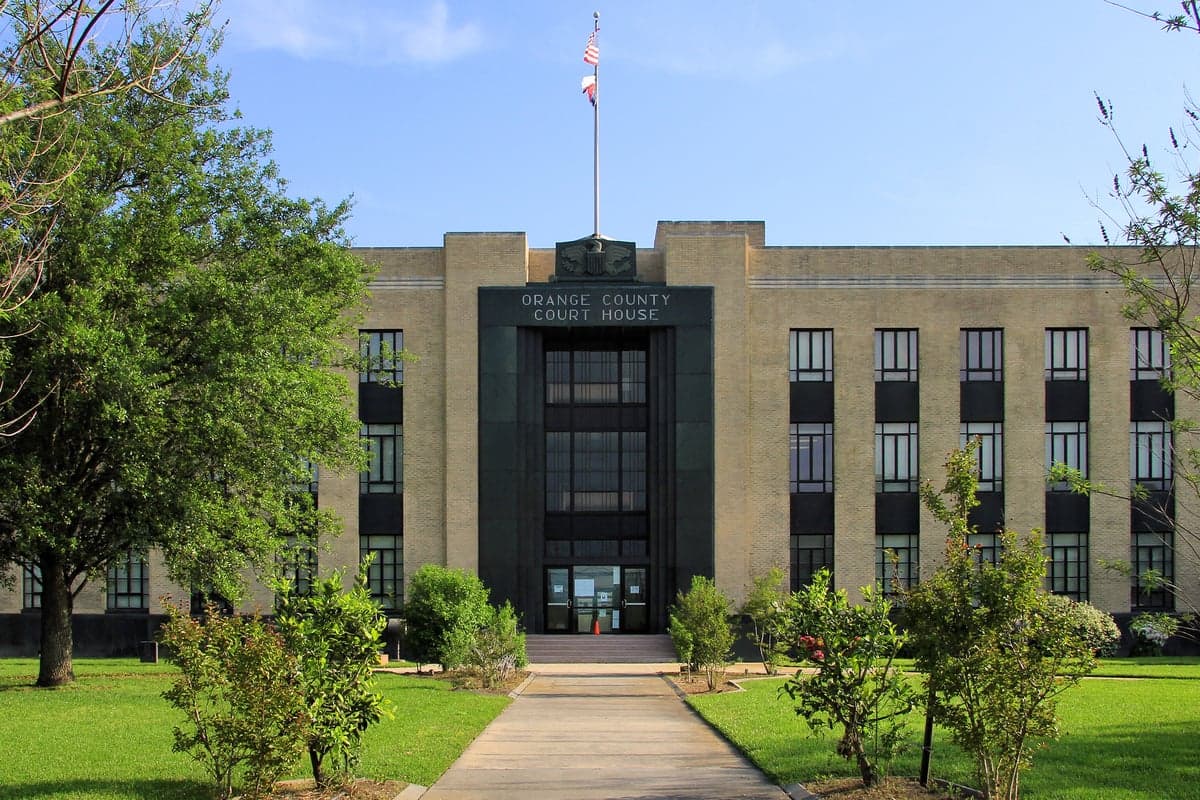
Photo: Wikipedia
Demographics of Orange County
Affluence Level in Orange County
A below-average socioeconomic profile. Incomes, home values, and educational attainment trail the U.S., with higher poverty and unemployment.
People of Orange County
Orange County, Texas, is home to 84,993 residents who form one of the most culturally and ethnically homogeneous populations in the Houston–Beaumont corridor. With a foreign-born share of just 1.8% and a population that is 77.9% white, 9.1% Hispanic, and 8.4% Black, the county retains a distinctly Southern, working-class character rooted in its history as a timber, oil, and petrochemical hub. Its people are defined by deep family ties, a strong sense of local identity, and a pace of life that feels more like the rural Deep South than the fast-growing suburbs of nearby Houston.
Settlement & growth (pre-1960)
Long before European settlers arrived, the area now known as Orange County was inhabited by the Atakapa people, a Gulf Coast tribe whose territory stretched from present-day western Louisiana into Southeast Texas. The Atakapa lived along the Sabine River and its tributaries, relying on fishing, hunting, and gathering in the region's dense piney woods and bayous. European contact, beginning with Spanish explorers in the 16th century and later French traders from Louisiana, brought disease and displacement, and by the early 1800s, the Atakapa population had been decimated.
Anglo-American settlement began in earnest after the Louisiana Purchase and the establishment of the Mexican state of Coahuila y Tejas. The first permanent Anglo settlers arrived in the 1820s and 1830s, primarily from the Lower South — Georgia, Alabama, Mississippi, and Tennessee — drawn by cheap land grants under the Mexican colonization laws and later the Republic of Texas. These early settlers were largely Scots-Irish and English yeoman farmers who established small homesteads along the Sabine River and the banks of Cow Bayou. The town of Orange, originally called Madison, was founded in 1836 and became the county seat in 1852. Its location on the Sabine River made it a natural port for shipping timber and agricultural goods.
The timber industry drove the county's first major economic boom in the late 19th century. The virgin pine forests of Southeast Texas attracted lumber companies from the Northeast and Midwest, and by the 1880s, Orange was a bustling sawmill town. The arrival of the railroad in the 1870s connected Orange County to national markets, and the population grew steadily. Small communities like Bridge City, West Orange, and Pinehurst emerged as mill towns and farming hamlets. The county's population, which had been just 2,938 in 1860, reached 17,912 by 1900.
The discovery of oil at Spindletop in 1901 transformed the region's economy and demographics. Orange County was not a major oil-producing area itself, but its location on the Sabine River and the Gulf Intracoastal Waterway made it an ideal site for refining and petrochemical manufacturing. During World War I and especially World War II, the federal government invested heavily in shipbuilding and synthetic rubber plants in Orange. The Consolidated Steel Corporation shipyard in Orange employed thousands of workers during the war, drawing migrants from across Texas, Louisiana, Arkansas, and Oklahoma. Many of these workers were white Southerners from rural areas — the "Okies" and "Arkies" of the Dust Bowl and Great Depression era — who settled in Orange and the surrounding communities. The county's population surged from 40,567 in 1940 to 60,567 in 1950.
African Americans have been present in Orange County since the era of slavery, when the region's plantation economy relied on enslaved labor to produce cotton and timber. After emancipation, freedmen established small communities, including the Little Cypress area and parts of Orange's south side. The Great Migration saw many Black residents leave for industrial jobs in Houston, Dallas, and the West Coast, but a significant community remained, centered on churches, schools, and fraternal organizations. By 1960, Black residents made up roughly 18% of the county's population, a share that has since declined.
Modern era (post-1965)
The 1965 Hart-Cellar Act, which abolished national-origin quotas and opened immigration from Asia, Africa, and Latin America, had a minimal direct impact on Orange County. The county's foreign-born population remains exceptionally low at 1.8%, compared to 17% nationally and 34% in Harris County (Houston). The small immigrant community is primarily Hispanic (9.1% of the total population) and East/Southeast Asian (0.7%), with a negligible Indian-subcontinent population (0.1%). Most of these residents are concentrated in Orange and Bridge City, where they work in the petrochemical industry, healthcare, and service jobs.
The dominant demographic story of the post-1965 era in Orange County is not immigration but domestic migration and suburbanization. The expansion of the petrochemical industry along the Sabine River — including major facilities operated by DuPont, Chevron Phillips Chemical, and Firestone Polymers — created a stable, well-paying blue-collar job base that attracted workers from across Texas and Louisiana. The construction of Interstate 10 in the 1960s and 1970s made Orange County more accessible to Beaumont and Houston, and bedroom communities like Vidor (in neighboring Orange County) and Mauriceville grew as commuter towns.
Suburbanization reshaped the county's settlement patterns. The population of Orange proper has remained relatively flat since 1970, while unincorporated areas and smaller towns have absorbed most new growth. Bridge City, incorporated in 1970, grew from a few hundred residents to over 8,000 by 2020. The county's racial composition has shifted gradually: the white share has declined from over 85% in 1980 to 77.9% today, while the Hispanic share has risen from 3% to 9.1%. The Black share has fallen from 18% in 1960 to 8.4%, reflecting both outmigration and a lower birth rate relative to the white and Hispanic populations.
Hurricanes have also shaped the modern population. Hurricane Rita in 2005 and Hurricane Ike in 2008 caused widespread damage, particularly in low-lying areas along the Sabine River and the Gulf Coast. Some residents left permanently, while others rebuilt with federal assistance. The storms reinforced the county's reputation as a place of resilience and mutual aid, but they also highlighted the vulnerability of its aging housing stock and infrastructure.
The future
Orange County is projected to grow slowly over the next two decades, with the population likely reaching 90,000–95,000 by 2040. The county is becoming slightly more diverse, driven by Hispanic in-migration from South Texas and Mexico, as well as a small but growing East/Southeast Asian population employed in the petrochemical and healthcare sectors. However, the county will remain overwhelmingly white and native-born, with a foreign-born share that is unlikely to exceed 3–4%.
The most significant demographic trend is the aging of the population. The median age in Orange County is 39.5, slightly above the national average, and the share of residents over 65 is growing as younger adults leave for college and jobs in Houston, Dallas, and Austin. The county's low college attainment rate (17.8%) limits its ability to attract knowledge-economy employers, and the economy will continue to depend on the petrochemical industry, healthcare, and small businesses. New residential development is concentrated in the I-10 corridor between Orange and Bridge City, as well as in the Mauriceville area, where larger lots and lower property taxes appeal to families and retirees.
Culturally, Orange County is likely to remain a conservative, churchgoing, family-oriented community. The political and social values of its residents are deeply rooted in the Scots-Irish and Southern heritage of its founding settlers, and the county has voted Republican by wide margins in every presidential election since 2000. The small but growing Hispanic population is largely assimilated into this cultural mainstream, and there is little evidence of the ethnic enclaves or linguistic separation seen in larger Texas cities.
For someone moving to Orange County today, the area offers affordable housing, low crime relative to urban centers, and a strong sense of community. The trade-offs are limited economic diversity, a modest cultural and dining scene, and a climate that includes the risk of hurricanes and flooding. The county is not becoming a cosmopolitan suburb or a diverse melting pot; it is becoming a slightly more varied version of what it has always been — a place where family, faith, and hard work are the enduring values, and where the people are shaped as much by the Sabine River and the piney woods as by any outside influence.

* Values derived from national, state, county, city and local statistics and may differ in a specific area. Last updated: 2026-08-08T13:20:18.000Z
Narrative content on this page is AI-generated and may contain mistakes. Verify any details that matter before acting on them.
ReloMaps may earn a commission from affiliate links at no extra cost to you.

