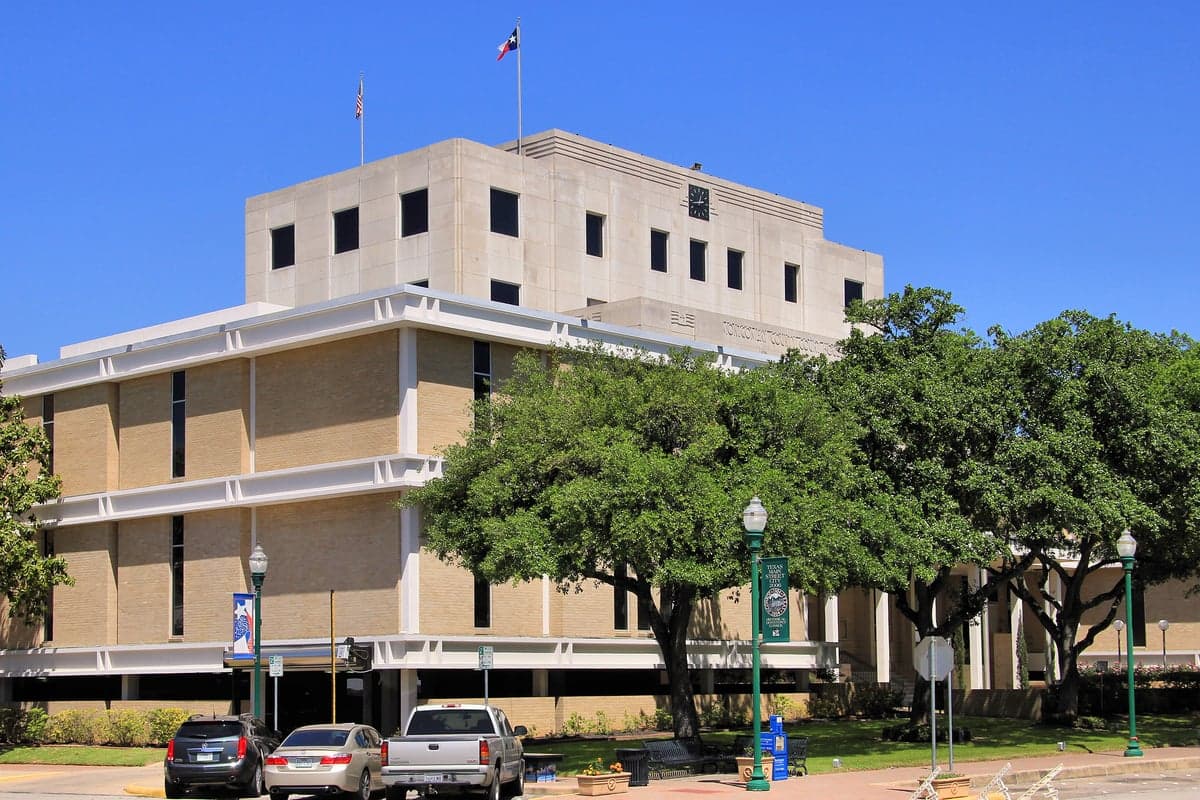
Photo: Wikipedia
Political ClimatePolitical Climate in Montgomery County
Showing district-level results — no local-only data available.
Local Political AnalysisPolitical Analysis of Montgomery County
Montgomery County is one of the most reliably Republican counties in Texas, with a Cook Partisan Voting Index of R+16 — a full 12 points redder than the state's R+4 average. That gap isn't just statistical; it shapes everything from local elections to development debates. If you've been around here long enough, you've watched Conroe and Magnolia stay deep red for decades, while The Woodlands has gradually become the county's most politically mixed area. A handful of precincts around the Woodlands Township and along the Research Forest corridor now lean blue or are true swing precincts, especially in presidential years. But outside those pockets, the county tilts hard right, and the trajectory is actually getting redder: as rural areas north of Conroe and around Lake Conroe grow, they pull the county further from the statewide purple trend.
How it compares
The difference between Montgomery County and Texas as a whole is stark. Texas overall has been flirting with swing-state status — Trump won it by 9 points in 2016, then by 6 in 2020, and by 14 in 2024 (a temporary red shift). Meanwhile, Montgomery County gave Trump margins of 30+ points each time. In the 2024 election, 73% of Montgomery County voters chose Trump, compared to 56% statewide. That means the average resident here lives in a political bubble that's far more conservative than the state's diverse urban and suburban mix. The county's Republican primary is often the real election; Democratic candidates rarely exceed 35% countywide, except in The Woodlands where they can hit mid-40s. For perspective, compare that to Harris County next door, where Democrats regularly win — the contrast is day and night.
What this means for residents
For conservative residents, Montgomery County feels like home: local officials, school boards, and county commissioners are almost uniformly Republican, and policy aligns with small-government, pro-growth views. Property taxes are a perennial issue, but the local GOP machine keeps spending in check. For liberal residents, it's a different reality — you learn which precincts to vote in for a closer race, and local activism often focuses on minority representation in Conroe ISD or The Woodlands Township board. There's a small but active Democratic group, especially around Oak Ridge North and Shenandoah, but they're fighting uphill. In practice, the political lean means county-wide ballot measures and bond elections often reflect conservative priorities: fewer new social programs, more road bonds, and tight budgets for arts and transit. The swing precincts in The Woodlands occasionally flip local races, but that's the exception, not the rule.
Culturally, Montgomery County wears its conservatism on its sleeve — you'll see more gun racks than hybrid cars, and church attendance is high. But there are policy distinctions within the county: The Woodlands imposes stricter development regulations and has a higher property tax rate for its municipal utility district services, while unincorporated areas near Magnolia resist zoning altogether. School board races in Conroe ISD have become flashpoints for curriculum and library book debates, mirroring national culture wars. If you're moving here, understand that local governance is fragmented — your experience in a master-planned community like The Woodlands will differ sharply from life in a rural subdivision west of Willis. The red lean is consistent, but the intensity of local policy fights varies block by block.

State Political ClimatePolitical Climate in Texas
State Political AnalysisPolitical Environment in the State
Texas has been a reliably Republican state for the past three decades, but the nature of that dominance is shifting. The state’s Cook Partisan Voting Index of R+4 reflects a solid, but not overwhelming, GOP lean, and the 10-to-20-year trajectory shows a slow but steady tightening. In 2020, Donald Trump won Texas by 5.6 points, down from 9 points in 2016 and 16 points in 2012, driven by explosive growth in the Democratic-leaning suburbs of Houston, Dallas, and Austin, even as rural and exurban areas become more deeply Republican. The result is a state that still elects a Republican governor and legislature, but where statewide races are becoming genuinely competitive, and where the political conversation is increasingly defined by the tension between a fast-growing, diverse urban core and a deeply conservative rural and small-town base.
Urban vs. rural divide
The political map of Texas is a study in stark contrasts. The major metros — Houston, Dallas-Fort Worth, Austin, San Antonio, and El Paso — are the engine of Democratic votes. Harris County (Houston) alone delivered a net 200,000-vote margin for Biden in 2020, while Dallas and Travis County (Austin) added another 300,000 combined. But the suburbs are where the real action is. Collin County, north of Dallas, was once a GOP stronghold; it voted for Trump by only 3 points in 2020, down from 18 points in 2012. Similarly, Fort Bend County, southwest of Houston, flipped to Biden in 2020 and has not looked back. Meanwhile, the vast rural stretches — the Panhandle around Lubbock, the Piney Woods of East Texas, and the Hill Country west of Austin — vote 70-80% Republican. The result is a state where the political center of gravity is slowly moving toward the urban and suburban corridors, but where the legislature is still drawn by a Republican majority that has successfully gerrymandered to preserve its power.
Policy environment
Texas’s policy environment is defined by a low-tax, low-regulation posture that appeals strongly to conservative relocators. There is no state income tax, which is the single biggest draw for high-earning individuals and families. Property taxes are high — averaging about 1.6% of assessed value — to compensate, but the overall tax burden is among the lowest in the country. The state’s regulatory posture is famously business-friendly, with minimal zoning in many areas and a right-to-work law that limits union power. On education, Texas has a robust school choice system, including charter schools and a new Education Savings Account program passed in 2023 that allows parents to use state funds for private school tuition. Healthcare policy is more limited: the state has not expanded Medicaid under the Affordable Care Act, leaving roughly 1.5 million uninsured residents, but private insurance markets are relatively competitive. Election laws have been tightened, with the 2021 Senate Bill 1 restricting mail-in voting, adding ID requirements, and limiting drive-through and 24-hour voting options — a move that critics say suppresses turnout but that supporters argue ensures ballot integrity.
Recent policy direction
The last three legislative sessions have pushed Texas decisively to the right on a broad range of issues that relocators care about. On gun rights, Texas became a permitless carry state in 2021, allowing anyone 21 or older who can legally possess a firearm to carry it in public without a license or training. On parental and education rights, the 2023 session passed a ban on diversity, equity, and inclusion programs at public universities and restricted how teachers can discuss race and gender in the classroom. Speech and privacy issues have been a flashpoint: the state passed a law in 2023 requiring age verification for adult websites, and it has aggressively sued the Biden administration over border enforcement, asserting state sovereignty. Medical and bodily autonomy is sharply divided: Texas has one of the most restrictive abortion bans in the country (SB 8, the “heartbeat bill,” and a near-total ban after 2021), but it has also expanded telemedicine and direct primary care options. Property rights are strong, with no state-level rent control and a homestead exemption that protects primary residences from forced sale. On voting and ballot access, the 2021 law tightened rules, but early voting hours remain generous, and voter turnout in 2024 was the highest in decades.
Civil unrest & political movements
Texas has seen its share of political flashpoints. The 2020 protests in Austin over police brutality were among the largest in the country, leading to a city council defunding of the police that was later partially reversed. Immigration politics are a constant, visible issue, especially along the border in El Paso and the Rio Grande Valley, where the state has bused migrants to northern cities and installed razor wire along the river. The “Operation Lone Star” border initiative, launched by Governor Greg Abbott in 2021, has deployed thousands of National Guard troops and state troopers, leading to legal battles with the Biden administration. Secession rhetoric, while not mainstream, has a vocal fringe: the “Texit” movement gained some traction after the 2020 election, with a few county Republican parties passing resolutions in favor of exploring independence. Election integrity controversies have been a persistent undercurrent, with the 2020 and 2022 cycles seeing lawsuits over ballot drop boxes and voter roll maintenance. A new resident in a blue city like Austin or Dallas will see occasional protests and political signage, but in most of the state, daily life is calm and politically unremarkable.
Projection
Over the next 5-10 years, Texas is likely to become more competitive at the statewide level, but not necessarily more liberal. The in-migration pattern — roughly 1,000 new residents per day — is split between conservative-leaning families from California and blue states seeking lower taxes and more freedom, and younger, more diverse workers moving to Austin, Dallas, and Houston for tech and energy jobs. The net effect is a state that is becoming more polarized internally, with the urban cores getting bluer and the exurbs getting redder. The legislature will remain Republican for the foreseeable future due to gerrymandering, but the margin will shrink. A new resident moving in now should expect a state that continues to champion low taxes and gun rights, but where the culture wars over education, abortion, and immigration will intensify. The practical takeaway: if you are conservative, you will find a state that largely aligns with your values and is fighting to preserve them. If you are liberal, you will find vibrant, like-minded communities in the cities, but you will live under a state government that is actively working against many of your policy preferences.
For a relocator, the bottom line is that Texas offers a political environment that is stable, predictable, and deeply conservative at the state level, but with significant local variation. Your experience will depend heavily on where you land: Lubbock and Amarillo feel like deep-red country; Austin and El Paso feel like blue islands; and the suburbs of Dallas and Houston are the true battlegrounds where the state’s future is being decided. If you value low taxes, gun rights, and a hands-off government, Texas will feel like home. If you prioritize progressive social policies and strong public services, you will need to choose your city carefully and accept that state-level politics will often be at odds with your views.
* Values derived from national, state, county, city and local statistics and may differ in a specific area. Last updated: 2026-06-17T03:45:16.000Z
Narrative content on this page is AI-generated and may contain mistakes. Verify any details that matter before acting on them.
ReloMaps may earn a commission from affiliate links at no extra cost to you.

