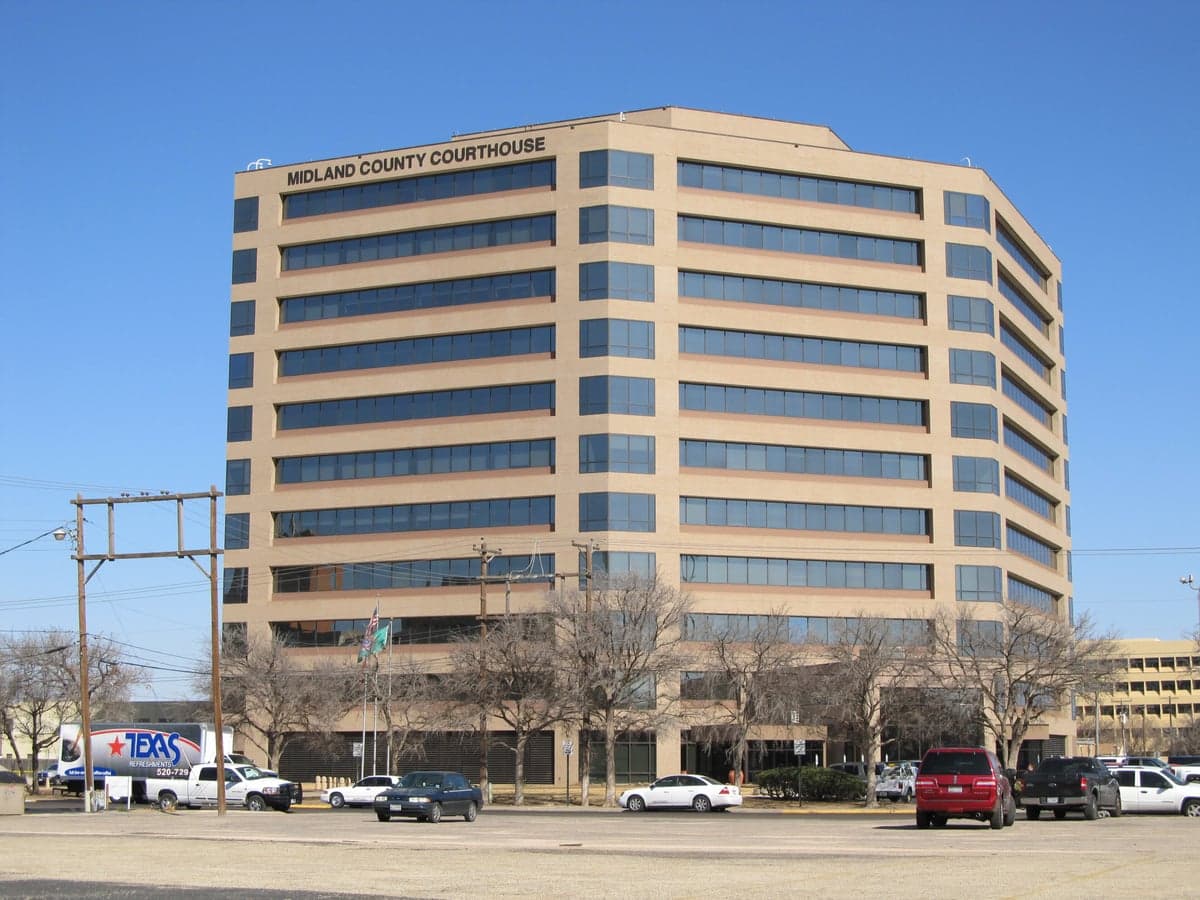
Photo: Wikipedia
Political ClimatePolitical Climate in Midland County
Showing district-level results — no local-only data available.
Local Political AnalysisPolitical Analysis of Midland County
Midland County is one of the most reliably Republican counties in Texas, with a Cook Partisan Voting Index (PVI) of R+22 — a full 18 points more conservative than the state’s overall R+4 rating. That gap has actually widened over the past decade as the Permian Basin oil boom brought in a wave of workers and wealth that reinforced the area’s pro-business, low-regulation ethos. While Texas as a whole has inched toward competitiveness in presidential races, Midland County has moved in the opposite direction, with Republican candidates routinely clearing 75-80% of the vote in countywide races. The county seat, Midland, dominates the population and sets the political tone, but there are subtle variations across the county worth understanding.
How it compares
Statewide, Texas is a solidly Republican state that has shown signs of shifting — Democrats have made gains in the suburbs of Houston, Dallas, and Austin, and the R+4 PVI reflects that tightening. Midland County, by contrast, is a deep-red stronghold where Democratic candidates rarely break 25% in general elections. The city of Midland itself is overwhelmingly conservative, but there are pockets of variation. The downtown and historic neighborhoods near the Midland College campus tend to be slightly more moderate, with a handful of precincts that occasionally vote 35-40% Democratic, driven by younger professionals and a small academic community. The western edge of the county, toward the New Mexico border, is sparsely populated and even more conservative, with precincts that regularly hit 85-90% Republican. The town of Greenwood, a small unincorporated community east of Midland, leans heavily red as well, reflecting the rural ranching and oil-field culture. There are no significant blue-leaning towns in Midland County — the closest thing to a swing area is the southern part of the city near the airport, where a mix of oil-field workers and service-industry employees creates a slightly more competitive environment, though still safely Republican.
What this means for residents
For conservative residents, Midland County’s political climate means their values are reflected in nearly every level of local government — from the school board to the county commissioners to the state legislature. Taxes are low, regulations are minimal, and the oil and gas industry operates with strong community support. For liberal or moderate residents, the reality is more isolating. There is no organized Democratic Party infrastructure to speak of, and progressive candidates rarely appear on the ballot outside of presidential primaries. Socially conservative policies dominate — the county has been a battleground over library book content and transgender athlete participation in school sports, with conservative majorities consistently prevailing. That said, the high cost of living — driven by the oil economy — means that even many conservative residents feel squeezed, and there is occasional cross-party frustration over housing affordability and infrastructure strain. The political monoculture can feel stifling to newcomers, but it also creates a predictable, stable environment for those who align with the majority.
Culturally, Midland County stands apart from the rest of Texas in its unapologetic embrace of the oil industry as the center of civic life. While cities like Austin and Houston have diversified their economies and politics, Midland remains a single-industry town where the boom-and-bust cycle shapes everything from school enrollment to church attendance. The county’s politics are not just Republican — they are oil-and-gas Republican, with a focus on deregulation, mineral rights, and energy independence that goes beyond the typical conservative platform. This creates a distinct local identity: residents are proud of the area’s role in powering the country, and that pride translates into a political culture that is resistant to change, even as the rest of Texas evolves around it. For anyone moving here, understanding that the local politics are not just an echo of the state’s but a more intense version of it is key to navigating daily life.

State Political ClimatePolitical Climate in Texas
State Political AnalysisPolitical Environment in the State
Texas has been a reliably Republican state for decades, with a Cook Partisan Voting Index of R+4, but the last 10-20 years have seen a slow, steady shift toward competitiveness. The dominant coalition remains conservative, anchored by rural and suburban voters, but explosive growth in the Dallas-Fort Worth metroplex, Houston, and especially Austin has injected a strong Democratic counterweight. In 2020, Donald Trump won Texas by 5.6 points, down from 9 points in 2016 and 16 points in 2012, and in 2024 he carried it by roughly 4.5 points — the narrowest margin for a Republican since 1996. The state is still red, but the shade is fading, and the political reality for a new resident is that you’ll find deep red counties, deep blue cities, and a growing number of purple suburbs where every election is a fight.
Urban vs. rural divide
The political map of Texas is a story of two worlds. Rural West Texas, the Panhandle, and most of East Texas are solidly Republican — think Lubbock, Amarillo, and Tyler, where counties routinely vote 70-80% Republican. The big metros are the Democratic engine: Harris County (Houston) went for Biden by 13 points in 2020, Dallas County by 16, Travis County (Austin) by 44, and El Paso County by 37. The real action is in the suburbs and exurbs. Collin County (north of Dallas) was once a GOP stronghold but has shifted from +32 R in 2012 to +14 R in 2024. Tarrant County (Fort Worth) flipped from red to blue in 2020 and stayed blue in 2024. Bexar County (San Antonio) is now reliably Democratic. The fastest-growing counties — like Comal (New Braunfels), Hays (south of Austin), and Montgomery (north of Houston) — are trending purple, with young families and out-of-state transplants diluting the old Republican base. If you’re moving to Texas, your political experience will depend heavily on whether you land in a dense urban core, a sprawling suburb, or a small town.
Policy environment
Texas’s policy environment is defined by low taxes, light regulation, and a strong tilt toward individual liberty in some areas and government intervention in others. There is no state income tax — the state relies on property taxes and sales taxes, which are among the highest in the country when combined (average effective property tax rate around 1.6%, sales tax up to 8.25% in some cities). The regulatory posture is famously business-friendly: no state-level minimum wage above the federal $7.25, no state-level paid family leave, and a right-to-work law that limits union power. Education policy is a battleground: the state funds public schools through a complex Robin Hood system that redistributes property tax revenue from wealthy districts to poor ones, and in 2023 the legislature passed a school voucher-like program (HB 3) that lets families use public money for private school expenses. Healthcare is a mixed bag: Texas has the highest uninsured rate in the nation (around 17%), and the state has refused to expand Medicaid under the Affordable Care Act. Election laws have tightened: SB 1 (2021) restricted mail-in voting, added ID requirements, and banned 24-hour and drive-through voting. For a conservative relocator, the tax and regulatory environment is a major draw; for a liberal one, the lack of a safety net and restrictive voting laws are significant drawbacks.
Recent policy direction
The last five years have seen Texas move decisively in a conservative direction on several fronts, while also carving out some surprising libertarian space. On gun rights, Texas became a constitutional carry state in 2021 (HB 1927), allowing permitless carry of handguns for anyone 21 or older who can legally possess a firearm. On parental and education rights, the 2023 session passed HB 900, which restricts sexually explicit content in school libraries, and SB 17, which banned diversity, equity, and inclusion offices at public universities. On speech, the state passed HB 20 in 2021, which prohibits social media platforms from moderating content based on viewpoint — a law currently tied up in court. On privacy and surveillance, Texas has been aggressive in suing the Biden administration over border security, and in 2023 passed SB 4, which makes illegal entry into Texas a state crime, though it’s also blocked in court. On medical and bodily autonomy, Texas has one of the strictest abortion bans in the nation (SB 8, 2021, and the trigger law that took effect in 2022), with no exceptions for rape or incest. On property rights, the state has strong eminent domain protections and no state-level rent control. On taxation, the 2023 legislature passed a $18 billion property tax cut (Proposition 4), which was approved by voters. On voting, SB 1 (2021) made Texas one of the more restrictive states for ballot access. The overall direction is toward more individual liberty on guns and speech, more government intervention on abortion and education, and a hardline stance on immigration enforcement.
Civil unrest & political movements
Texas has a long history of political activism on both sides, and recent years have been no exception. The 2020 Black Lives Matter protests in Austin, Houston, and Dallas were among the largest in the country, with Austin alone seeing over 100 consecutive nights of demonstrations. On the right, the “Trump Train” convoys and counter-protests were a regular feature in 2020-2021, particularly in rural areas and along the I-35 corridor. Immigration politics are a constant flashpoint: the border city of El Paso has seen periodic migrant surges, and Governor Greg Abbott’s Operation Lone Star (2021-present) has deployed state troopers and National Guard to the border, bused migrants to Democratic-led cities, and installed razor wire and buoys in the Rio Grande. The “sanctuary city” debate is active — Texas passed SB 4 in 2017, which banned sanctuary policies and allowed law enforcement to inquire about immigration status, and it remains in effect. Secession rhetoric is mostly fringe, but the Texas Nationalist Movement has a small but vocal following; a 2022 Texas GOP platform plank called for a referendum on secession, though it has no real political traction. Election integrity controversies flared after 2020, with some Republican county officials calling for audits, but no widespread fraud was found. A new resident will notice the political polarization most visibly in yard signs, bumper stickers, and the occasional protest, but daily life is generally peaceful — the flashpoints are concentrated in Austin and along the border.
Projection
Over the next 5-10 years, Texas is likely to continue its slow shift toward purple, driven by demographic change and in-migration. The state is adding about 1,000 new residents a day, and a significant share come from blue states like California and New York. These newcomers tend to be younger, more diverse, and more moderate or liberal, especially in the suburbs of Dallas, Houston, and Austin. The Hispanic population, which makes up about 40% of the state, is not monolithic — it leans Democratic but has been trending slightly right in recent cycles, particularly among working-class men in the Rio Grande Valley. The rural vote will remain deeply Republican, but its share of the total vote is shrinking. By 2030, Texas could be a true swing state, with presidential margins in the 1-3 point range. For a new resident, this means the political environment will become more contested, with more competitive races, more campaign spending, and more policy volatility. The state’s conservative policy direction may moderate slightly if Democrats gain ground in the legislature, but the structural advantages of gerrymandered districts and low turnout in Democratic-leaning areas mean a full flip is unlikely before 2032 at the earliest.
For a new resident, the bottom line is that Texas offers a low-tax, business-friendly environment with strong protections for gun rights and a hardline stance on immigration, but also high property taxes, limited public services, and a deeply polarized political culture. If you’re conservative, you’ll find a state that largely aligns with your values, especially outside the major cities. If you’re liberal, you’ll find vibrant blue cities and a growing political movement, but you’ll also face restrictive abortion laws, limited healthcare access, and a state government that is actively hostile to many of your priorities. The key is to choose your location carefully — your experience in Austin will be radically different from your experience in Lubbock or Tyler. Texas is not a monolith, and the political climate you encounter will depend almost entirely on which Texas you choose to live in.
* Values derived from national, state, county, city and local statistics and may differ in a specific area. Last updated: 2026-07-05T22:49:16.000Z
Narrative content on this page is AI-generated and may contain mistakes. Verify any details that matter before acting on them.
ReloMaps may earn a commission from affiliate links at no extra cost to you.

