
Photo: Wikipedia
Political ClimatePolitical Climate in Kleberg County
Showing district-level results — no local-only data available.
Local Political AnalysisPolitical Analysis of Kleberg County
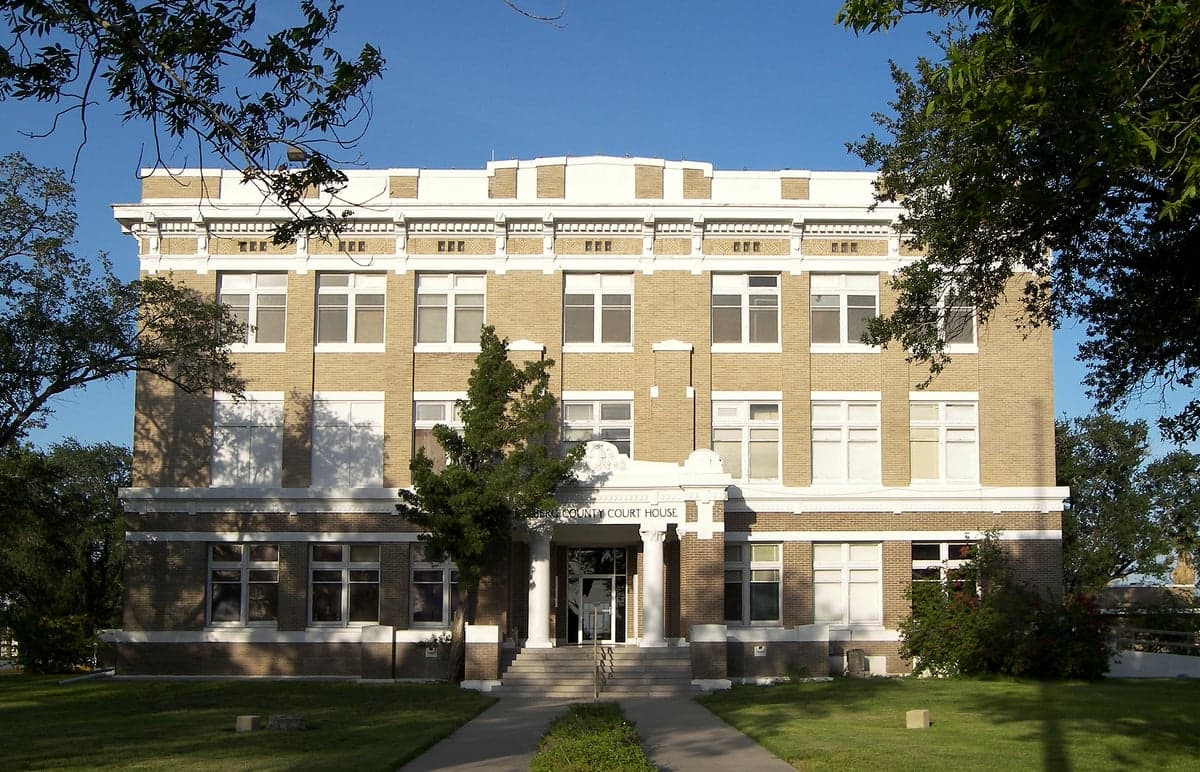
Kleberg County is a true political bellwether in Texas, with a Cook Partisan Voting Index of EVEN, meaning it votes almost exactly in line with the national average. This makes it one of the few counties in the state that doesn't lean decisively Republican, standing in stark contrast to Texas's overall R+4 rating. The county has shifted rightward in recent cycles—Donald Trump won it by 4 points in 2024 after it went for Biden by 0.2 points in 2020—but it remains a genuine swing county where both parties compete seriously.
How it compares
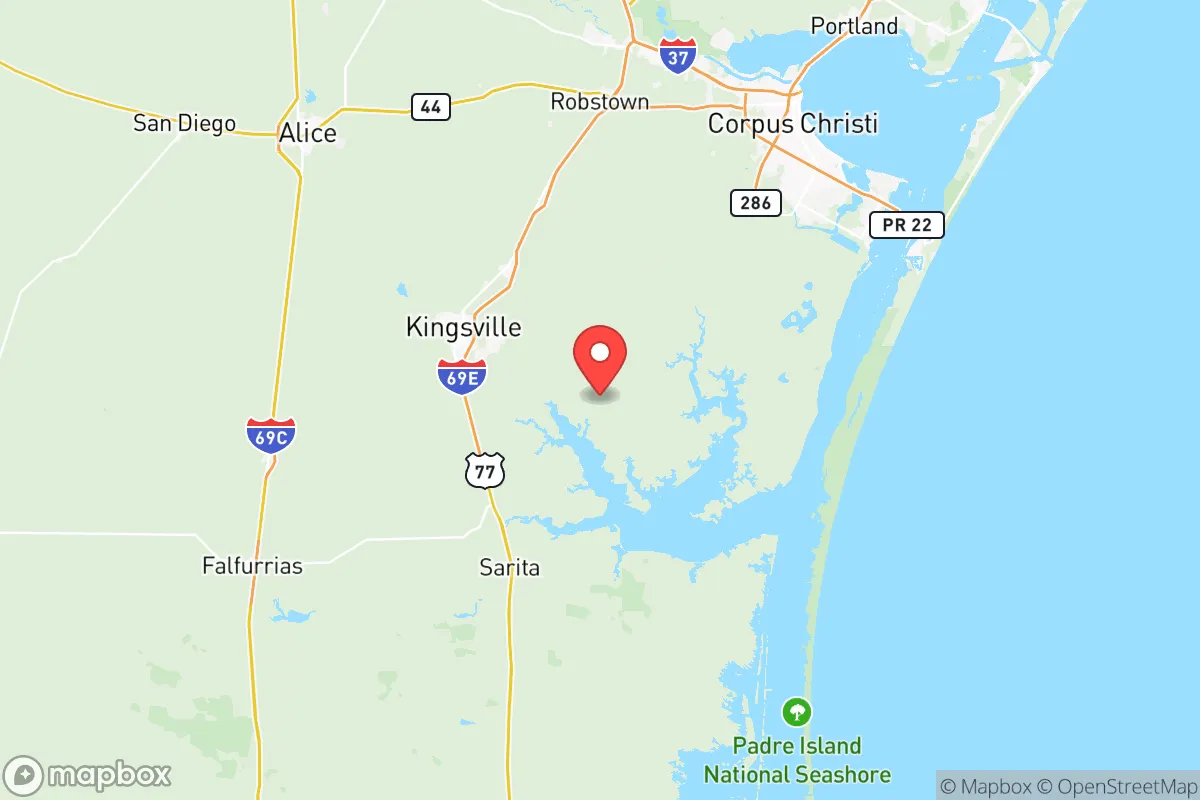
Kleberg County's EVEN rating is a political outlier in Texas, where the vast majority of counties are R+10 or deeper. The county's politics are shaped by its unique demographics: a heavily Hispanic population (over 70%), a large student body at Texas A&M University-Kingsville, and a rural-agricultural base. The city of Kingsville, the county seat, is the political battleground. Precincts around the university and the historic downtown lean blue, often voting 55-60% Democratic, while the outlying rural precincts—especially around Ricardo and the ranchlands east of Highway 77—vote 65-70% Republican. The swing precincts are the newer subdivisions on the north side of Kingsville, where working-class Hispanic families and young professionals mix; these areas have trended red since 2016 but remain competitive. By contrast, Texas as a whole is a solidly Republican state at the presidential level, though its major metros (Harris, Dallas, Travis, Bexar counties) are deep blue. Kleberg County's EVEN rating means it's a microcosm of the national mood, not the state's.
What this means for residents
For conservative residents, Kleberg County offers a more competitive environment than deep-red rural Texas. You can't take a win for granted here—local GOP candidates have to work for every vote, especially in Kingsville's city council races. The county commission is currently split 3-2 Republican, but that majority is fragile. For liberal residents, the county is one of the few places in South Texas outside the Rio Grande Valley where a Democrat can realistically win a local office. The county Democratic Party is active and well-organized, particularly around voter registration drives at the university. However, both sides agree on some things: the county is reliably pro-oil and gas (the Eagle Ford Shale is a major employer) and generally skeptical of state-level property tax reform, which many locals fear would cut school funding. The practical effect of the EVEN rating is that national issues—abortion, immigration, the economy—dominate local conversations more than in deep-red counties, because every election feels winnable for both sides.
Culturally, Kleberg County is distinct from much of Texas. The county's strong Mexican-American heritage means that local politics often center on bilingual services, immigration enforcement's impact on families, and the preservation of historic ranching traditions. The annual Kingsville Western Days festival and the presence of the King Ranch (one of the largest ranches in the world) reinforce a conservative, land-owning ethos, but the university brings a younger, more progressive energy. Policy-wise, the county has been slower than the state to adopt restrictive voting laws—early voting hours are generous, and mail-in ballot access is relatively easy. The county also maintains a higher minimum wage for county employees than the state's $7.25 floor, a small but telling sign of its moderate streak. For anyone moving here, the key takeaway is that Kleberg County is a place where your vote genuinely matters, and where the national political divide plays out in real time, block by block, precinct by precinct.

State Political ClimatePolitical Climate in Texas
State Political AnalysisPolitical Environment in the State
Texas is a solidly Republican state with a Cook PVI of R+4, but that label masks a far more complex reality than it did a decade ago. The dominant coalition is a mix of suburban conservatives, rural voters, and business interests, but the state is being reshaped by explosive growth in its major metros, which has turned the once-reliable GOP stronghold into a competitive battleground over the last 20 years. While Republicans still control every statewide office and both legislative chambers, the margin of victory has shrunk from double digits in 2012 to a 5.5-point win for Donald Trump in 2024, and Democrats have flipped several suburban state House seats in the Dallas-Fort Worth and Houston areas.
Urban vs. rural divide
The political map of Texas is a story of three distinct regions. The big urban cores—Houston, Dallas, Austin, San Antonio, and El Paso—are solidly Democratic, with Harris County (Houston) and Dallas County delivering margins of 55-60% for Democrats in recent cycles. The suburbs that ring these cities, places like Collin County (north of Dallas) and Fort Bend County (southwest of Houston), have been the real battleground. Collin County, once a GOP stronghold, voted for Trump by only 3 points in 2024, down from a 20-point margin in 2016. Meanwhile, rural West Texas, the Panhandle, and East Texas remain deeply Republican—Lubbock County gave Trump 70% of the vote, and Midland-Odessa is even more lopsided. The Rio Grande Valley, historically Democratic, has shifted right, with Hidalgo County (McAllen) flipping to Trump in 2024 after backing Biden by 17 points in 2020. This urban-rural split means that a resident of Austin lives in a very different political world than someone in Abilene, even though they share the same state government.
Policy environment
Texas’s policy environment is defined by a low-tax, low-regulation posture that appeals to conservatives and businesses. There is no state income tax, and property taxes are high (averaging 1.6% of home value) to compensate, though the state offers a homestead exemption and a 10% cap on appraisal increases for homeowners. The regulatory climate is business-friendly, with no state-level minimum wage above the federal $7.25 and a right-to-work law that limits union power. On education, the state funds public schools through a complex Robin Hood system that redistributes property tax revenue from wealthy districts to poor ones, and it has expanded school choice through Education Savings Accounts (ESAs) for special-needs students, with a broader voucher bill debated in 2025. Healthcare policy is conservative: Texas did not expand Medicaid under the ACA, leaving roughly 1.5 million uninsured residents, and abortion is banned from conception with narrow exceptions. Election laws have tightened since 2021, with SB 1 requiring photo ID for mail-in ballots, limiting drop boxes, and banning drive-through voting. The state also has a permitless carry law for handguns (HB 1927, 2021) and a "stand your ground" self-defense statute.
Recent policy direction
The last five years have seen Texas move decisively to the right on several fronts, even as the electorate has grown more diverse. On gun and self-defense law, the 2021 permitless carry law (HB 1927) allows any adult who can legally own a firearm to carry it openly or concealed without a license. Parental and education rights have been a flashpoint: the 2023 "Parental Bill of Rights" (SB 1515) requires school districts to notify parents of any curriculum changes involving sexuality or gender identity, and the state banned diversity, equity, and inclusion (DEI) offices at public universities (SB 17, 2023). On speech and privacy, a 2023 law (HB 20) prohibits social media platforms from moderating content based on viewpoint, though it has been challenged in court. Medical and bodily autonomy is sharply restricted: abortion is illegal, and the state has a bounty-hunter-style enforcement mechanism (SB 8, 2021) that allows private citizens to sue anyone who performs or aids an abortion. Property rights are strong, with no state-level rent control and a 2023 law (HB 2127) that preempts local ordinances on issues like paid sick leave and short-term rentals. Taxation remains low, but the 2023 property tax cut (SB 2) provided $18 billion in relief by raising the homestead exemption and compressing school tax rates. Voting and ballot access has tightened: SB 1 (2021) added ID requirements for mail ballots, banned 24-hour and drive-through voting, and gave partisan poll watchers more access. The overall direction is toward a more assertive state government that preempts local control, particularly on social issues.
Civil unrest & political movements
Texas has seen significant political activism from both sides. The 2020 George Floyd protests in Houston, Austin, and Dallas were among the largest in the country, with Austin seeing nightly demonstrations for weeks. The 2021 abortion ban (SB 8) sparked ongoing protests at the state capitol and outside clinics, though enforcement has largely shut down legal abortion access. On the right, the "constitutional carry" movement successfully pushed permitless carry, and the "school choice" coalition has been a major force in the legislature, though a 2023 voucher bill failed due to rural Republican opposition. Immigration politics are a constant flashpoint: Governor Abbott’s Operation Lone Star has deployed state troopers and National Guard to the border, bused migrants to New York, Chicago, and Denver, and installed razor wire along the Rio Grande, leading to legal battles with the Biden administration. Secession rhetoric, while fringe, has been amplified by the Texas Nationalist Movement, though no serious legislative effort exists. Election integrity controversies have been persistent: the 2020 election saw Trump win Texas by 5.5 points, but his claims of fraud led to a 2021 audit of four counties (Harris, Dallas, Tarrant, Collin) that found no evidence of widespread fraud. A new resident will notice the political polarization in everyday life—yard signs, bumper stickers, and local news coverage that is sharply divided between conservative and liberal outlets.
Projection
Over the next 5-10 years, Texas is likely to become more competitive at the statewide level, but not necessarily Democratic. The state is growing by about 1,000 people per day, with most new arrivals moving to the suburbs of Dallas-Fort Worth, Houston, and Austin. These newcomers are a mix of out-of-state conservatives fleeing blue states and younger, more diverse voters who lean Democratic. The result is a slow shift toward purple: the Cook PVI could move from R+4 to R+2 or even a toss-up by 2032 if current trends hold. However, the state’s political geography makes it hard for Democrats to win statewide—they need to run up huge margins in Houston, Dallas, Austin, and San Antonio while cutting losses in the suburbs and rural areas. The 2024 results showed that Trump gained ground with Hispanic voters in the Rio Grande Valley and with working-class voters in East Texas, offsetting Democratic gains in the suburbs. For a new resident, this means that the political climate will remain conservative at the state level for the foreseeable future, but local control will vary dramatically—a move to Austin means living in a deep-blue city with progressive policies on housing and policing, while a move to Katy (a Houston suburb) means a more moderate, swing-voter environment. The biggest wildcard is the state’s growing Hispanic electorate, which is not monolithic and could shift the balance if Republicans continue to make inroads.
For a new resident, the bottom line is that Texas offers a low-tax, business-friendly environment with strong property rights and gun laws, but it also has a deeply polarized political culture that plays out in local elections, school board meetings, and daily life. If you’re conservative, you’ll find a state government that largely aligns with your values, though you may need to navigate local blue pockets in the big cities. If you’re liberal, you’ll find vibrant communities in the urban cores and some suburbs, but you’ll face state-level policies on abortion, voting, and education that are sharply at odds with your views. The key is to choose your specific city or town carefully—the political reality of Plano is very different from that of Lubbock, even though both are in the same state. Texas is not a monolith, and its political future is being written by the people moving in right now.
* Values derived from national, state, county, city and local statistics and may differ in a specific area. Last updated: 2026-07-27T12:31:22.000Z
Narrative content on this page is AI-generated and may contain mistakes. Verify any details that matter before acting on them.
ReloMaps may earn a commission from affiliate links at no extra cost to you.

