

Photo: Wikipedia
Demographics of Kleberg County
Affluence Level in Kleberg County
A below-average socioeconomic profile. Incomes, home values, and educational attainment trail the U.S., with higher poverty and unemployment.
People of Kleberg County
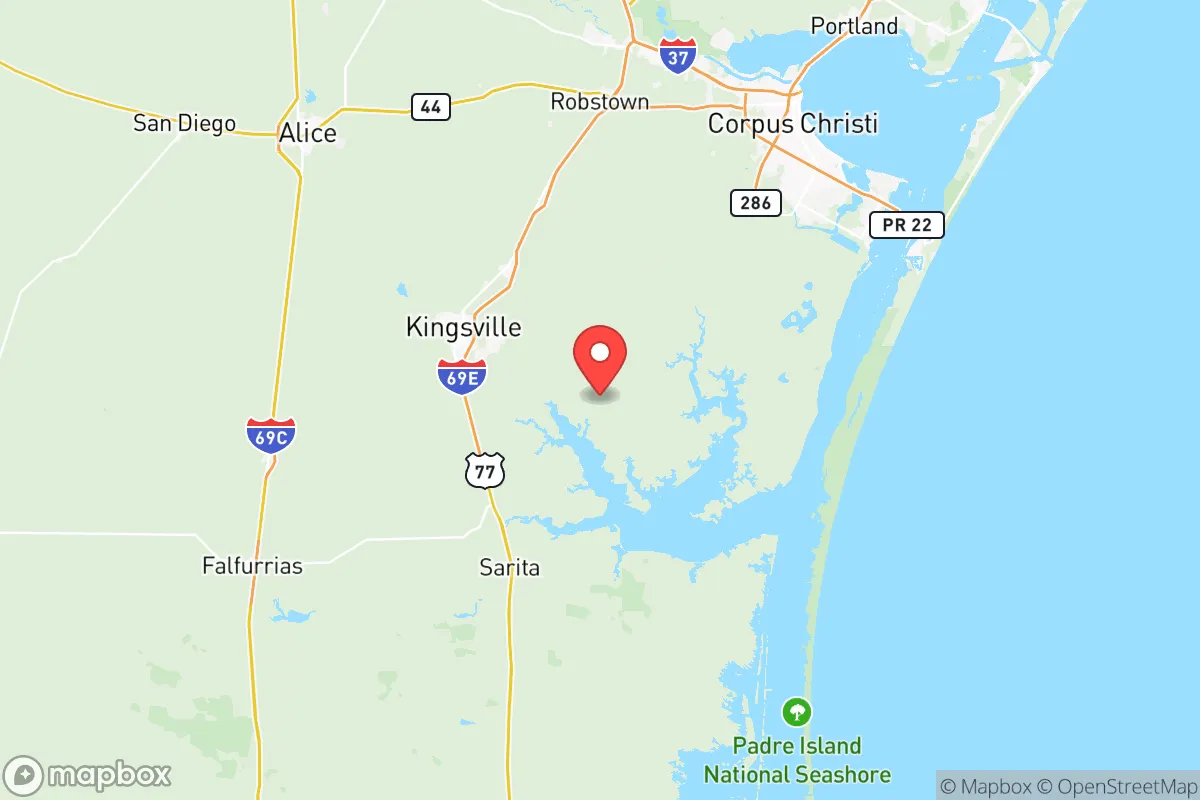
Kleberg County, Texas, is home to roughly 30,600 residents, a population that is overwhelmingly Hispanic (71.3%) and young, with a median age well below the national average. The county’s identity is deeply rooted in the ranching and agricultural heritage of the South Texas brush country, centered on the county seat of Kingsville and the smaller communities of Ricardo and Riviera. This is a place where the legacy of the King Ranch—a vast 825,000-acre operation—still shapes the local economy, culture, and social fabric, creating a distinctive blend of Tejano, Anglo, and ranching traditions that sets it apart from the more suburbanized counties to the north.
Settlement & growth (pre-1960)
Long before European contact, the area that is now Kleberg County was home to nomadic bands of the Coahuiltecan peoples, who lived along the creeks and resacas of the Nueces River basin. Spanish explorers and missionaries passed through as early as the 16th century, but the region remained sparsely populated frontier land under Spanish and later Mexican rule. The first significant non-Native settlement came in the mid-18th century with the establishment of Spanish land grants, though these were vast, unfenced tracts used for cattle grazing rather than towns.
The true founding of Kleberg County’s population began after the Texas Revolution and the U.S.-Mexican War. In the 1850s, Anglo-American ranchers, many of them from the southern United States, began moving into the area, drawn by the promise of cheap, open range for cattle. The pivotal event was the arrival of Captain Richard King in 1853, who established the King Ranch along the Santa Gertrudis Creek. King brought in Mexican vaqueros—skilled horsemen and cattle handlers—who became the backbone of the ranch’s labor force. These vaqueros, many of whom settled with their families in what is now Kingsville, form the direct ancestral line of a large portion of the county’s current Hispanic population.
The county was officially formed in 1913 from parts of Nueces County, named after Robert J. Kleberg, a King Ranch manager. The founding of Kingsville in 1904 as a railroad town and the county seat spurred a new wave of settlement. The St. Louis, Brownsville and Mexico Railway brought Anglo merchants, railroad workers, and professionals, while the King Ranch continued to attract Mexican and Mexican-American laborers. Small farming communities like Ricardo and Riviera grew up along the rail line, settled by Anglo farmers and Hispanic sharecroppers who grew cotton and grain. By 1930, the county’s population had reached roughly 15,000, with a roughly equal split between Anglo and Hispanic residents, though segregation was the norm in housing and schools.
World War II brought the establishment of the Naval Air Station Kingsville in 1942, which drew military personnel and civilian workers from across the country. This base, still active today, injected a small but steady stream of Anglo and Black families into the area, though the county’s rural character remained dominant. The post-war period saw the mechanization of ranching and farming, which reduced the need for farm labor and led to some out-migration of Hispanic families to larger cities. By 1960, the population had grown to about 23,000, with Kingsville as the clear urban center and the King Ranch still the dominant employer and landowner.
Modern era (post-1965)
The 1965 Hart-Cellar Act had a relatively muted direct effect on Kleberg County compared to major urban centers, as the area did not attract large numbers of new international immigrants. The foreign-born population today stands at just 3.6%, well below the national average. However, the act’s broader impact on Texas—fueling rapid growth in Houston, Dallas, and the Rio Grande Valley—indirectly reshaped Kleberg County through domestic migration patterns.
The most significant demographic shift since 1965 has been the steady increase in the Hispanic share of the population, driven by higher birth rates among established Mexican-American families and continued migration from the Rio Grande Valley and northern Mexico. In 1970, the county was roughly 50% Hispanic; by 2020, that figure had risen to over 70%. This growth has been concentrated in Kingsville, where neighborhoods like the Bishop Addition and Santa Gertrudis areas are now predominantly Hispanic, and in the unincorporated colonias around Ricardo and Riviera, where newer, lower-income Hispanic families have settled in search of affordable housing.
The Anglo population, which once made up nearly half the county, has declined to about 21% today. This is partly due to out-migration of younger Anglos to larger cities for education and employment, and partly because the aging Anglo cohort has not been replaced by new arrivals. The Black population remains small at 3.2%, concentrated among military families stationed at the Naval Air Station and a few long-established families in Kingsville. East and Southeast Asian communities (0.9%) and Indian-subcontinent residents (0.4%) are tiny, mostly affiliated with Texas A&M University-Kingsville or the naval base. The college-educated share of the population is 23.7%, reflecting the presence of the university but also the limited professional job market outside of education and government.
Suburbanization has been minimal. Kingsville itself has grown outward with new subdivisions like El Tesoro and Rancho Vista, but these remain modest in scale. The county has not experienced the explosive suburban growth seen in counties closer to Corpus Christi or San Antonio, largely due to its distance from major metro areas and the dominance of the King Ranch, which holds vast tracts of undeveloped land.
The future
Kleberg County’s population is projected to remain stable or grow slowly over the next 10-20 years, with the Hispanic share continuing to rise toward 80% or more. The county’s age structure—younger than the state average—means natural increase (births minus deaths) will drive growth, even as net migration remains modest. The Anglo population will likely continue its gradual decline, while the Black and Asian communities may see slight increases if the naval base and university expand their recruitment efforts.
New residential development is likely to concentrate in Kingsville’s expanding subdivisions and along the Highway 77 corridor, where land is cheaper than in Corpus Christi. The county’s cultural identity will remain anchored in the King Ranch legacy and Tejano traditions, but with a growing influence from the university and the military base, which bring in outsiders from across the country. The political character, already conservative but with a strong Democratic Hispanic vote, may shift slightly toward the center as younger, more diverse voters become a larger share of the electorate.
For someone moving in now, Kleberg County offers a stable, family-oriented community with a strong sense of place, affordable housing, and a slower pace of life. The trade-offs are a limited job market outside of agriculture, education, and government, and a population that is becoming more homogeneous in ethnic terms even as it remains culturally rich. It is not a place of rapid change or explosive growth, but rather a deeply rooted South Texas community where the past—the ranches, the railroads, the vaqueros—still shapes the present.

* Values derived from national, state, county, city and local statistics and may differ in a specific area. Last updated: 2026-07-27T12:31:22.000Z
Narrative content on this page is AI-generated and may contain mistakes. Verify any details that matter before acting on them.
ReloMaps may earn a commission from affiliate links at no extra cost to you.

