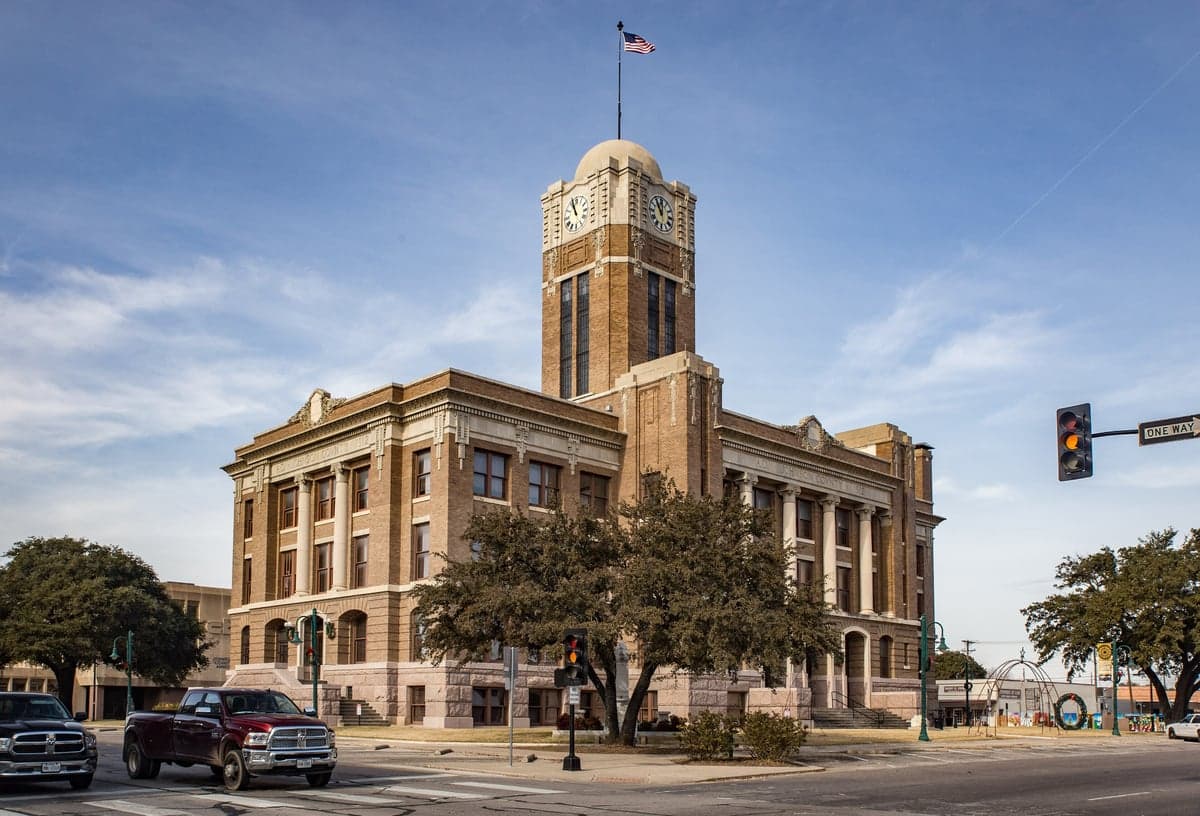
Photo: Wikipedia
Political ClimatePolitical Climate in Johnson County
Showing state-level results — no local-only data available.
Local Political AnalysisPolitical Analysis of Johnson County
Johnson County is about as solidly conservative as they come in Texas, with a Cook PVI of R+18 that puts it deep in the red column. That’s a full 14 points more Republican than the state as a whole, which sits at R+4, and it’s not just a statistic—it’s how people live their lives here. The county has been trending even redder over the last decade as folks from more progressive areas move in looking for a place where government stays out of their business, not the other way around. You can feel it in the local elections, where school board and county commissioner races are won on promises of lower taxes and less regulation, not on expanding programs or social engineering.
How it compares
Compared to Texas as a whole, Johnson County is a fortress of traditional values. While the state’s R+4 rating reflects a more mixed electorate—especially in fast-growing urban hubs like Austin and Houston—Johnson County’s R+18 means there’s no real competition for conservative candidates in most races. The real story is the variation within the county itself. Towns like Cleburne, the county seat, and Burleson are reliably red, with precincts routinely voting 70-80% Republican. But you’ll find a few pockets of blue in Alvarado and parts of Joshua, where some newer subdivisions have brought in folks from Dallas or Tarrant County who carry more progressive ideas. Those areas are still small, though—maybe 10-15% of the vote—and they haven’t shifted the overall direction. The swing precincts are mostly in the rural stretches between Grandview and Venus, where independent ranchers and farmers vote their conscience but still lean heavily conservative on issues like gun rights and property taxes.
What this means for residents
For anyone living here, the political climate means you can expect a government that stays out of your personal life. There’s no push for mask mandates, no talk of defunding the sheriff’s office, and no tolerance for zoning laws that tell you what you can do with your own land. The county commission and school boards are filled with folks who believe in low taxes and local control, which is a breath of fresh air if you’ve dealt with the overreach in places like Austin or Dallas. That said, the growth is bringing pressure. Some of the newer subdivisions near Burleson and Cleburne are attracting families who want the same conservative values but also demand better infrastructure—roads, water, internet—without the government sticking its nose in. It’s a balancing act, and so far, the county has held the line.
Cultural and policy distinctions
What really sets Johnson County apart from the rest of Texas is the cultural resistance to progressive trends. You won’t find a city council here debating critical race theory or pushing for sanctuary city policies. The local sheriff’s office cooperates fully with ICE, and the county has a strong Second Amendment culture—open carry is common, and no one bats an eye. The biggest policy fights are over property taxes and school funding, not social issues. Looking ahead, the concern is that as more people move in from blue areas, they’ll bring their voting habits with them. If the county’s R+18 starts slipping toward R+10 or R+5 in the next decade, that’s a warning sign that the freedom-loving character of Johnson County could be diluted. For now, though, it’s still a place where you can live your life without the government breathing down your neck, and that’s worth holding onto.

State Political ClimatePolitical Climate in Texas
State Political AnalysisPolitical Environment in the State
Texas is a solidly Republican state with a Cook PVI of R+4, but that number barely scratches the surface of a deeply complex political landscape. Over the past 20 years, the state has shifted from a near-unanimous GOP stronghold to a battleground where surging urban growth in places like Austin, Dallas, and Houston is slowly chipping away at the Republican advantage, while exurban and rural counties have hardened their conservative resolve. The dominant coalition remains a mix of suburban conservatives, rural ranchers, and energy-sector professionals, but the margin of victory has narrowed from double digits in 2012 to single digits in recent cycles, making Texas the most watched state in national politics.
Urban vs. rural divide
The political map of Texas is a story of two worlds. The major metros—Harris County (Houston), Dallas County, Travis County (Austin), and Bexar County (San Antonio)—have become Democratic strongholds, with Travis County voting over 70% for Biden in 2020. These urban cores are driven by a mix of young professionals, minority voters, and transplants from blue states, and they’ve flipped several state legislative seats in the last decade. Meanwhile, the rural and exurban counties—places like Collin County (north of Dallas), Montgomery County (north of Houston), and the entire Panhandle around Lubbock and Amarillo—vote Republican by 60-80% margins. The real story is the suburbs: Fort Bend County, once reliably red, has trended purple as its diverse population grows, while Denton County remains a GOP stronghold but with shrinking margins. The divide isn’t just about geography; it’s about culture, with rural Texans feeling increasingly alienated from the policies of the urban cores.
Policy environment
Texas’s policy environment is a textbook example of limited-government conservatism, though recent years have seen some concerning cracks. The state has no personal income tax, a cap on property tax growth (Proposition 4, 2023), and a regulatory climate that attracts businesses—Texas added over 400,000 new residents in 2023 alone. Education policy is a mixed bag: school choice legislation has stalled in the House, but the state has expanded charter schools and passed a parental rights bill (HB 900) requiring age-appropriate content in school libraries. Healthcare remains a flashpoint—Texas refused Medicaid expansion under Obamacare, but the state has the highest uninsured rate in the nation (over 18%), a fact that frustrates both sides. Election laws tightened after 2020 with SB 1, which banned 24-hour and drive-through voting, added ID requirements for mail ballots, and empowered poll watchers. For a conservative, the policy environment is largely favorable, but the growing urban population is pushing for more progressive taxation and spending.
Trajectory & freedom
On balance, Texas is becoming more free in some areas and less in others, and the trend is worth watching. The state expanded gun rights with permitless carry (HB 1927, 2021), allowing adults to carry handguns without a license—a clear win for personal liberty. Parental rights were strengthened with the passage of the “Save Women’s Sports Act” (SB 15, 2023) and the ban on gender transition procedures for minors (SB 14, 2023), which many conservatives see as protecting children from medical overreach. Property rights got a boost with the elimination of the “death tax” (estate tax) at the state level and the passage of a constitutional amendment (Prop 2, 2023) to fund school safety without raising property taxes. However, the state has also seen a troubling expansion of government power: the 2021 abortion ban (SB 8) created a private enforcement mechanism that some civil libertarians—even on the right—found chilling. And the state’s aggressive use of the “abortion travel ban” (SB 4, 2023) to restrict out-of-state travel for procedures has raised eyebrows among those who value medical autonomy. The trajectory is toward more cultural conservatism, but the mechanism is often more government control, not less.
Civil unrest & political movements
Texas has seen its share of political flashpoints, and a new resident should be aware of the tensions. The 2020 Black Lives Matter protests in Austin were among the largest in the country, leading to the city council cutting police funding by $150 million—a move that was later partially reversed after a spike in violent crime. On the right, the “Texas Nationalist Movement” (Texit) has gained some traction, with a 2022 poll showing 18% of Texans supporting secession, though it remains a fringe idea. Immigration politics are a constant: Governor Abbott’s Operation Lone Star has deployed state troopers and National Guard to the border, bused migrants to sanctuary cities like New York and Chicago, and passed SB 4 (2023) making illegal entry a state crime. This has created a visible law enforcement presence in border towns like El Paso and Brownsville, and has sparked legal battles with the Biden administration. Election integrity remains a hot-button issue—the 2022 primary saw record turnout, but accusations of fraud in Harris County (where a judge ordered a recount in a judicial race) keep the issue alive. For a new resident, the most visible sign of political tension is the constant presence of campaign signs, the heated local news coverage, and the occasional protest at the state capitol.
Projection
Over the next 5-10 years, Texas is likely to become more competitive but not necessarily more liberal. The in-migration of 1,000+ people per day—many from California, New York, and Illinois—is slowly shifting the electorate, but these newcomers are often conservative-leaning themselves, fleeing high taxes and crime. The suburbs of Dallas-Fort Worth and Houston will be the battlegrounds: places like Collin County and Montgomery County are growing fast but staying red, while Fort Bend and Williamson County (north of Austin) are trending purple. The GOP will likely hold the state legislature through redistricting, but the governor’s race in 2026 could be competitive if a moderate Democrat emerges. The biggest wildcard is the Hispanic vote—Texas’s Hispanic population is growing, but it’s not monolithic; many are socially conservative and economically moderate. If the GOP can hold its margins with this group, Texas stays red. If not, the state could flip by 2032. For a conservative moving in now, expect a decade of political tension, but the overall trajectory remains favorable for limited government and cultural conservatism—provided the GOP doesn’t overreach on social issues that alienate suburban moderates.
Bottom line for a new resident: Texas is still a conservative state where your rights to keep and bear arms, choose your children’s education, and keep more of your paycheck are protected. But the political climate is shifting under your feet. If you’re moving to Austin or Houston, you’ll find a blue bubble with progressive policies on taxes and policing. If you’re heading to Lubbock, Tyler, or the Hill Country, you’ll find a deep-red community that shares your values. The key is to pick your county wisely—local politics matter more here than in most states. And keep an eye on the state legislature: the next few sessions will determine whether Texas remains a beacon of freedom or drifts toward the median.
* Values derived from national, state, county, city and local statistics and may differ in a specific area. Last updated: 2026-05-09T13:27:31.000Z
Narrative content on this page is AI-generated and may contain mistakes. Verify any details that matter before acting on them.
ReloMaps may earn a commission from affiliate links at no extra cost to you.

