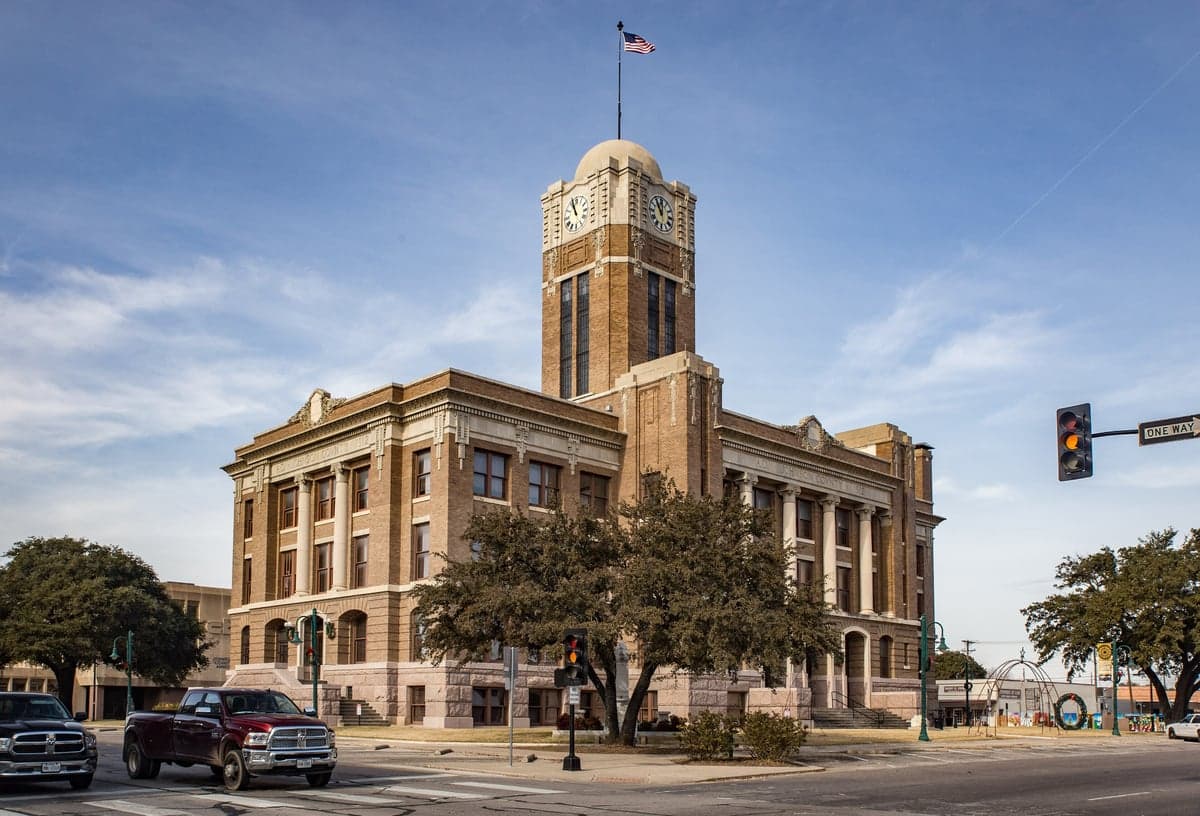
Photo: Wikipedia
Demographics of Johnson County
Affluence Level in Johnson County
A middle-class area roughly in line with national averages across income, home values, education, and employment.
People of Johnson County
The people of Johnson County, Texas, today are predominantly white and native-born, with a growing Hispanic minority that now makes up nearly a quarter of the population. With 188,820 residents, the county retains a distinctly rural and small-town character despite its proximity to the Dallas-Fort Worth metroplex, reflected in a low foreign-born share of just 3.5% and a college attainment rate of 23.5%. The county’s identity is shaped by its agricultural roots, a strong evangelical Protestant presence, and a political culture that leans heavily conservative, distinguishing it from the more diverse and urbanized counties to its east and north.
Settlement & growth (pre-1960)
Before American settlement, the area now known as Johnson County was home to the Comanche and Wichita peoples, who used the rolling prairies and river bottoms for hunting and seasonal camps. Spanish and Mexican authorities claimed the region but established no permanent settlements here, leaving it as a contested frontier zone until the Republic of Texas era. The first Anglo-American settlers arrived in the 1840s and 1850s, primarily from the Upper South—Tennessee, Kentucky, and Missouri—drawn by cheap land grants under the Texas annexation and the promise of cotton farming along the Brazos River tributaries. These early settlers were overwhelmingly of Scots-Irish and English stock, bringing with them a culture of independent farming, Protestant dissent, and suspicion of centralized authority that still echoes in local politics.
The county was formally organized in 1854, with Cleburne established as the county seat. The post-Civil War period saw a modest influx of freed slaves, who formed small farming communities and tenant labor forces; by 1870, Black residents made up roughly 15% of the population, though that share would decline steadily over the following century. The arrival of the railroad in the 1880s transformed Cleburne into a regional cotton and livestock shipping hub, attracting a small number of German and Czech families who settled in and around the town of Grandview. These immigrant groups, though never numerous, established a few Lutheran and Catholic congregations that remain active today. The Dust Bowl and Great Depression pushed some displaced farmers from Oklahoma and the Texas Panhandle into Johnson County during the 1930s, but the population remained stable at around 30,000 through the 1940s, with the economy still anchored in cotton, cattle, and dairying.
World War II and the subsequent expansion of defense industries in Dallas and Fort Worth triggered the first significant suburban spillover. By the 1950s, a trickle of white families from the metroplex began moving into southern Johnson County, particularly around the towns of Burleson and Joshua, seeking cheaper land and a slower pace of life. However, the county remained overwhelmingly rural and agricultural through 1960, with a population of just over 34,000 and a racial composition that was roughly 85% white, 10% Black, and 5% Hispanic.
Modern era (post-1965)
The 1965 Hart-Cellar Act had a minimal direct impact on Johnson County, as the region attracted very few post-1965 immigrants compared to urban Texas. The foreign-born population today stands at just 3.5%, far below the state average of 17%. Instead, the county’s modern demographic story is one of domestic migration and suburbanization. Beginning in the 1970s and accelerating through the 1990s, white middle-class families from Dallas and Tarrant counties moved south along the I-35W corridor, settling in Burleson, which grew from a town of 2,500 in 1970 to over 40,000 by 2020. This wave was driven by the search for affordable housing, lower taxes, and perceived safety, as well as the expansion of white-collar employment in the Metroplex.
The Hispanic population began to grow noticeably in the 1990s, rising from 5% in 1990 to 24.6% today. This growth came primarily from domestic migration of Mexican-American families from South Texas and the Rio Grande Valley, rather than from recent immigration. These families concentrated in Cleburne and the unincorporated areas around Alvarado and Venus, where they found work in construction, warehousing, and the county’s remaining agricultural sector. The Black population, meanwhile, declined from its post-Reconstruction peak to just 4.7% today, as younger Black residents moved to Dallas and Fort Worth for better economic opportunities. East/Southeast Asian residents (0.8%) and Indian-subcontinent residents (0.2%) remain very small, mostly professionals employed in the healthcare and logistics sectors in Burleson and Cleburne.
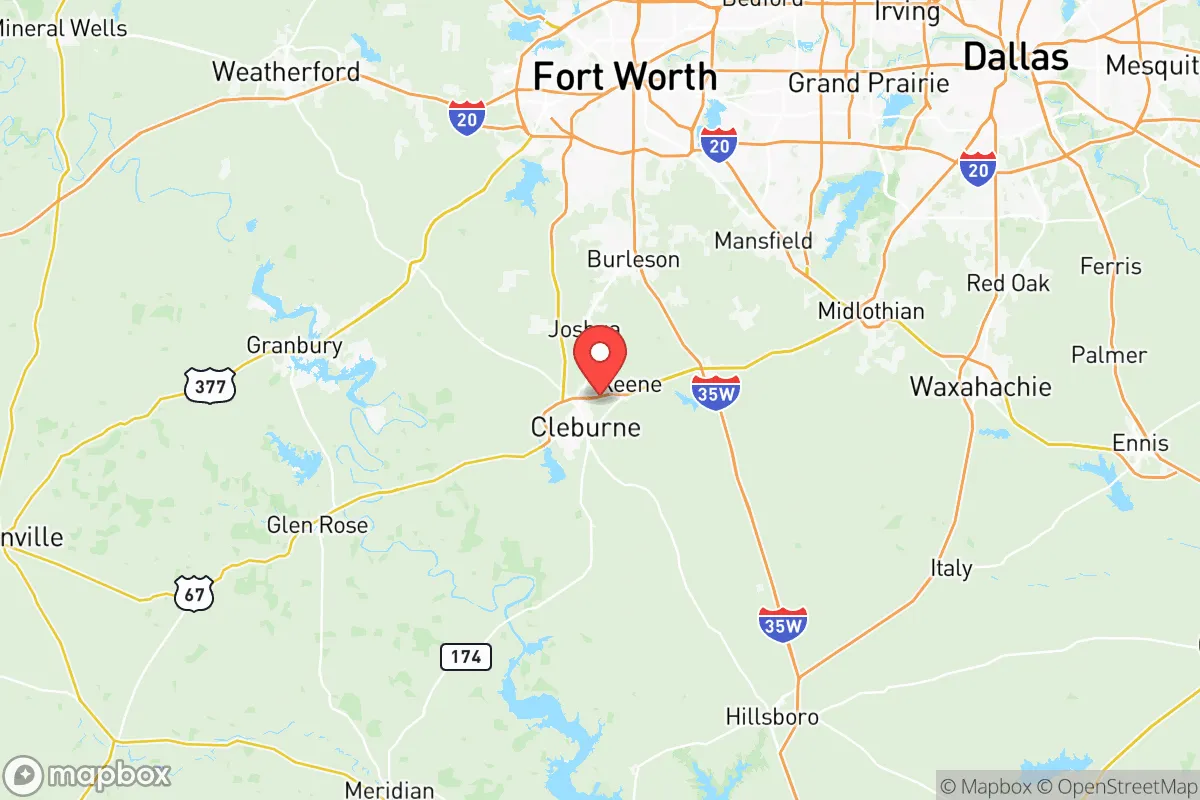
Suburbanization has reshaped the county’s geography. The northern tier—Burleson, Joshua, and the area around Lake Pat Cleburne—has become a classic exurban bedroom community, with subdivisions, chain retail, and commuter traffic. The southern half, including Grandview and the rural stretches toward Hill County, retains a more traditional agricultural character, with working ranches and small-town main streets. This internal divide is also cultural: northern Johnson County votes reliably Republican but is more engaged with Metroplex media and trends, while the southern part remains more insular and locally oriented.
The future
Johnson County is projected to continue growing, likely reaching 250,000 residents by 2040, driven almost entirely by domestic in-migration from the Dallas-Fort Worth metroplex. The Hispanic share is expected to rise slowly, possibly to 30-32%, as younger Hispanic families move in from other parts of Texas, but the county will remain majority white and native-born for the foreseeable future. The foreign-born share is unlikely to rise above 5%, as the county lacks the immigrant job networks and ethnic enclaves that attract newcomers to urban areas.
The cultural identity of the county is likely to remain stable, as new residents are largely absorbed into the existing conservative, evangelical, and rural-oriented ethos. The northern exurbs may become slightly more diverse and politically moderate over time, but the southern half will resist that trend. The county is not tribalizing into distinct ethnic enclaves; rather, it is homogenizing around a white-majority, English-dominant, Republican-voting norm, with the Hispanic population increasingly assimilated into that mainstream. The small Black and Asian communities will likely remain stable or grow only marginally.
For someone moving in now, Johnson County offers a predictable, culturally cohesive environment where change is gradual and the dominant identity is clear. It is not a place of rapid demographic transformation or ethnic friction, but rather a steady, slow-growth exurb where the past and present are closely aligned. The county’s future is more of the same: more houses, more commuters, more churches, and a population that, while growing, will look and vote much like it does today.

* Values derived from national, state, county, city and local statistics and may differ in a specific area. Last updated: 2026-05-09T13:27:31.000Z
Narrative content on this page is AI-generated and may contain mistakes. Verify any details that matter before acting on them.
ReloMaps may earn a commission from affiliate links at no extra cost to you.

