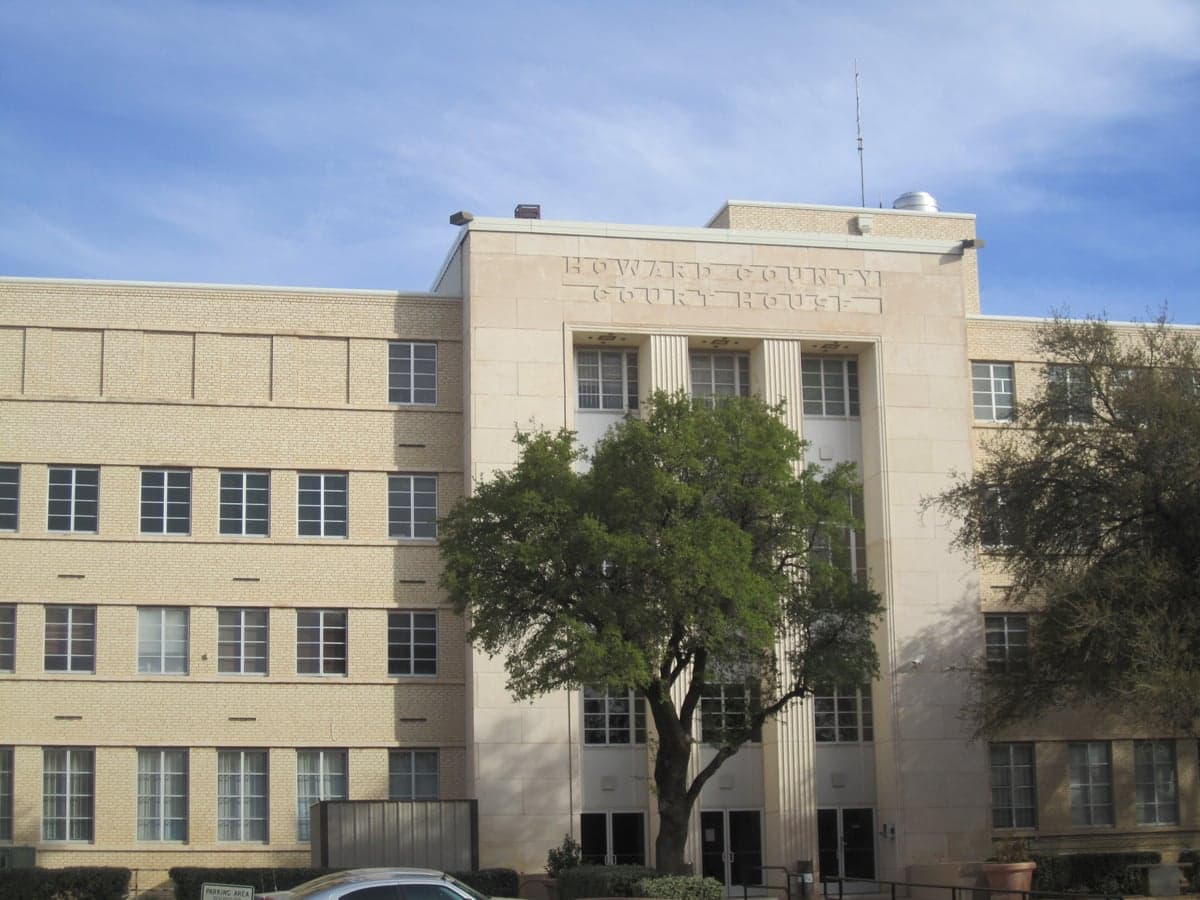
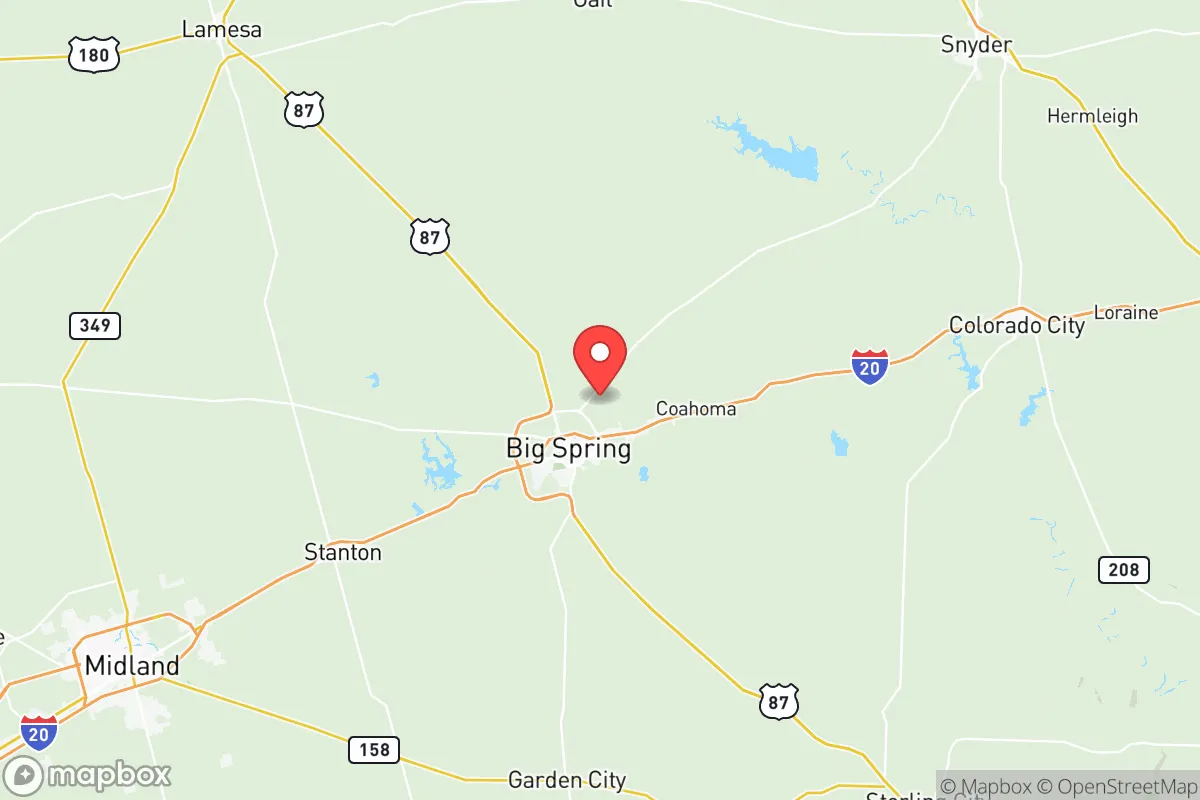
Photo: Wikipedia
Demographics of Howard County
Affluence Level in Howard County
A middle-class area roughly in line with national averages across income, home values, education, and employment.
People of Howard County
Howard County, Texas, is a community of roughly 33,000 residents defined by a near-even split between its White (44.0%) and Hispanic (46.9%) populations, a small but established Black community (4.9%), and a modest foreign-born share of 8.4%. The county’s identity is rooted in its role as an oil-and-agriculture hub of the Permian Basin, where a pragmatic, hardworking character prevails and where the population is notably less college-educated (15.3%) than the state average. This is a place where the legacy of early 20th-century oil booms and steady Hispanic migration has created a bicultural, working-class region that remains deeply tied to the energy sector and the land.
Settlement & growth (pre-1960)
Before Anglo-American settlement, the area that is now Howard County was part of the traditional territory of the Comanche and Lipan Apache peoples, who used the region for seasonal hunting and travel along the Colorado River. Spanish and Mexican expeditions passed through in the 18th and early 19th centuries, but no permanent European settlements were established. The county was formally created in 1876 from the Bexar District, but it remained sparsely populated until the arrival of the Texas and Pacific Railway in 1881, which connected the area to national markets.
The first major wave of settlers were Anglo-American ranchers and farmers, primarily of Scots-Irish and English descent, who moved into the area from the Deep South and East Texas during the 1880s and 1890s. They established the county seat of Big Spring as a cattle-shipping point, and small farming communities like Coahoma, Forsan, and Vincent grew up around cotton and grain production. The discovery of oil in the Permian Basin in the 1920s transformed the county’s economy and demographics. The population surged from roughly 8,000 in 1920 to over 22,000 by 1930, as workers from Oklahoma, Arkansas, and the Texas Hill Country—many of them Dust Bowl refugees—flooded into Big Spring and the new oil camps of Sand Springs and Lomax. This wave was overwhelmingly White and native-born, and it established the county’s enduring identity as an oil-patch community.
African Americans arrived in smaller numbers during the same period, primarily as domestic workers, railroad laborers, and later oil-field hands. They settled mostly in Big Spring, where a small but distinct Black neighborhood formed near the railroad tracks. The Hispanic population began to grow significantly in the 1940s and 1950s, as Mexican-American laborers were recruited for agricultural work—especially cotton harvesting—and for the expanding oil industry. These families settled in Big Spring and Coahoma, forming the early foundations of what would become the county’s largest ethnic group. By 1960, the county’s population had stabilized at around 26,000, with a White majority of roughly 75% and a Hispanic share of about 20%.
Modern era (post-1965)
The 1965 Hart-Cellar Act did not dramatically alter Howard County’s immigration patterns, as the region never attracted the large-scale Asian or Middle Eastern immigration seen in Texas’s major cities. Instead, the county’s demographic story since the 1970s has been one of steady Hispanic growth through both immigration and natural increase, combined with a gradual out-migration of younger White residents seeking opportunities in larger metropolitan areas. The Hispanic share of the population rose from roughly 25% in 1980 to 35% in 2000, and then to 46.9% by the 2020s. This growth has been driven by families from northern Mexico and the Texas borderlands, drawn by the steady demand for labor in the oil fields, construction, and service industries. The foreign-born share of 8.4% is modest by Texas standards but significant for a rural county, and it is overwhelmingly Mexican-born.
The Black population has remained stable at around 5%, with most families still concentrated in Big Spring. The East/Southeast Asian community (0.7%) and Indian-subcontinent community (0.3%) are very small, consisting mostly of professionals in the healthcare and energy sectors who have arrived since 2000. These groups are dispersed within Big Spring rather than forming distinct enclaves. Domestic migration since the 1990s has been dominated by a reverse pattern: while some retirees and workers have moved in from other parts of Texas and the Rust Belt to work in the oil industry, the county has also seen a steady outflow of young adults to cities like Midland, Lubbock, and Dallas. Suburbanization has been limited; the county remains rural, with Big Spring (population roughly 28,000) serving as the only significant urban center, and smaller communities like Coahoma, Forsan, and Vincent functioning as bedroom communities and agricultural service hubs.
The future
Howard County is projected to become slightly more Hispanic over the next 10–20 years, driven by higher birth rates among Hispanic families and continued immigration from Mexico and the Texas borderlands. The White population share is likely to continue its gradual decline, falling below 40% by 2040, while the Black and Asian shares are expected to remain small but stable. The county’s overall population growth will depend heavily on the boom-and-bust cycle of the Permian Basin oil industry; a sustained period of high oil prices could attract new workers and families, while a downturn could accelerate out-migration. New residents are most likely to settle in Big Spring and its immediate outskirts, as the smaller communities lack the housing stock and services to absorb significant growth. The county’s cultural identity is evolving from a predominantly Anglo oil-patch culture to a bicultural one, where English and Spanish are both common in public life and where local institutions—schools, churches, and businesses—are increasingly reflecting this dual heritage.
For someone moving in now, Howard County offers a stable, family-oriented community where the cost of living is low and the economy is tied to a globally significant energy industry. The population is becoming more Hispanic and more bicultural, but the county remains a place where traditional values of hard work, self-reliance, and neighborliness are widely shared. It is not a place of rapid demographic transformation or cultural conflict, but rather a slow, organic shift toward a majority-minority population that is already well underway.

* Values derived from national, state, county, city and local statistics and may differ in a specific area. Last updated: 2026-06-14T23:30:09.000Z
Narrative content on this page is AI-generated and may contain mistakes. Verify any details that matter before acting on them.
ReloMaps may earn a commission from affiliate links at no extra cost to you.

