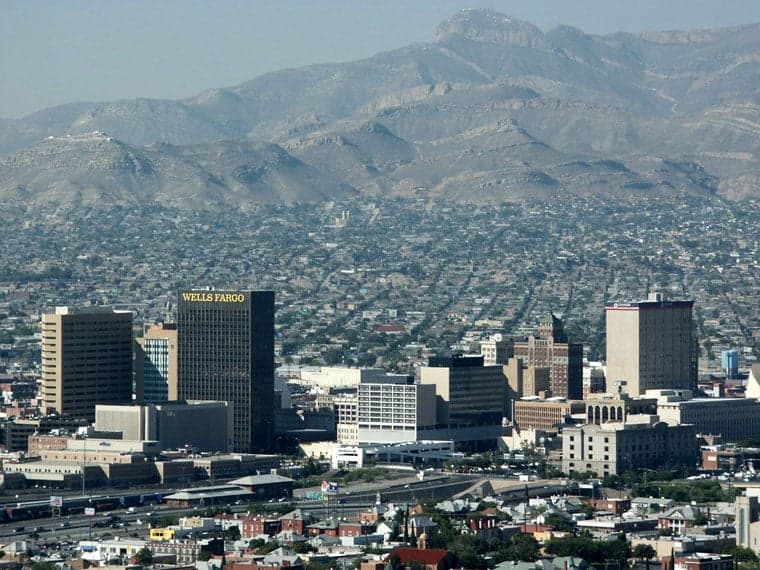
Photo: Wikipedia
Political ClimatePolitical Climate in El Paso County
Showing district-level results — no local-only data available.
Local Political AnalysisPolitical Analysis of El Paso County
El Paso County is a solid blue stronghold in deep red Texas, with a Cook Partisan Voting Index of D+11 that makes it one of the most reliably Democratic counties in the state. This isn't a recent shift — the county has voted for the Democratic presidential candidate in every election since 1988, and in 2024, it delivered a 20-point margin for Kamala Harris while the rest of Texas swung +14 points for Donald Trump. The political DNA here is shaped by a majority-Latino population, a strong union presence tied to Fort Bliss and border industries, and a cultural identity that feels more connected to Ciudad Juárez than to Dallas or Houston. That said, the county isn't a monolith — there are real pockets of conservatism, especially as you move east toward the suburbs and exurbs.
How it compares
Texas as a whole carries a Cook PVI of R+4, meaning the state leans about 4 points more Republican than the national average. El Paso County, at D+11, leans 15 points more Democratic than the state — a gap that's among the widest of any urban county in Texas. To put it in local terms: if you live in Central El Paso or the Mission Valley (Ysleta, Socorro, San Elizario), you're in deep blue territory where Democrats routinely win by 30-40 points. Head east to Horizon City or Fabens, and you'll find precincts that split much closer to 50-50, with some even tipping red in down-ballot races. The West Side (around Coronado Hills and the Country Club area) is more moderate — still Democratic, but with a noticeable Republican minority that shows up in school board and city council races. The swing precincts tend to cluster in the Far East Side near the Montana Vista and Agua Dulce areas, where newer subdivisions attract a mix of military families and commuters who lean more conservative on fiscal issues.
What this means for residents
For liberal residents, El Paso County is a comfortable place to live politically — you'll see Democratic candidates campaigning here regularly, and local offices from county judge to school board are dominated by Democrats. Progressive policies like paid sick leave ordinances and sanctuary city protections have passed here despite state preemption efforts. For conservative residents, it can feel like swimming upstream in local elections, but you're not isolated — the county GOP is active, and Republican candidates still pull 35-40% in most countywide races. The real tension plays out in the tension between local and state law: El Paso's Democratic leadership frequently clashes with the Republican-controlled state legislature over issues like immigration enforcement, abortion access, and voting rights. That dynamic means residents on both sides see their values reflected at different levels of government — local for liberals, state for conservatives — which creates a constant, low-grade political friction that defines daily life here.
Culturally, El Paso County stands apart from the rest of Texas in ways that go beyond voting patterns. The binational character of the region means that politics here is deeply personal — immigration policy isn't abstract when half your family lives across the border. You'll find a pragmatic, live-and-let-live attitude in most social settings; people are more likely to ask where you went to high school than who you voted for. The University of Texas at El Paso and Fort Bliss anchor a population that's younger, more educated, and more transient than the rest of the county, which adds a layer of political diversity that outsiders often miss. Looking ahead, the county's Democratic lean is likely to hold — the Latino electorate here is not trending Republican the way it is in South Texas — but the margins could tighten as the Far East Side grows and the West Side ages. For now, El Paso County remains Texas's most reliable blue island, and that's unlikely to change anytime soon.

State Political ClimatePolitical Climate in Texas
State Political AnalysisPolitical Environment in the State
Texas has been a reliably Republican state for decades, with a Cook Partisan Voting Index of R+4, but the political reality on the ground is far more nuanced than that single number suggests. The state’s dominant coalition is a blend of suburban conservatives, rural voters, and business interests, but a massive demographic shift—driven by explosive growth in the metroplexes of Dallas-Fort Worth, Houston, San Antonio, and Austin—has been slowly chipping away at the GOP’s margins. Over the last 10 to 20 years, the trajectory has been one of gradual tightening: while Republicans still control every statewide office and both legislative chambers, the margin of victory in presidential races has shrunk from nearly 16 points in 2004 to about 5.5 points in 2020, and down to roughly 4 points in 2024. That’s a real shift, and it means the state is in a slow but steady political realignment.
Urban vs. rural divide
The political map of Texas is a textbook study in the urban-rural split. The big Democratic strongholds are the major cities and their inner suburbs: Austin is the most liberal major city in the state, with Travis County routinely voting 70%+ Democratic, while El Paso and Houston’s Harris County are also deep blue. Dallas and San Antonio lean Democratic, though their surrounding suburbs are more mixed. The GOP’s firewall is the vast rural and exurban expanse—places like the Panhandle around Lubbock, East Texas, and the Hill Country west of Austin. The real battleground has become the fast-growing suburban counties that ring the metros: Collin County (north of Dallas) and Denton County used to be reliably red, but they’ve shifted purple in recent cycles. In 2020, Biden actually won Tarrant County (Fort Worth) for the first time since 1964, though it flipped back to Trump in 2024. That’s the story of Texas politics right now—a tug-of-war in the suburbs.
Policy environment
Texas’s policy environment is defined by a low-tax, low-regulation posture that has been consistent for decades. There is no state income tax, which is the single biggest draw for relocators, and property taxes are high to compensate—among the highest in the nation. The state’s regulatory approach is famously business-friendly, with minimal zoning in many cities and a right-to-work labor environment. On education, the state has a school choice voucher program that was expanded in 2023, and the curriculum standards have been a flashpoint in culture wars. Healthcare policy is marked by the state’s refusal to expand Medicaid under the ACA, leaving roughly 18% of the population uninsured—the highest rate in the country. Election laws have been tightened in recent years, with the 2021 Senate Bill 1 adding new ID requirements for mail-in voting and limiting drive-through and 24-hour voting options. For a conservative relocator, this environment is largely welcoming; for a liberal one, it can feel like swimming upstream.
Recent policy direction
The last few legislative sessions have pushed Texas decisively in a conservative direction on nearly every front a relocator might care about. On gun rights, the state became a permitless carry state in 2021 with HB 1927, meaning anyone over 21 who can legally possess a firearm can carry it openly or concealed without a license. On parental rights and education, the 2023 session passed HB 900, which restricts what books can be in school libraries, and the state has been aggressive in investigating parents for providing gender-affirming care to minors under SB 14. On speech and privacy, the state’s 2021 law targeting social media platforms (HB 20) prohibits them from moderating content based on viewpoint, though it’s been tied up in court. On medical and bodily autonomy, Texas has one of the strictest abortion bans in the country, with no exceptions for rape or incest, and the trigger law from 2021 went into effect after Dobbs. Property rights are generally strong, though the state’s use of eminent domain for infrastructure projects like the I-35 expansion has been controversial. On voting access, the 2021 law made it harder to vote by mail and banned 24-hour polling places, but turnout has actually increased in subsequent elections. The overall direction is clear: Texas is doubling down on a conservative policy framework, even as its electorate slowly diversifies.
Civil unrest & political movements
Texas has seen its share of political flashpoints in recent years. The 2020 protests in Austin over police brutality were among the largest and most sustained in the country, leading to a city council vote to defund the police by $150 million—a decision that was later partially reversed after a backlash and a 2021 state law (HB 1900) that penalizes cities that cut police budgets. Immigration politics are a constant presence, especially along the border in El Paso and the Rio Grande Valley, where Governor Abbott’s Operation Lone Star has deployed state troopers and National Guard to arrest migrants on trespassing charges. The state has also bused thousands of migrants to northern cities, a move that has been both praised and condemned. Secession rhetoric, often called “Texit,” flares up periodically but has no serious political traction—a 2023 poll found only about 20% of Texans support it. Election integrity remains a live issue, with the state’s 2020 audit of four counties (including Harris and Dallas) finding no evidence of widespread fraud but still fueling ongoing distrust among some conservatives. For a new resident, the most visible sign of political tension is likely the yard signs and bumper stickers in the suburbs, which are more polarized than ever.
Projection
Looking ahead 5 to 10 years, Texas is likely to remain a Republican-controlled state, but the margins will continue to narrow. The key demographic driver is the influx of new residents—about 1,000 people move to Texas every day—and they are coming from both blue and red states. The net effect has been a slight Democratic lean in the suburbs, but the rural and exurban areas are growing too, and they are solidly red. The biggest wild card is the Hispanic vote: the Rio Grande Valley, once reliably Democratic, swung hard toward Trump in 2020 and 2024, suggesting that the GOP is making inroads with working-class Hispanic voters. If that trend continues, Texas could stay red for longer than the current projections suggest. Conversely, if the suburban shift accelerates, the state could become a true battleground by the early 2030s. For someone moving in now, expect a state that remains conservative in policy but increasingly competitive in elections, with the culture wars playing out in school boards, city councils, and the state legislature.
For a new resident, the bottom line is that Texas offers a political environment that is broadly conservative and stable, but not monolithic. If you’re a conservative, you’ll find a state government that largely shares your values on taxes, guns, education, and abortion. If you’re a liberal, you’ll find strong communities in the major cities and a growing political movement that is slowly gaining ground, but you’ll also face a state government that is actively working against many of your priorities. The practical takeaway is that where you live within Texas matters enormously—the difference between living in Austin and Lubbock is like living in two different states. Choose your city and county carefully, because the political climate varies more within Texas than it does between many other states.
* Values derived from national, state, county, city and local statistics and may differ in a specific area. Last updated: 2026-07-22T23:08:28.000Z
Narrative content on this page is AI-generated and may contain mistakes. Verify any details that matter before acting on them.
ReloMaps may earn a commission from affiliate links at no extra cost to you.

