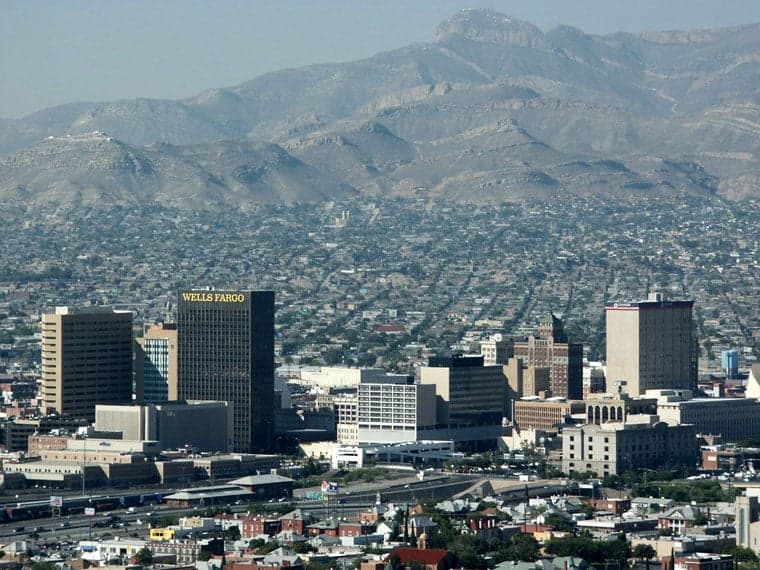
Photo: Wikipedia
Personal Sovereignty in El Paso County
Viable for self-reliance. Generally workable, though some barriers may limit total independence.
What does Personal Sovereignty tell us?
Personal Sovereignty measures your capacity for self-reliance and independence with minimal government friction. Higher scores mean fewer barriers between you and the way you want to live... but it assumes you have the space you need and good neighbors.
What does this tell us?
Personal Sovereignty measures your capacity for self-reliance and independence with minimal government friction. Higher scores mean fewer barriers between you and the way you want to live... but it assumes you have the space you need and good neighbors.
State Policy
Energy independence: Net exporter (220% of energy produced in-state)
Personal Liberty
Homesteading

Personal Liberty Analysis
El Paso County, Texas, offers a notably high degree of personal sovereignty, grounded in Texas’s strong tradition of limited government, low taxation, and expansive individual rights, though the specific experience varies significantly between the urban core of El Paso and the rural expanses of the county’s eastern and northern reaches. The county’s regulatory environment is generally light-touch compared to states like California or New York, but residents must navigate a mix of city-level ordinances in El Paso proper and more permissive county rules in unincorporated areas. For individuals and families prioritizing autonomy, the key differentiators are the county’s tax burden, gun laws, homesteading feasibility, and the breadth of personal liberties protected under state law.
Tax burden and regulatory posture in El Paso County
Texas’s absence of a state income tax is the cornerstone of its pro-sovereignty posture, and El Paso County residents benefit directly from this, keeping 100% of their earned income free from state-level taxation. The county’s property tax burden is moderate by Texas standards: the combined county, city, and school district rates in El Paso city typically range from 2.5% to 2.8% of assessed value, while unincorporated areas like Fabens or Clint see slightly lower rates due to fewer municipal services. Regulatory oversight is minimal for most businesses and homeowners; there is no county-wide zoning in unincorporated areas, meaning a resident in Canutillo or San Elizario can operate a home-based business or keep livestock without the layers of permitting common in more regulated states. However, El Paso city imposes stricter building codes and business license requirements, so those seeking maximum regulatory freedom should look to the county’s rural precincts. Sales tax in El Paso County is 8.25% (state + local), which is standard for Texas and funds local infrastructure without a personal income tax trade-off.
Self-defense and gun law specifics in El Paso County
Texas law provides robust self-defense rights, and El Paso County fully reflects this state-level framework. The county is a “constitutional carry” jurisdiction, meaning any adult who can legally possess a firearm may carry it openly or concealed without a permit, a right codified in 2021. There are no county-specific gun registration requirements, waiting periods, or magazine capacity limits. The sheriff’s office in El Paso County issues License to Carry (LTC) permits for those who want reciprocity with other states, but the process is shall-issue and straightforward. In practice, gun culture is strong across the county, but the urban environment of El Paso city sees fewer public carriers than rural areas like Horizon City or Socorro, where open carry is more common. Stand-your-ground laws apply statewide, eliminating any duty to retreat before using deadly force in self-defense. For residents concerned about property crime, Texas law also protects the use of force to defend one’s home, vehicle, or workplace. The only notable restriction is that firearms are prohibited in certain government buildings and schools, but these are standard limitations that do not undermine the overall pro-self-defense environment.
Self-reliance and homesteading viability in El Paso County
Homesteading and off-grid living are viable in El Paso County, but the arid climate and water availability are the primary constraints, not government regulation. In unincorporated areas like Fort Hancock and Anthony, lot sizes can be as small as one acre for residential use, but many parcels range from 5 to 40 acres, offering ample space for gardening, small livestock, or solar installations. There is no county-wide ban on rainwater harvesting, and Texas law actually encourages it, though the region’s low annual rainfall (under 10 inches) means a cistern system must be sized accordingly. Zoning in unincorporated areas is virtually nonexistent, so residents can build alternative housing (e.g., tiny homes, earthships, or RVs) without the permitting hurdles found in El Paso city limits. Off-grid solar is practical given the area’s high sun exposure, and net metering is available through El Paso Electric, though the utility’s interconnection process is straightforward. The main challenge is water: drilling a well costs $10,000–$20,000 depending on depth, and water rights are tied to the land. For those seeking a self-reliant lifestyle, the rural eastern part of the county near Hudspeth County offers the most freedom, while El Paso city’s building codes and water utility requirements make true off-grid living more difficult.
Personal liberties in El Paso County: parental rights, medical autonomy, speech, and property
Texas law protects a broad range of personal liberties that directly impact daily life in El Paso County. Parental rights are strongly guarded: the Texas Parental Rights statute (Chapter 151 of the Texas Family Code) affirms that parents have the fundamental right to direct their children’s education, healthcare, and religious upbringing. This means families in El Paso can homeschool without state interference, choose private or religious schools, or opt their children out of specific public school curricula. Medical autonomy is similarly robust; Texas has not imposed vaccine mandates for adults or children beyond standard school requirements, and the state’s ban on COVID-19 vaccine passports remains in effect. For property owners, Texas’s strong eminent domain protections and the absence of a state property tax on homesteads (though local property taxes still apply) provide a stable environment. Free speech is protected under both the U.S. and Texas Constitutions, and El Paso County has no local ordinances that restrict political speech or assembly beyond standard public safety regulations. The only notable limitation is that El Paso city has a noise ordinance and some sign regulations, but these are minor compared to the overall permissive legal climate.
Overall, El Paso County ranks among the more sovereignty-friendly areas in Texas, especially when compared to the regulatory density of Austin or Dallas. The combination of no state income tax, constitutional carry, minimal zoning in rural areas, and strong parental rights creates an environment where individuals and families can exercise significant control over their lives. The trade-off is that the county’s urban core imposes more rules, while the rural areas offer near-total freedom but require self-sufficiency in water and energy. For a relocation-minded reader who values personal autonomy, El Paso County delivers a high degree of independence, particularly if they choose a location like Fabens or Clint over the city of El Paso itself.

* Values derived from national, state, county, city and local statistics and may differ in a specific area. Last updated: 2026-07-22T23:08:28.000Z
Narrative content on this page is AI-generated and may contain mistakes. Verify any details that matter before acting on them.
ReloMaps may earn a commission from affiliate links at no extra cost to you.

