Photo: Wikipedia
Demographics of El Paso County
Affluence Level in El Paso County
A below-average socioeconomic profile. Incomes, home values, and educational attainment trail the U.S., with higher poverty and unemployment.
People of El Paso County
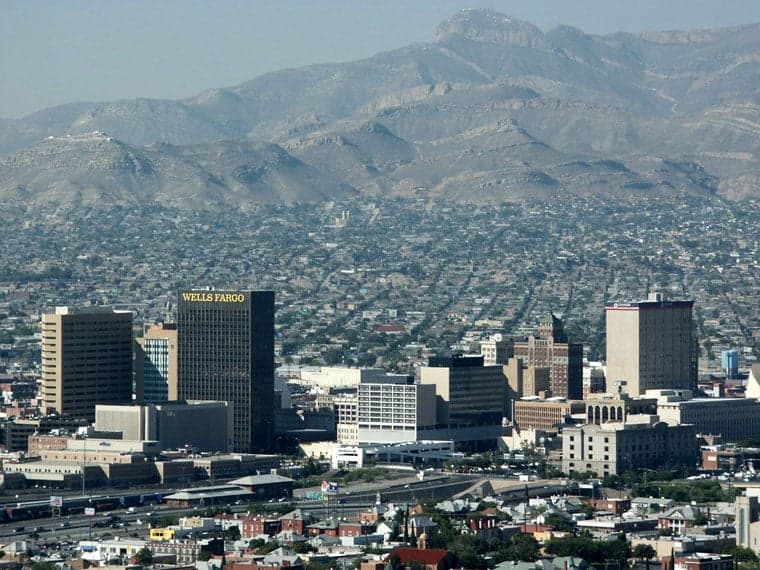
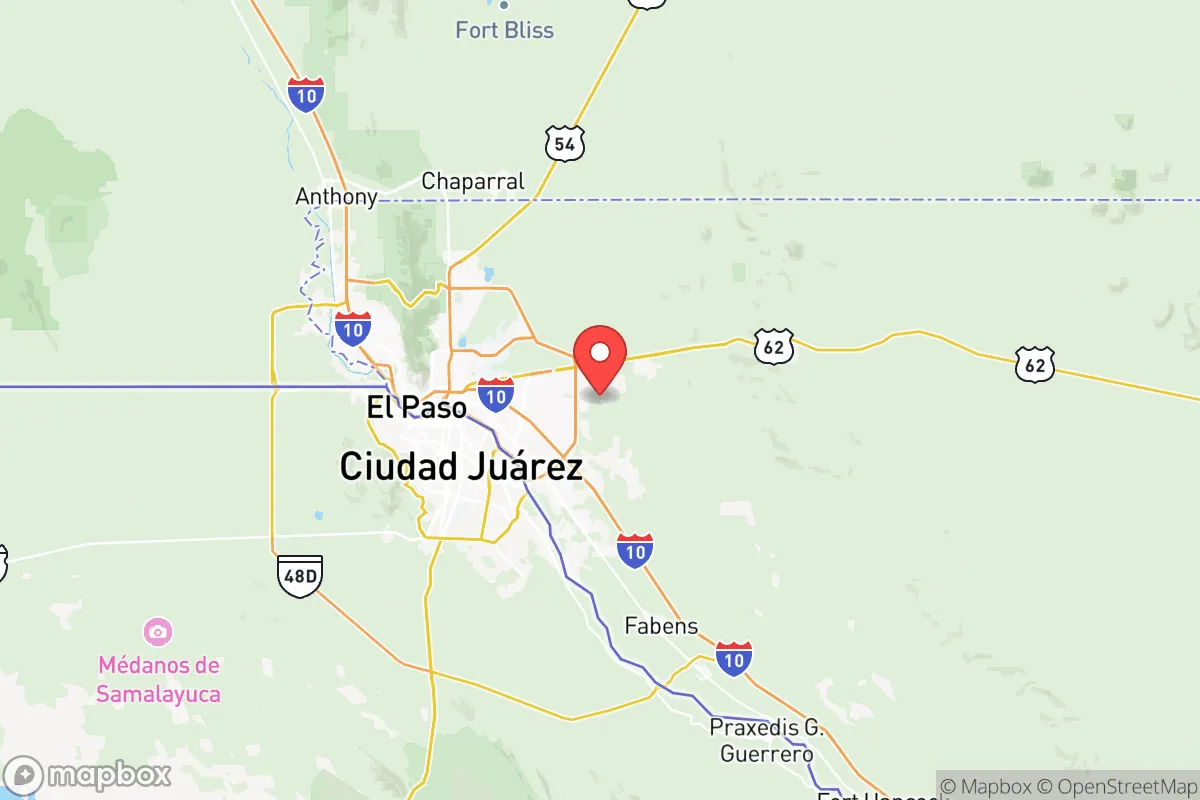
The people of El Paso County, Texas, today form a predominantly Hispanic community of 866,275 residents, with 82.7% identifying as Hispanic or Latino, a figure that gives the county one of the highest Hispanic population shares of any large U.S. county. This is a binational, bicultural region where daily life flows across the Rio Grande into Ciudad Juárez, Mexico, creating a distinctive border identity unlike anywhere else in Texas. The non-Hispanic White population stands at just 11.2%, while Black residents make up 2.9%, East and Southeast Asian communities account for 0.8%, and Indian-subcontinent residents represent 0.3%. With 25.4% of adults holding a college degree, the county's educational attainment trails state and national averages, reflecting an economy historically rooted in border trade, manufacturing, and military employment rather than white-collar industries.
Settlement & growth (pre-1960)
Long before European contact, the region now known as El Paso County was home to the Manso, Suma, and Jumano peoples, semi-nomadic groups who lived along the Rio Grande and relied on farming, hunting, and trade. Spanish colonization arrived in 1598 when Juan de Oñate claimed the area for New Spain, but permanent European settlement did not take hold until 1659 with the founding of the Misión de Nuestra Señora de Guadalupe in what is now Ciudad Juárez. On the north bank of the river, the Spanish established the settlement of Ysleta in 1682, making it the oldest continuously inhabited European-founded community in Texas. These early colonial settlements—Ysleta, Socorro, and San Elizario—formed the core of what would become El Paso County, and their descendants remain a significant presence in these historic communities today.
After the Mexican-American War and the 1848 Treaty of Guadalupe Hidalgo, the Rio Grande became the international boundary, and the U.S. Army established Fort Bliss in 1849, anchoring American control over the region. The arrival of the Southern Pacific Railroad in 1881 transformed El Paso from a dusty border outpost into a booming rail and trade hub, attracting Anglo-American merchants, Mexican laborers, and a small but influential group of European immigrants, including German and Irish settlers who opened businesses and built the city's early infrastructure. The Mexican Revolution (1910–1920) sent tens of thousands of refugees north across the border, dramatically expanding the Hispanic population and cementing Spanish-language culture as dominant. By 1930, El Paso was already a majority-Mexican-origin city, a demographic reality that set it apart from most other American cities of the era.
The mid-20th century brought further growth through military expansion at Fort Bliss and the rise of the maquiladora industry just across the border in Juárez. World War II and the Cold War turned Fort Bliss into a major Army post specializing in air defense and missile training, drawing military families from across the country. These newcomers were disproportionately non-Hispanic White, creating a distinct military-affiliated subpopulation concentrated in the northeast El Paso neighborhoods near the base, such as the 79924 and 79936 zip codes. Meanwhile, the Bracero Program (1942–1964) brought hundreds of thousands of Mexican agricultural workers into the region, many of whom settled permanently in colonias—unincorporated, often impoverished communities like those in the Lower Valley around Socorro and San Elizario—laying the groundwork for the county's enduring Hispanic majority.
Modern era (post-1965)
The 1965 Hart-Cellar Act ended the national-origins quota system and opened the door to immigration from Asia, Africa, and Latin America, but El Paso County's demographic trajectory was already set. Unlike gateway cities such as Los Angeles or Houston, El Paso did not see a surge of new immigrant diversity; instead, the post-1965 period reinforced and deepened the existing Hispanic character. Family reunification provisions allowed Mexican-American residents to sponsor relatives, and ongoing economic pressures in Mexico continued to drive migration north. The county's foreign-born population today stands at 10.7%, a figure that is lower than many might expect given the border location, because a large share of the Hispanic population is multigenerational U.S.-born.
The most significant post-1965 demographic shift has been the suburbanization of the Hispanic population. Historically concentrated in the central city and the historic Mission Valley communities of Ysleta, Socorro, and San Elizario, Hispanic families have moved steadily into newer subdivisions in the East Side and Far East El Paso areas, including the master-planned community of Horizon City. These areas now feature a largely middle-class Hispanic population, blurring older patterns of ethnic and economic segregation. The non-Hispanic White population, meanwhile, has become increasingly concentrated in the West Side neighborhoods near the Franklin Mountains and in the wealthier enclaves of the Upper Valley, such as the area around Canutillo. The Black population, at 2.9%, is small but has a long history tied to Fort Bliss, and Black residents remain disproportionately military-affiliated, living in neighborhoods near the base. East and Southeast Asian communities, at 0.8%, are a modest presence concentrated in the medical and tech sectors, with small clusters near the University of Texas at El Paso and the Texas Tech University Health Sciences Center. Indian-subcontinent residents, at 0.3%, are a very recent arrival, largely professionals in healthcare and engineering.
Domestic migration patterns have also shifted. El Paso County has not experienced the explosive Sun Belt growth seen in Dallas-Fort Worth or Austin; its population grew by roughly 8% between 2010 and 2020, a moderate pace. The county attracts retirees and military veterans drawn by low housing costs and a mild winter climate, particularly to communities like Anthony and Canutillo in the Upper Valley. However, the region also loses young, college-educated residents to larger Texas metros, a brain drain that helps explain the below-average college attainment rate of 25.4%.
The future
El Paso County is projected to become slightly more diverse in the coming decades, though the change will be incremental rather than dramatic. The Hispanic share of the population is expected to remain above 80%, driven by higher birth rates and continued, if moderated, immigration from Mexico. The non-Hispanic White population will continue to shrink as a share, both because of outmigration and an older age profile. The small but growing Asian and Indian-subcontinent populations will likely expand as the region works to diversify its economy beyond border trade and military employment, particularly if efforts to grow the healthcare and technology sectors succeed. The county's cultural identity will remain firmly binational and bilingual, but the internal divide between the older, working-class Hispanic communities of the Lower Valley and the newer, more affluent Hispanic and Anglo populations of the West Side and Far East may become more pronounced. For someone moving in now, El Paso County offers a deeply rooted border culture, affordable housing, and a strong sense of community, but also a limited white-collar job market and a population that is overwhelmingly Hispanic—a reality that shapes everything from politics to daily life.
El Paso County is becoming a more suburban, more middle-class version of its historic self, with the Hispanic majority spreading across the entire county rather than remaining concentrated in the central city and Mission Valley. For newcomers, this means access to a distinctive bicultural lifestyle that is genuinely unlike the rest of Texas, but also a region where economic opportunity is narrower and educational attainment lower than in the state's booming metros. The county's future is one of slow, steady growth, deepening Hispanic cultural dominance, and a gradual diversification at the margins—a stable, family-oriented border community that rewards those who value affordability and cultural richness over career dynamism.

* Values derived from national, state, county, city and local statistics and may differ in a specific area. Last updated: 2026-07-22T23:08:28.000Z
Narrative content on this page is AI-generated and may contain mistakes. Verify any details that matter before acting on them.
ReloMaps may earn a commission from affiliate links at no extra cost to you.

