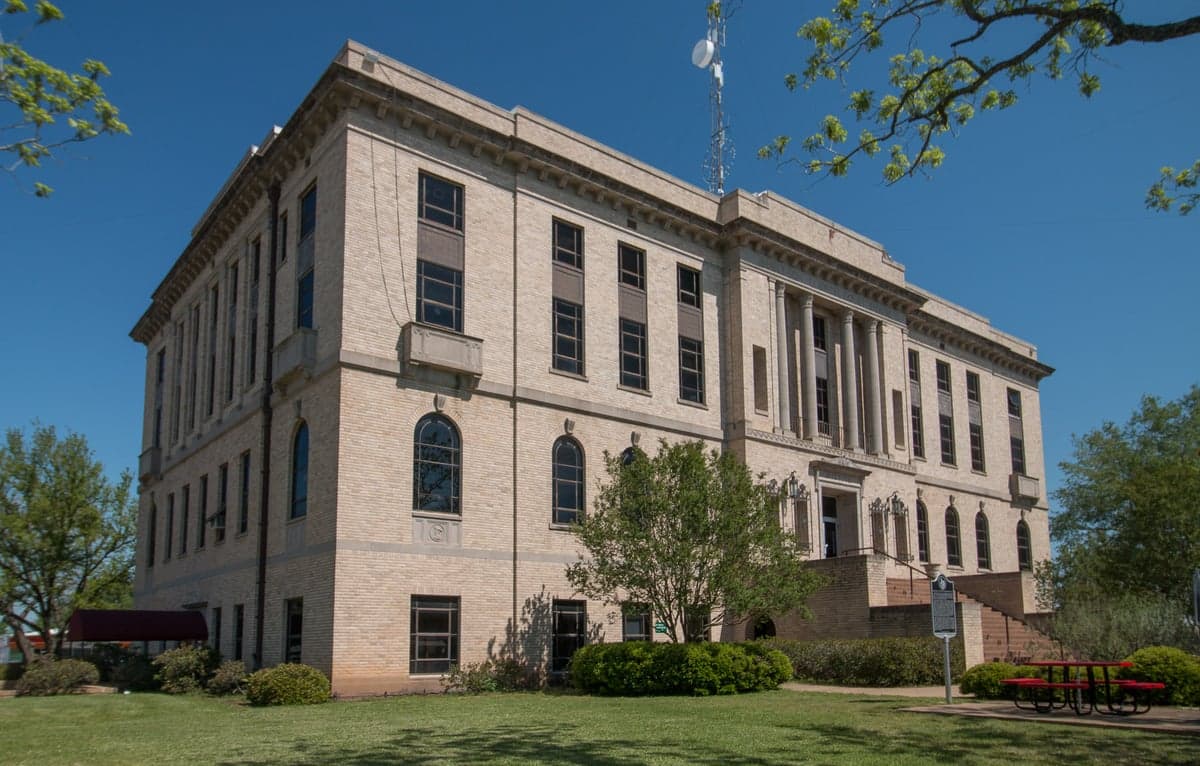
Photo: Wikipedia
Political ClimatePolitical Climate in Burleson County
Showing county-level results — no local-only data available.
Lean and PVI are calculated from this county’s 2020 and 2024 presidential results, Cook-style.
Political rankings in Texas
- Most Conservative Cities in Texas
- Most Liberal Cities in Texas
- Best Liberal-Leaning Towns in the South
- Safest Liberal-Leaning Towns in the South
- Safest Conservative-Leaning Towns in the South
- Affordable Small Towns for Conservatives
- Most Affordable Liberal-Leaning Small Towns in the U.S.
- Safest Conservative-Leaning Cities in the U.S.
- Most Conservative Counties in Texas
- Most Liberal Counties in Texas
Local Political AnalysisPolitical Analysis of Burleson County
Burleson County, Texas, is a reliably conservative area with a Cook Partisan Voting Index (PVI) of R+12, meaning it votes about 12 points more Republican than the national average. This isn't a new development—the county has been a Republican stronghold for decades, though the margins have tightened slightly in recent cycles as the broader region's demographics shift. The county seat, Caldwell, tends to be the most reliably red, while the smaller communities like Snook and Somerville show slightly more variation, though still lean conservative overall.
How it compares
Compared to Texas as a whole, Burleson County is significantly more Republican. While the state's overall PVI is unknown, Texas has trended slightly more competitive in recent presidential elections, with margins shrinking from double digits to single digits in some cycles. Burleson County, by contrast, has remained solidly in the R+12 range, reflecting a deeper and more entrenched conservative base. The county's rural character and agricultural economy—centered on cotton, corn, and cattle—help explain this stability. In the 2024 election, Burleson County voted for the Republican presidential candidate by a margin of roughly 68% to 30%, a spread that outpaces the state's overall result by several points. The precincts around Lake Somerville and the town of Snook sometimes show slightly more competitive numbers, but nowhere in the county has flipped blue in a major race since the 1990s.
What this means for residents
For conservative residents, the political climate means their values are broadly reflected in local governance—school board decisions, county commission votes, and law enforcement priorities tend to align with traditional conservative positions. For liberal residents, the reality is more nuanced. While they are a clear minority, they are not invisible. The county's small size means that personal relationships often matter more than party labels, and many residents report that political disagreements rarely spill into daily life. That said, liberal-leaning residents in Caldwell or Somerville may feel less comfortable displaying political signage or discussing certain topics openly, especially in more rural precincts. The county's trajectory suggests this dynamic will persist for the foreseeable future, though the growing influence of Texas A&M University in nearby College Station could slowly introduce more diverse perspectives into the county's political conversation over the next decade.
Culturally, Burleson County is distinct from the state's major urban centers in several ways. The county has no city with a population over 5,000, and its economy remains heavily tied to agriculture and small-scale manufacturing. This shapes local policy priorities—property taxes, water rights, and rural infrastructure dominate county commission meetings, while the culture-war issues that dominate state-level politics in Austin often feel more abstract here. The county's small-town character also means that local elections—for sheriff, county commissioner, and school board—tend to draw higher voter turnout relative to national races, and these contests often hinge on personal reputation rather than party affiliation. For anyone moving to the area, understanding that local politics is more about relationships than ideology is key to navigating the community successfully.

State Political ClimatePolitical Climate in Texas
State Political AnalysisPolitical Environment in the State
Texas has been a reliably Republican state for decades, but the political reality on the ground is far more complex than a simple red label. The state’s overall partisan lean remains solidly GOP at the statewide level — no Democrat has won a statewide office since 1994 — but the margin has been shrinking. In 2020, Donald Trump carried Texas by just 5.6 points, down from 9 points in 2016 and 16 points in 2012. The 2024 results showed a slight rebound to about a 7-point margin, but the long-term trajectory is unmistakable: the state is becoming more competitive, driven by explosive growth in the urban crescent from Dallas-Fort Worth down through Austin to San Antonio and Houston. For a relocator, this means you’re moving into a state where conservative policy dominates the capitol, but where local politics can vary wildly depending on which city or suburb you choose.
Urban vs. rural divide
The political map of Texas is a textbook study in geographic polarization. The major metros — Austin, Houston, Dallas, San Antonio, and El Paso — are Democratic strongholds that generate the bulk of the state’s blue votes. Harris County (Houston) alone accounts for roughly a quarter of all Democratic votes in the state. Meanwhile, the vast rural and exurban expanses — places like the Panhandle around Lubbock, East Texas timber country, and the sprawling suburbs north of Dallas like Frisco and McKinney — vote overwhelmingly Republican. The most dramatic shift in recent cycles has been in the suburbs: formerly reliable red areas like Collin County (north of Dallas) and Fort Bend County (southwest of Houston) have moved sharply toward Democrats, with Fort Bend actually flipping blue in 2018 and 2020. Conversely, the Rio Grande Valley, once a Democratic stronghold, has shown surprising movement toward Republicans, particularly in Starr County, which flipped from +60 points Democratic in 2012 to just +5 in 2024. For a new resident, this means your day-to-day political environment depends almost entirely on whether you land in a dense urban core, a fast-growing suburb, or a small town.
Policy environment
Texas’s policy environment is defined by its absence of a state income tax, a deeply ingrained low-regulation ethos, and a legal framework that favors business and property owners. The state constitution limits government spending growth and requires a balanced budget. Property taxes are high — among the highest in the nation — to compensate for no income tax, and there is no statewide cap on how fast they can rise, though recent legislation has attempted to slow growth. Education policy is dominated by school choice debates: the 2023 legislative session saw a major push for education savings accounts (vouchers) that ultimately failed due to a coalition of rural Republicans and Democrats. Healthcare remains a flashpoint: Texas has the highest uninsured rate in the country, having refused Medicaid expansion under the Affordable Care Act. Election laws were tightened in 2021 with Senate Bill 1, which added ID requirements for mail-in voting, limited drive-through and 24-hour voting, and expanded poll watcher access. For a conservative relocator, the low-tax, low-regulation environment is a major draw; for a liberal one, the lack of a social safety net and restrictive voting laws may be a concern.
Recent policy direction
The 2023 and 2025 legislative sessions have pushed Texas sharply in a conservative direction across multiple fronts. On gun rights, Texas became a permitless carry state in 2021, allowing most adults to carry handguns without a license or training. On education and parental rights, the 2023 session passed a law banning diversity, equity, and inclusion (DEI) programs at public universities and restricting how teachers can discuss race and gender in classrooms. The state also banned gender-affirming care for minors, with providers facing potential license revocation. On abortion, Texas enacted one of the nation’s strictest bans — Senate Bill 8 in 2021, which banned abortion after roughly six weeks and empowered private citizens to sue violators, followed by a near-total trigger ban in 2022 after Dobbs. Property rights saw a boost with the 2023 passage of a law limiting the ability of homeowners’ associations to restrict certain uses of land. On privacy and surveillance, Texas passed a data privacy law in 2023 giving consumers more control over their personal information, but also expanded the use of license plate readers by law enforcement. Voting access was tightened, as noted, but the state also expanded early voting hours in some counties. For a relocator, the bottom line is that Texas is actively legislating on the cultural front lines — if you align with the current majority, you’ll find the state moving your direction; if not, you’ll find yourself on the defensive.
Civil unrest & political movements
Texas has a long history of political activism from both sides, and recent years have been no exception. The 2020 Black Lives Matter protests in Austin and Houston were among the largest in the country, with Austin seeing sustained demonstrations that led to the city council defunding the police by $150 million (later partially restored). On the right, the “Trump Train” convoys that surrounded a Biden campaign bus in 2020 on I-35 near San Marcos became a national flashpoint, and the “Operation Lone Star” border security initiative under Governor Abbott has drawn both praise and legal challenges. Immigration politics are front and center: Texas has bused thousands of migrants to Democratic-led cities, passed a law (SB 4 in 2023) allowing state law enforcement to arrest people suspected of illegal entry, and sued the Biden administration repeatedly over border policy. Secession rhetoric — “Texit” — flares up periodically but remains a fringe movement with no serious political traction. Election integrity remains a live issue: the 2020 and 2022 cycles saw intense scrutiny of Harris County’s election administration, leading to the state taking over the county’s elections in 2024. For a new resident, the most visible sign of political tension will be the sheer volume of campaign signs, the intensity of local news coverage, and the fact that your neighbors are likely to be open about their politics in a way that might surprise someone from a less polarized state.
Projection
Over the next 5-10 years, Texas is likely to continue its slow drift toward competitiveness, but not toward becoming a swing state in the way Virginia or Colorado did. The key demographic driver is the influx of domestic migrants — roughly 1,000 people move to Texas per day — and they are split roughly evenly between conservatives and liberals, with a slight lean toward the right. The urban cores will continue to deepen their Democratic margins, while the exurbs and smaller cities like Midland and Tyler will remain deeply red. The wild card is the suburbs: places like Katy (west of Houston) and Celina (north of Dallas) are growing so fast that their political character is still being formed. If the trend of college-educated suburbanites moving left continues, Texas could be genuinely competitive at the presidential level by 2032. However, the state’s Republican-controlled legislature is likely to continue drawing congressional maps that protect incumbents, and the state’s voter ID laws and limited early voting options tend to suppress Democratic turnout. For a relocator, the practical implication is that Texas will remain a conservative-led state for at least the next decade, but the intensity of that conservatism will be moderated by the growing urban and suburban populations.
For someone moving to Texas, the political climate means you’re getting a state that is actively shaping national conservative policy, with low taxes, light regulation, and a government that is willing to take bold stands on cultural issues. If you’re conservative, you’ll find a welcoming environment where your values are reflected in state law and local governance in most areas outside the major cities. If you’re liberal, you’ll find strong communities in the urban centers and a growing political counterweight, but you’ll also face state-level policies that may feel restrictive on issues from abortion to voting to education. The key takeaway is that Texas is not a monolith — your experience will be shaped far more by your specific city or suburb than by the state as a whole. Choose your neighborhood carefully, and you can find a political environment that fits you, whether that’s deep red, deep blue, or somewhere in between.
* Values derived from national, state, county, city and local statistics and may differ in a specific area. Last updated: 2026-11-07T20:13:15.000Z
Narrative content on this page is AI-generated and may contain mistakes. Verify any details that matter before acting on them.
ReloMaps may earn a commission from affiliate links at no extra cost to you.

