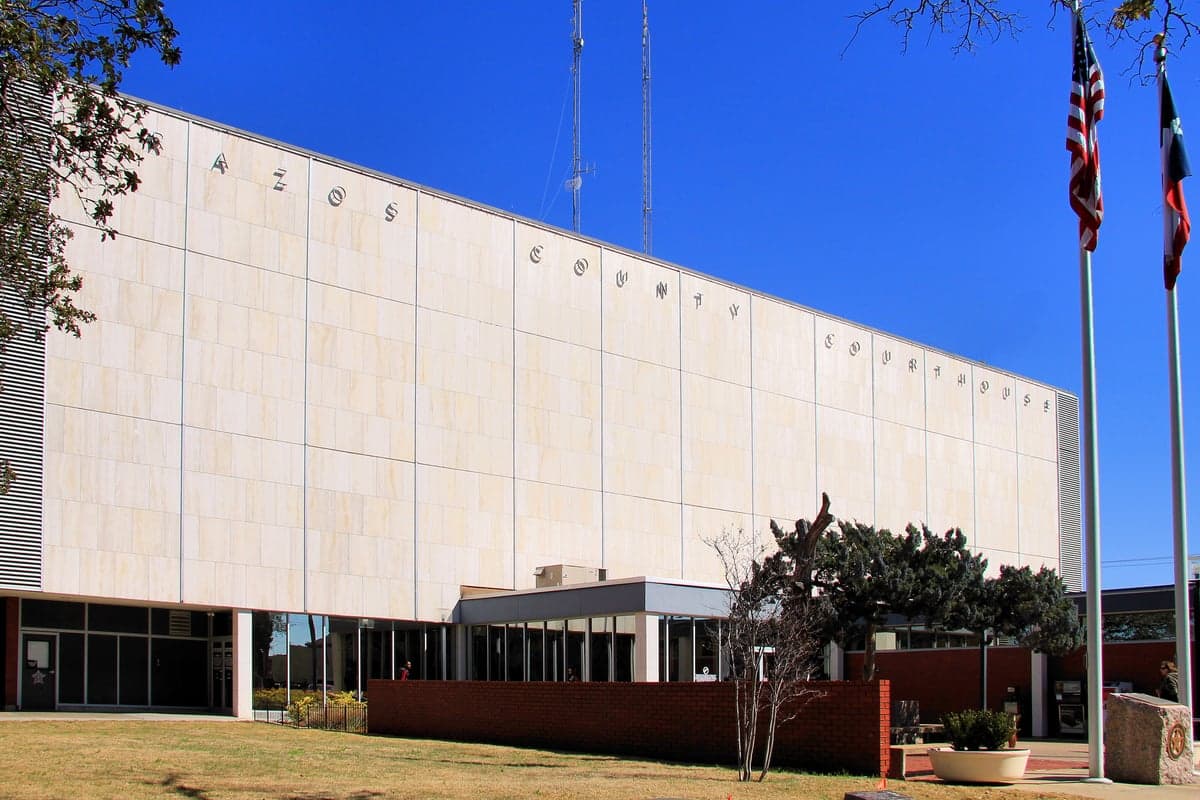
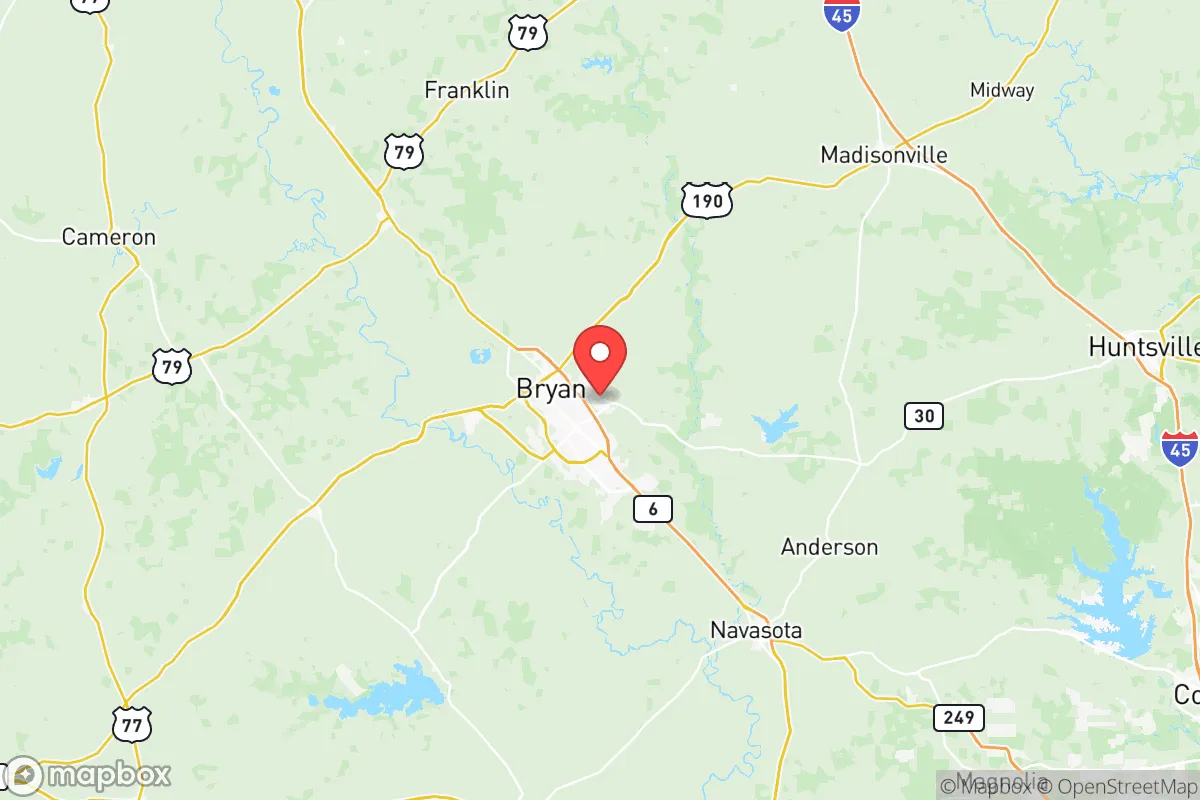
Photo: Wikipedia
Demographics of Brazos County
Affluence Level in Brazos County
A below-average socioeconomic profile. Incomes, home values, and educational attainment trail the U.S., with higher poverty and unemployment.
People of Brazos County
Brazos County, anchored by the twin cities of Bryan and College Station, is home to 237,980 residents who form a distinctive blend of a classic Texas agricultural hub and a modern, university-driven economy. The population is notably young and educated, with 42.5% holding a college degree, a figure driven by Texas A&M University’s massive presence. The county’s identity is shaped by a White majority (53.5%) alongside a substantial Hispanic community (27.1%), a significant Black population (10.3%), and growing East/Southeast Asian (3.3%) and Indian (2.3%) enclaves, creating a social fabric that is both rooted in Southern tradition and increasingly global.
Settlement & growth (pre-1960)
Long before European settlement, the area that is now Brazos County was home to the Bidai, a group of Indigenous peoples who lived along the Brazos River basin. The Spanish and later Mexican governments claimed the region, but significant Anglo-American settlement did not begin until after Texas won independence in 1836. The Republic of Texas established the area as part of the Robertson Colony, and by the 1840s, settlers primarily from the U.S. South—Tennessee, Alabama, and Mississippi—arrived to farm cotton along the fertile river bottoms. These early settlers were largely of Scots-Irish and English descent, and they established the county seat of Boonville in 1841, though it was later moved to Bryan in 1866 after the railroad bypassed the original town.
The arrival of the Houston and Texas Central Railway in the 1860s transformed the county. The railroad spurred the founding of Bryan as a commercial center and brought a wave of German and Czech immigrants who settled in the surrounding farmlands, particularly around Wellborn and Millican. These groups established small family farms and contributed to the region’s agricultural diversity. After the Civil War, the county’s Black population grew significantly as freedmen and women moved to the area to work as sharecroppers and tenant farmers, forming communities such as Beverly Hills and Pecan Acres within Bryan. The founding of the Agricultural and Mechanical College of Texas (now Texas A&M University) in College Station in 1876 brought a new class of residents: faculty, staff, and students, though the town itself remained a small railroad stop for decades.
The early 20th century saw the county’s economy remain heavily tied to cotton and cattle, with the population growing slowly. The Dust Bowl of the 1930s brought a modest influx of displaced farmers from Oklahoma and the Texas Panhandle, but Brazos County did not experience the massive waves of Dust Bowl migration seen in West Texas. World War II and the subsequent G.I. Bill dramatically expanded Texas A&M, turning College Station from a sleepy college town into a growing population center. By 1960, the county’s population had reached roughly 44,000, still predominantly White and native-born, with a significant Black minority and a small Hispanic community primarily composed of Mexican-American families who had worked in agriculture for generations.
Modern era (post-1965)
The 1965 Hart-Cellar Act fundamentally reshaped Brazos County’s demographics, though the effects were initially slow. The most dramatic change came from the explosive growth of Texas A&M University, which transformed from a male-only military college into a coeducational research powerhouse. Starting in the 1970s, the university began recruiting internationally, bringing the first significant waves of East/Southeast Asian graduate students and faculty—particularly from China, South Korea, and Taiwan—who settled in College Station near the campus. By the 1990s, a distinct Indian subcontinent community had also formed, with professionals in engineering and medicine concentrating in neighborhoods like Southwood and Castlegate.
Domestic migration has been equally transformative. Since the 1980s, Brazos County has been a beneficiary of the broader Sun Belt shift, attracting families and retirees from the Rust Belt and California. The Hispanic population grew rapidly from the 1990s onward, driven by both immigration from Mexico and Central America and by domestic migration from other Texas cities. Today, Hispanic residents make up 27.1% of the county, with strong communities in Bryan’s historic downtown and eastern neighborhoods, as well as in Navasota (which straddles the county line). The Black population, now 10.3%, has remained stable but has seen internal shifts, with many families moving from older Bryan neighborhoods into newer subdivisions in College Station and the unincorporated area around Kurten.
The foreign-born population stands at 8.2%, a figure that is modest by national standards but significant for a mid-sized Texas county. The largest foreign-born groups are from Mexico, India, China, and Vietnam. These communities are not highly segregated; instead, they tend to disperse across the county’s newer suburban developments, though a notable concentration of Indian families exists near the Texas A&M Health Science Center. The county’s college-educated rate of 42.5% is nearly double the national average, reflecting the university’s gravitational pull on professionals and the growing tech and biomedical sectors in the Research Valley area.
The future
Brazos County is on a trajectory toward greater diversity and continued growth. The White share of the population has declined from roughly 65% in 2000 to 53.5% today, and this trend is expected to continue as younger, more diverse cohorts age into the population. The Hispanic share is projected to rise toward 30-35% over the next two decades, driven by both natural increase and continued migration. The East/Southeast Asian and Indian communities are also likely to grow, as Texas A&M continues to recruit internationally and the local economy diversifies beyond agriculture into research, healthcare, and technology.
New residential development is concentrated in the southern and western edges of College Station, around Rock Prairie and Wellborn, as well as in master-planned communities like Miramont and Pebble Creek. These areas are attracting a mix of young families, university faculty, and professionals, and they are notably more diverse than the county’s older neighborhoods. Bryan is experiencing a revival of its historic downtown, drawing younger residents and creating a more urban feel. The county’s cultural identity is evolving from a conservative, agrarian-rooted community into a more politically mixed, education-driven region, though it remains a reliably Republican area in statewide elections.
For someone moving in now, Brazos County offers a unique combination: a low cost of living, a strong job market anchored by the university and the growing medical district, and a population that is becoming more diverse and educated by the year. The county is not a melting pot in the style of Houston or Dallas, but it is a place where distinct communities—longtime White families, Hispanic agricultural workers, Black professionals, and Asian academics—coexist with a degree of stability. The next decade will likely see the county become more suburban, more diverse, and more connected to the broader Texas Triangle, while retaining the small-city feel that defines Bryan-College Station.

* Values derived from national, state, county, city and local statistics and may differ in a specific area. Last updated: 2026-06-27T07:09:24.000Z
Narrative content on this page is AI-generated and may contain mistakes. Verify any details that matter before acting on them.
ReloMaps may earn a commission from affiliate links at no extra cost to you.

