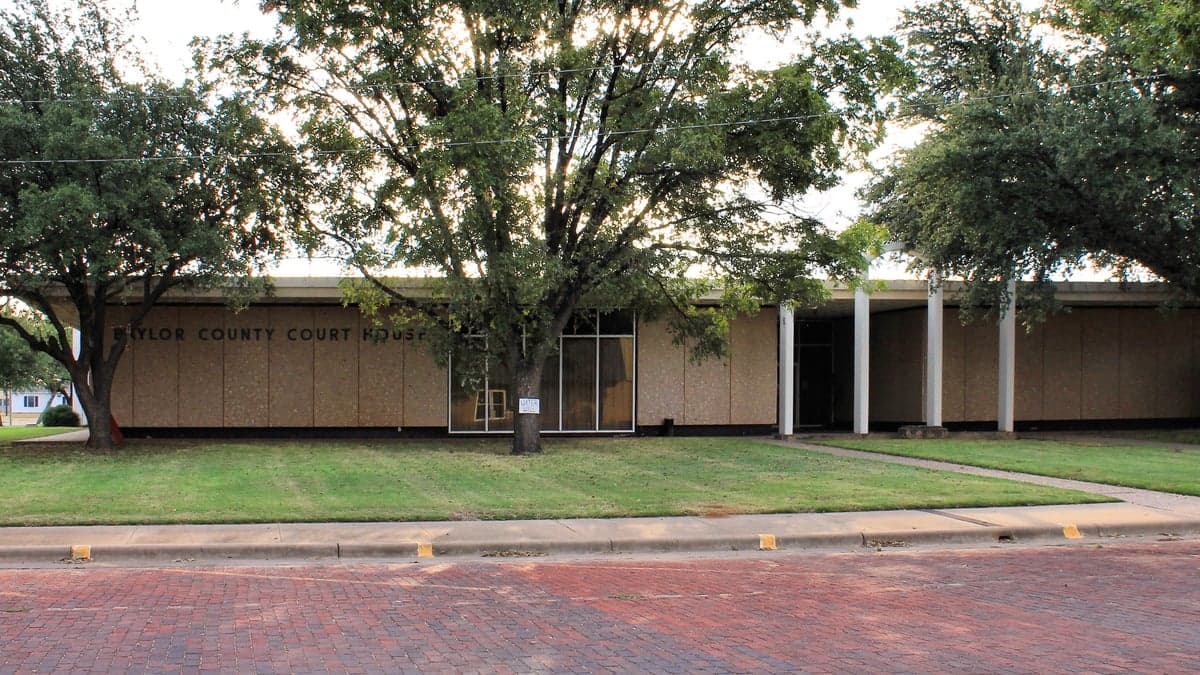
Photo: Wikipedia
Political ClimatePolitical Climate in Baylor County
Showing county-level results — no local-only data available.
Lean and PVI are calculated from this county’s 2020 and 2024 presidential results, Cook-style.
Political rankings in Texas
- Most Conservative Cities in Texas
- Most Liberal Cities in Texas
- Best Liberal-Leaning Towns in the South
- Safest Liberal-Leaning Towns in the South
- Safest Conservative-Leaning Towns in the South
- Affordable Small Towns for Conservatives
- Most Affordable Liberal-Leaning Small Towns in the U.S.
- Safest Conservative-Leaning Cities in the U.S.
- Most Conservative Counties in Texas
- Most Liberal Counties in Texas
Local Political AnalysisPolitical Analysis of Baylor County
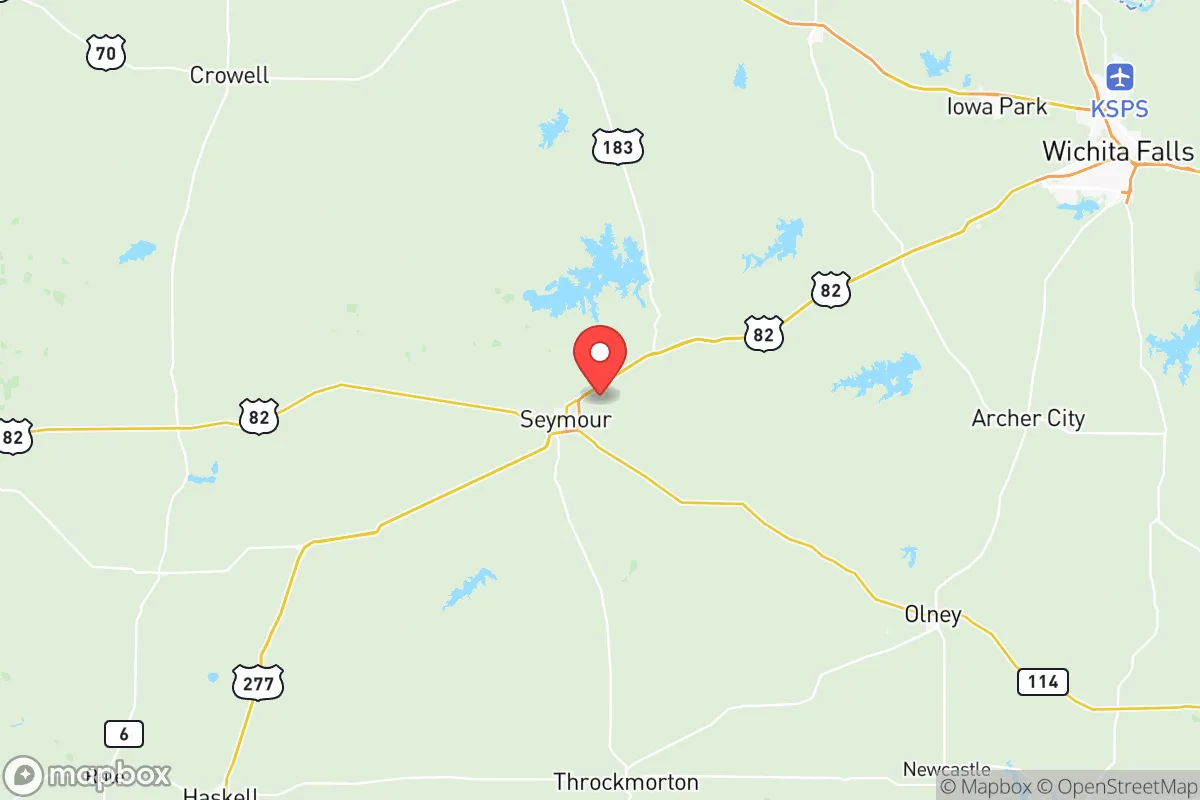
Baylor County, Texas, is a deeply conservative area with a Cook Partisan Voting Index of R+24, meaning it votes about 24 points more Republican than the national average. This isn't a recent shift; the county has been a Republican stronghold for decades, and the trend has only solidified in the last two election cycles. While the state of Texas as a whole is also reliably red, Baylor County is significantly more conservative than the state's average, which leans Republican but includes major urban centers like Houston and Dallas that pull the overall index toward the center.
How it compares
Compared to Texas as a whole, Baylor County is a political outlier even within a red state. The state's Cook PVI is not officially calculated, but based on recent presidential results, Texas leans roughly R+5 to R+8. That means Baylor County is three to four times more Republican than the state average. Within the county itself, there's little variation: the largest town, Seymour, votes overwhelmingly red, with precincts near the downtown core showing slightly less conservative margins but still solidly Republican. The smaller communities like Mabelle and Bomarton are even more uniformly conservative, often seeing Republican candidates win by 80% or more. There are no notable "blue" towns or swing precincts in Baylor County; the political spectrum here runs from deep red to deeper red.
What this means for residents
For conservative residents, life in Baylor County means their values are reflected in local policy and culture. The county commission, school board, and city council in Seymour are all dominated by Republicans, and issues like gun rights, limited regulation, and traditional social values are mainstream. For liberal residents, the reality is more isolating. There is no organized Democratic presence, and progressive viewpoints are rarely voiced in public forums. A liberal resident in Seymour would likely feel politically invisible, with few like-minded neighbors and little representation in local government. That said, the county's small population—around 3,500 people—means that personal relationships often transcend political differences, and most residents prioritize neighborliness over partisanship in daily life.
Culturally, Baylor County is distinct from urban Texas in its emphasis on self-reliance and local tradition. The county is dry, meaning alcohol sales are restricted, which reflects the strong influence of conservative Christian values. Policy-wise, the county government focuses on low taxes and minimal services, with a property tax rate that is among the lowest in the state. There is little appetite for new regulations or public spending, and residents generally expect to solve their own problems without government intervention. For someone moving from a more liberal area, the adjustment would involve accepting a slower pace of life where community norms are enforced socially rather than legally, and where political debate is rare because there is so little disagreement. The trajectory is stable: Baylor County will remain deeply red for the foreseeable future, with no demographic or economic shifts on the horizon that would alter its political character.

State Political ClimatePolitical Climate in Texas
State Political AnalysisPolitical Environment in the State
Texas has been a reliably Republican state for the past three decades, but the margin has been tightening. In 2024, Donald Trump won the state by roughly 9 points, down from 11 points in 2020 and 16 points in 2012. The dominant coalition remains a mix of rural conservatives, suburban moderates, and evangelical voters, but explosive growth in the urban crescent—from Dallas-Fort Worth down through Austin and San Antonio to Houston—is steadily shifting the electorate. The state is not flipping blue anytime soon, but it is becoming more competitive, and the internal political battles are increasingly between the party’s establishment and its populist wing rather than between Democrats and Republicans.
Urban vs. rural divide
The political map of Texas is a study in extremes. The big four metros—Houston, Dallas-Fort Worth, San Antonio, and Austin—are the Democratic strongholds. Harris County (Houston) and Dallas County both went for Biden in 2020 by double digits, and Travis County (Austin) is one of the most liberal counties in the South. But drive 30 minutes outside any of these cities, and you hit deep red territory. The rural Panhandle, East Texas, and most of West Texas vote Republican by 60-80% margins. The suburbs are the real battleground: Collin County (north of Dallas) and Fort Bend County (southwest of Houston) were once reliably red but have become competitive as diverse, college-educated populations move in. Tarrant County (Fort Worth) flipped to Biden in 2020 for the first time since 1964, then flipped back to Trump in 2024. That kind of volatility is the new normal.
Policy environment
Texas has no state income tax, which is the single biggest policy draw for relocators. Property taxes are high to compensate—averaging around 1.6-1.8% of assessed value—but there is no tax on wages. The regulatory posture is famously business-friendly: no state-level occupational licensing for many trades, weak union protections, and a tort reform system that caps noneconomic damages in medical malpractice cases. Education policy is dominated by the school choice debate; the state has a private school voucher program that was expanded in 2023, but it remains means-tested and capped. Healthcare is a mixed bag: Texas has the highest uninsured rate in the country (roughly 17%), and the state has not expanded Medicaid under the ACA. Election laws were tightened in 2021 with SB 1, which added ID requirements for mail-in voting, limited drive-through and 24-hour voting, and gave poll watchers more access. Abortion is effectively banned after about six weeks under the 2021 Heartbeat Act (SB 8) and the 2022 trigger law that took effect after Dobbs.
Recent policy direction
The last three legislative sessions have pushed Texas sharply to the right on cultural and liberty issues. On guns, permitless carry became law in 2021 (HB 1927), meaning anyone over 21 who can legally possess a firearm can carry it openly or concealed without a license. On parental rights and education, the 2023 session passed HB 900, which restricts library materials deemed "sexually explicit" and requires vendors to rate books sold to schools. Speech on campus has been a flashpoint: SB 17 (2023) banned diversity, equity, and inclusion offices at public universities. Privacy and surveillance saw a notable shift with HB 1399 (2023), which restricts the use of facial recognition by government agencies without a warrant. On medical and bodily autonomy, the state has banned gender-affirming care for minors (SB 14, 2023) and maintained the near-total abortion ban. Property rights remain strong: Texas has no state-level property tax on business inventory, and eminent domain reform passed in 2023 to require higher compensation for landowners. Voting access is more restricted than in many states: early voting is generous (two weeks), but mail-in voting is limited to those over 65, disabled, or out of the county on election day.
Civil unrest & political movements
Texas has seen its share of political flashpoints. The 2020 protests in Austin over George Floyd's death were among the largest in the country, and the city council later cut the police budget by about $150 million—a move that was partially reversed after a spike in violent crime. Immigration politics are a constant: Governor Abbott's Operation Lone Star, launched in 2021, has deployed state troopers and National Guard to the border, bused migrants to sanctuary cities like New York and Chicago, and installed razor wire along the Rio Grande. The state is in an ongoing legal standoff with the Biden administration over border enforcement. Secession rhetoric flares up periodically—the Texas Nationalist Movement has some grassroots support—but it remains a fringe position. Election integrity controversies have been quieter since SB 1 passed, but some rural counties have seen disputes over voting machine security. A new resident would notice the political polarization most in the yard signs and bumper stickers: "Come and Take It" flags alongside "In This House We Believe" signs, often on the same block in swing suburbs like Round Rock or Denton.
Projection
Over the next 5-10 years, Texas will continue to drift toward competitiveness, but the pace depends on who moves in. The state is adding about 1,000 new residents a day, and a disproportionate share are from California and other blue states. Many of these newcomers are conservative or libertarian-leaning—drawn by low taxes and business opportunity—but enough are left-leaning to shift the margins in suburban districts. The Texas House is likely to remain under Republican control, but the majority could shrink to single digits. The big wild card is the Hispanic vote: Texas Hispanics have trended rightward in recent cycles, especially in the Rio Grande Valley (Hidalgo County went from +40 D in 2012 to +15 D in 2024). If that trend continues, the state could remain red for another generation. If it reverses, Texas becomes a true swing state by 2032. For a relocator, the practical implication is that the state's politics will remain conservative but increasingly contested, especially in the suburbs around Dallas, Houston, and San Antonio.
For a new resident, the bottom line is this: Texas is a low-tax, low-regulation state where conservative cultural values dominate state policy, but the big cities are liberal enclaves with their own local dynamics. If you are conservative, you will find the state government aligned with your views on guns, taxes, and education. If you are liberal, you will find your political home in the urban cores, but you will have limited influence on state-level policy for the foreseeable future. The political climate is not static—it is shifting under the weight of rapid growth—but the direction of change is slow and contested. Come for the economy and the space; stay for the community you choose, because the state is big enough to let you find your own political bubble.
* Values derived from national, state, county, city and local statistics and may differ in a specific area. Last updated: 2026-10-27T22:07:24.000Z
Narrative content on this page is AI-generated and may contain mistakes. Verify any details that matter before acting on them.
ReloMaps may earn a commission from affiliate links at no extra cost to you.

