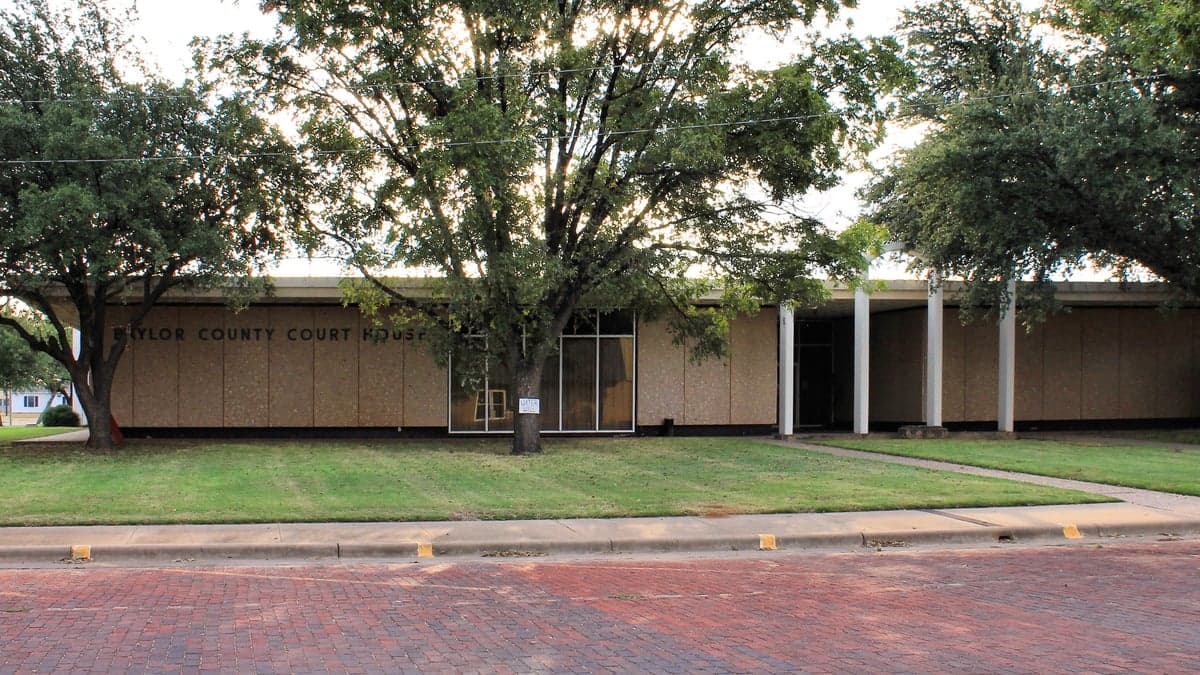
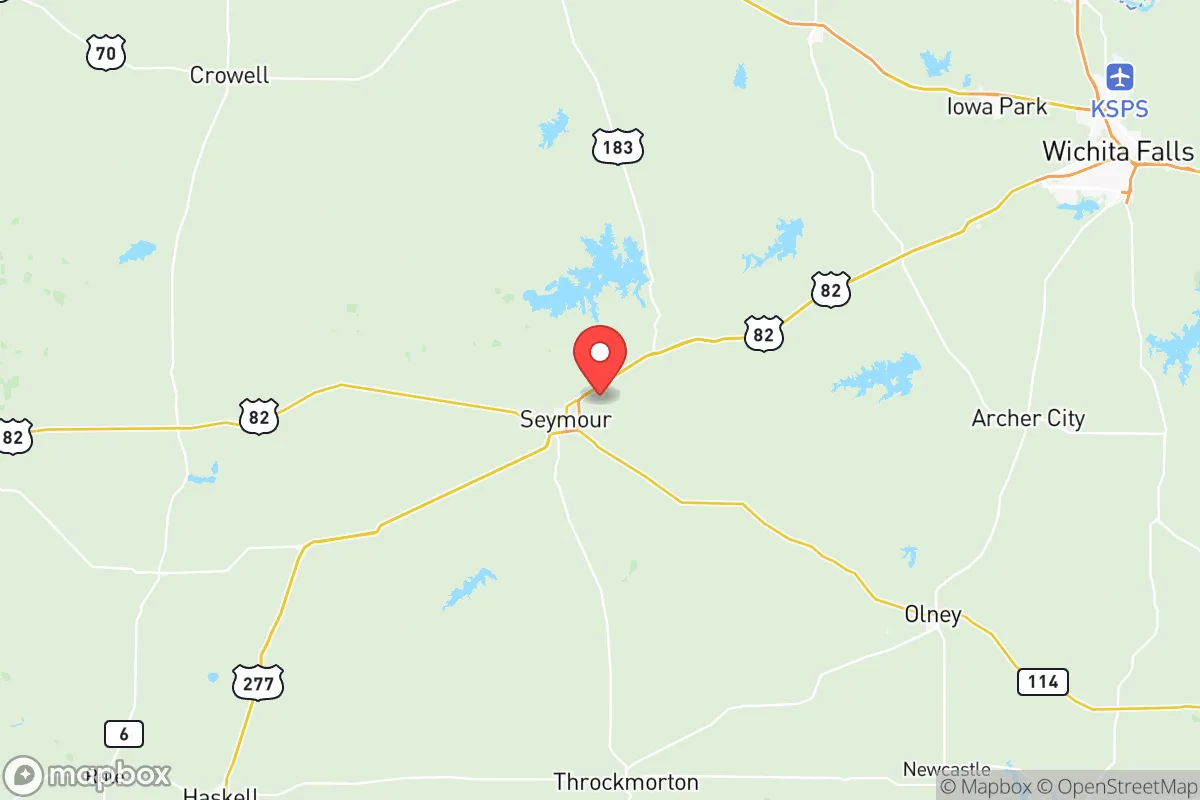
Photo: Wikipedia
Demographics of Baylor County
Affluence Level in Baylor County
A low-income area with significant economic hardship. Household wealth and educational attainment are well below national averages.
People of Baylor County
Baylor County, Texas, is a sparsely populated rural county of 3,464 residents, characterized by a predominantly white (75.9%) and Hispanic (13.7%) population, with a very low foreign-born share of just 1.4%. Its identity is rooted in ranching, oil, and a deep sense of small-town independence, centered on the county seat of Seymour. The county’s human history is one of boom-and-bust cycles, from Native American occupation to cattle drives and oil strikes, leaving a present-day population that is aging, shrinking, and overwhelmingly native-born.
Settlement & growth (pre-1960)
Before Anglo-American settlement, the area that is now Baylor County was part of the southern Plains, inhabited by Comanche and Kiowa peoples who followed bison herds. Spanish and Mexican expeditions passed through but established no permanent settlements. The first permanent Anglo settlers arrived in the 1870s, after the U.S. Army’s Red River War (1874-1875) forcibly removed the Comanche and Kiowa to reservations in Oklahoma. These early settlers were primarily Scots-Irish and English ranchers from the Lower South (Tennessee, Arkansas, and East Texas), drawn by the promise of open range for cattle grazing. The county was officially organized in 1879, and the town of Seymour was established as the county seat, named after a railroad official. A second wave of settlers, including German and Czech farmers, arrived in the 1880s and 1890s, drawn by the expansion of the Wichita Valley Railway and the availability of cheap land for cotton farming. These families established small farming communities like Mabelle and Bomarton, which remain as unincorporated crossroads today. The discovery of oil in the 1920s, particularly in the Westover area, brought a brief boom of transient workers, but the population peaked at 7,755 in 1930. The Dust Bowl and the Great Depression hit the county hard, causing a steady decline as cotton farming collapsed and families moved to cities like Wichita Falls and Dallas. By 1960, the population had fallen to 5,893, and the county’s agricultural base had shifted from cotton to cattle and wheat.
Modern era (post-1965)
The post-1965 era, shaped by the Hart-Cellar Act, had minimal direct impact on Baylor County’s demographics. The county’s foreign-born population remains at just 1.4%, and there are no significant enclaves of post-1965 immigrant groups. Instead, the county’s modern demographic story is one of domestic out-migration and Hispanic growth. Since the 1970s, the county has lost population to urban centers, with the 2020 census recording 3,465 residents—a 55% decline from the 1930 peak. The Hispanic share has grown from under 5% in 1980 to 13.7% today, driven by Mexican-American families moving from South Texas and the Rio Grande Valley for work in ranching, oilfield services, and the county’s small manufacturing base. These families have concentrated in Seymour, where they form a visible part of the workforce in construction, agriculture, and the local hospital. The Black population remains negligible at 0.8%, and there are no recorded East/Southeast Asian or Indian-subcontinent residents. The county’s college-educated share is 28.4%, slightly below the state average, reflecting the limited white-collar job market. Suburbanization has not occurred; instead, the county has experienced a slow hollowing-out, with young people leaving for education and jobs, and retirees staying put.
The future
Baylor County’s population is projected to continue its slow decline, with the Texas State Data Center estimating a drop to around 3,200 by 2040. The county is becoming slightly more diverse, with the Hispanic share expected to rise to 18-20% as younger Hispanic families have higher birth rates and some Anglo residents age out. However, the county is not attracting new immigrant communities; the foreign-born share will likely remain below 2%. The cultural identity of the county is evolving from a purely Anglo ranching culture to a more blended Texan-Mexican one, visible in local events like the Seymour Rodeo and the annual Baylor County Fair. New residents are almost exclusively domestic migrants—retirees seeking low taxes and a quiet life, or a small number of remote workers drawn by cheap housing. The county’s future hinges on whether it can retain its young people and attract new families, which will require economic diversification beyond oil and cattle. For now, it remains a place where the population is shrinking, aging, and slowly diversifying, but still overwhelmingly white and native-born.
For someone moving in now, Baylor County offers a deeply traditional, rural lifestyle with low crime, low cost of living, and a strong sense of community, but also limited economic opportunity and a population that is not growing. It is a place for those seeking solitude and self-reliance, not for those looking for a diverse, dynamic, or expanding job market.

* Values derived from national, state, county, city and local statistics and may differ in a specific area. Last updated: 2026-10-27T22:07:24.000Z
Narrative content on this page is AI-generated and may contain mistakes. Verify any details that matter before acting on them.
ReloMaps may earn a commission from affiliate links at no extra cost to you.

