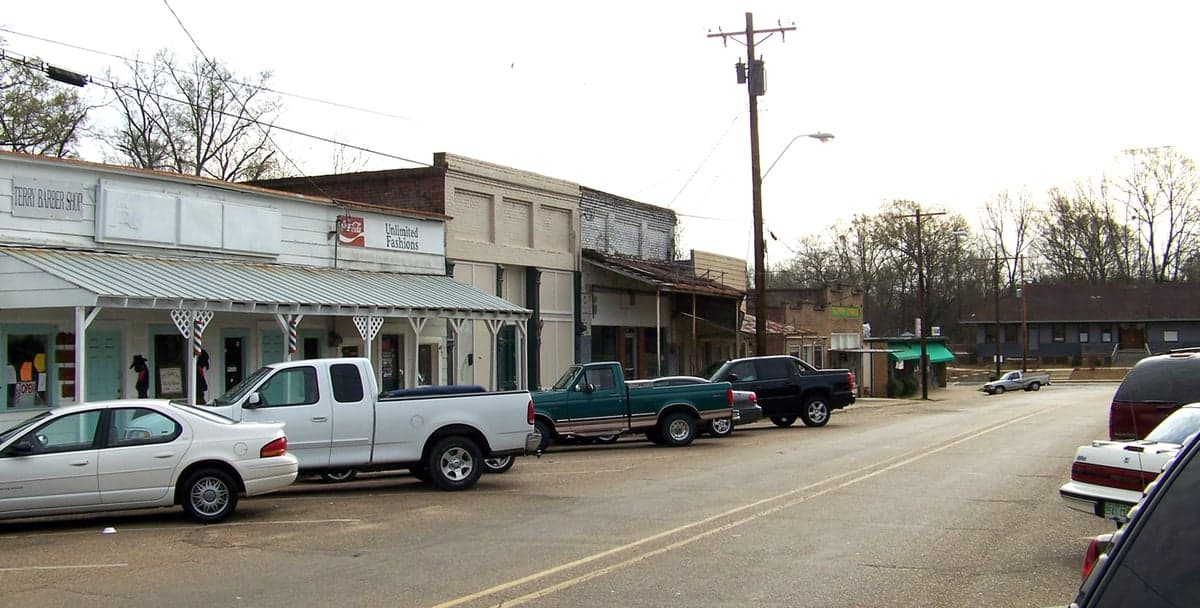

Photo: Wikipedia
Political ClimatePolitical Climate in Terry, MS
District shown is the primary district for this city’s centroid. Cities may span multiple districts.
Inherited from parent state — no local data available.
Local Political AnalysisPolitical Analysis of Terry, MS
Terry, Mississippi, sits squarely in one of the most reliably Republican corners of an already deep-red state. With Mississippi holding a Cook PVI of R+11, Terry and the surrounding Hinds County suburbs lean even further right than the state average, typically voting 65–70% for GOP presidential candidates in recent cycles. This isn’t a recent shift—it’s been building for three decades, tracking the broader realignment of the Jackson metro’s outer ring.
How it compares
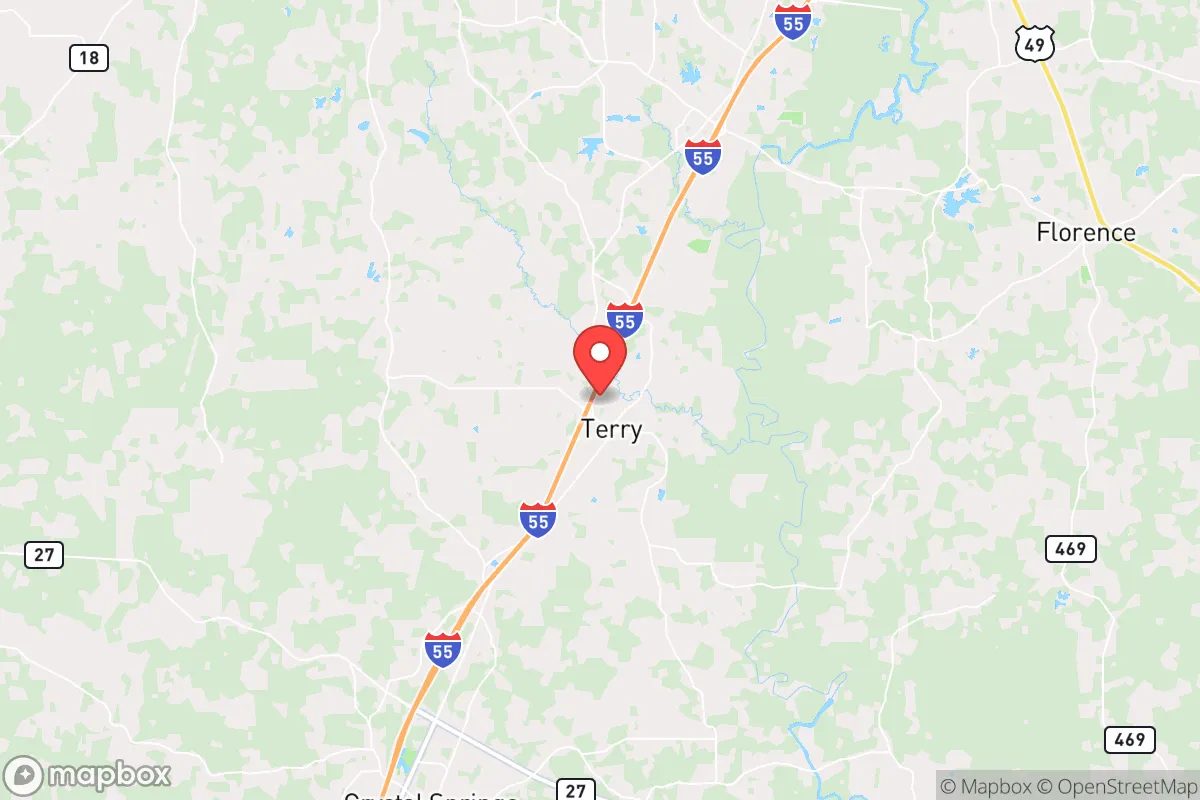
Terry’s politics are best understood against its immediate neighbors. Just 15 miles north, the city of Jackson is a Democratic stronghold, routinely voting 85–90% for Democratic candidates and serving as the state’s anchor for Black political power and progressive organizing. Terry, by contrast, is part of the white, exurban corridor that stretches from Brandon through Florence and into Terry—a belt that has grown more conservative as Jackson’s population has declined. The contrast is stark: a drive up Highway 18 takes you from Trump signs and “Don’t Tread on Me” flags in Terry to Harris-Walz yard signs and Black Lives Matter banners in Jackson’s Fondren neighborhood within 20 minutes.
What makes Terry distinctive is its racial and economic composition. Unlike the wealthier, whiter suburbs to the east (Madison, Ridgeland), Terry has a significant Black middle-class population, many of whom are politically moderate or conservative on social issues but vote Democratic in national races. This creates a more nuanced local dynamic than the monolithic red of, say, Rankin County. Precinct-level results in Terry often show 55–60% Republican, with the remainder split between Democrats and third-party protest votes—a pattern that reflects a community where church affiliation and family tradition matter as much as party loyalty.
What this means for residents
For conservatives, Terry is a comfortable place to live. The Hinds County Republican Party is active but not dominant, and local offices—sheriff, chancery clerk, county supervisor—are still competitive, meaning GOP voters have real influence without the sense of being in a permanent minority. The practical effect is lower taxes and a hands-off approach to zoning and development, which residents appreciate. For liberals, the reality is more isolating. There’s no active Democratic precinct organization in Terry itself; the nearest one is in Jackson, and attending it means crossing a political and cultural divide that feels wider than the 15 miles. Progressive residents often find their social circle through churches or schools rather than politics, and many simply don’t discuss their views at work or community events.
The trajectory is toward more Republican dominance, not less. As Jackson’s population continues to decline—down roughly 10% since 2020—more of its former residents are moving to Terry and similar exurbs, but they’re not bringing Jackson’s politics with them. The newcomers are largely Black families seeking better schools and safer streets, and while they vote Democratic in national races, they often split tickets locally. The net effect is a community that’s becoming more diverse demographically but not more liberal politically.
What this means for residents
In practice, Terry’s political climate means low drama and high stability. There’s no contentious city council (Terry is unincorporated, governed by Hinds County), no local school board fights over curriculum, and no visible political protests. The issues that dominate local conversation are practical: road maintenance on Highway 18, the new water tower, and whether the Dollar General will ever get a second checkout lane. State politics matter more than local—Terry residents are keenly aware that their state legislators in Jackson are conservative, and they vote accordingly. The cultural markers are Southern Baptist churches, hunting leases, and Friday night football at Terry High School. For a liberal, it’s a place to live quietly; for a conservative, it’s a place to live openly. Both can coexist, and mostly do, because the shared identity of being from Terry—a small town that still feels like one—trumps party affiliation in most daily interactions.

State Political ClimatePolitical Climate in Mississippi
State Political AnalysisPolitical Environment in the State
Mississippi is one of the most reliably Republican states in the country, holding a Cook PVI of R+11, but the real story is how that dominance has solidified over the last two decades. The state hasn't voted for a Democratic presidential candidate since Jimmy Carter in 1976, and the GOP's grip has only tightened since the 2010 midterms, when the party swept every statewide office. Today, the coalition is built on a foundation of white evangelical voters, rural and small-town residents, and a growing suburban base in the Jackson metro's outer rings, while Black voters—who make up nearly 38% of the population—remain overwhelmingly Democratic but are increasingly concentrated in urban centers and the Delta.
Urban vs. rural divide
The political map of Mississippi is a stark study in geographic polarization. The state's few urban islands—Jackson, the capital, and to a lesser extent the college towns of Oxford and Starkville—are Democratic strongholds. Jackson is the anchor of the resistance, consistently voting 85-90% Democratic, but its influence is diluted by the fact that it's a shrinking city with a stagnant population. The real Republican engine is the suburban and exurban ring around Jackson, particularly in Rankin County and Madison County, which have become some of the most reliably red suburbs in the South. Madison, in particular, has transformed from a sleepy bedroom community into a political powerhouse, with its affluent, family-oriented voters driving turnout for the GOP. Meanwhile, the Gulf Coast cities of Biloxi and Gulfport lean Republican but are more competitive, with a strong blue-collar, veteran-heavy demographic that responds to both economic populism and national security messaging. The Delta region—places like Greenville and Clarksdale—is the poorest and most Democratic part of the state outside Jackson, but its population decline has steadily eroded its electoral weight. The rural Pine Belt and Northeast Mississippi, anchored by Tupelo and Corinth, are deeply conservative, with cultural and religious issues often overshadowing economic ones at the ballot box.
Policy environment
Mississippi's policy environment is a textbook example of a low-tax, limited-government state, but with a few distinctive wrinkles. The state has no income tax on Social Security benefits and has been phasing down its personal income tax, with a plan to eliminate it entirely by 2026—a move that makes it one of the most tax-competitive states in the Southeast. The regulatory posture is decidedly business-friendly, with a right-to-work law and a tort reform regime that has capped non-economic damages in lawsuits, making it a magnet for manufacturing and logistics firms. Education policy is a mixed bag: the state has embraced school choice, with a robust charter school law and an Education Scholarship Account program passed in 2024 that allows parents to use public funds for private school tuition. However, public schools remain chronically underfunded, and the state's literacy rates are among the lowest in the nation. Healthcare is where Mississippi diverges most sharply from its regional peers—it is one of only ten states that have not expanded Medicaid under the Affordable Care Act, leaving roughly 80,000 working-age adults in the "coverage gap." Election laws are strict but not restrictive: the state requires a photo ID to vote, has no same-day registration, and does not offer no-excuse absentee voting, though it does have early in-person voting starting in 2025.
Recent policy direction
The last few legislative sessions have pointed Mississippi decisively toward a conservative cultural and legal agenda. In 2024, the state passed a near-total abortion ban with no exceptions for rape or incest, triggering immediately upon the Dobbs decision and leaving the state with one of the most restrictive reproductive laws in the country. On guns, Mississippi is a constitutional carry state—no permit is required to carry a concealed firearm—and in 2023 it added a "stand your ground" expansion that removed the duty to retreat in any place where a person has a legal right to be. Parental rights have been a major theme: the 2024 Education Scholarship Account law was framed explicitly as a parental empowerment measure, and the state has banned transgender athletes from competing in girls' sports and prohibited gender-affirming care for minors. On speech and privacy, Mississippi passed a law in 2023 requiring age verification for adult content websites, and it has resisted federal pressure on surveillance, with local law enforcement agencies declining to participate in certain federal data-sharing programs. Property rights are strongly protected, with a 2021 law that prohibits foreign nationals from certain countries from owning agricultural land. The overall direction is unmistakable: a state that is doubling down on individual liberty in the cultural sphere while maintaining a tight fiscal leash on government spending.
Civil unrest & political movements
Mississippi's political movements are less about street protests and more about institutional and legal battles. The state has a long and painful history of civil rights activism, and that legacy still shapes its politics—the 2022 special election in the 2nd Congressional District, which includes Jackson and the Delta, saw national attention focused on the state's voting rights record. The most visible flashpoint in recent years has been the fight over the state flag, which was changed in 2020 to remove the Confederate battle emblem, a decision that was driven by a coalition of business leaders and Black lawmakers but opposed by a significant segment of the white rural base. Immigration politics are relatively quiet, as Mississippi has a small foreign-born population, but the state has passed laws requiring E-Verify for public employers and banning sanctuary cities. Election integrity has been a recurring theme, with the state's Republican Secretary of State, Michael Watson, pushing for stricter voter roll maintenance and a 2023 law that added new signature verification requirements for absentee ballots. There is no serious secessionist movement, but there is a strong strain of states'-rights rhetoric, particularly around federal environmental regulations on the Gulf Coast and the Tennessee-Tombigbee Waterway. A new resident would notice the absence of large-scale protests—the state's political energy is channeled through churches, civic clubs, and county party committees rather than the streets.
Projection
Looking ahead five to ten years, Mississippi's political trajectory is likely to remain on a steady conservative course, but with some subtle shifts. The state's population is aging and slowly growing, driven by in-migration of retirees and remote workers from higher-cost states like California and Illinois, who are drawn by low taxes and low housing costs. These newcomers tend to be fiscally conservative but socially moderate, which could soften the edges of the state's cultural agenda over time. The suburbs around Jackson, particularly Madison and Rankin, are likely to become even more influential as the urban core continues to decline, and the Gulf Coast is poised for growth as a logistics and energy hub. The Democratic Party's base in Jackson and the Delta will continue to shrink demographically, but the party could gain ground if it can make inroads with the growing Latino population in the poultry-processing towns of the Pine Belt, like Morton and Forest. The elimination of the income tax by 2026 will be a defining fiscal moment, and the state's ability to fund infrastructure and education without that revenue will be a key test. The most likely scenario is a state that remains solidly Republican but becomes slightly less culturally rigid, more economically dynamic, and more integrated into the national migration patterns of the Sun Belt.
For a new resident, the bottom line is that Mississippi offers a political environment that is overwhelmingly conservative in practice, with low taxes, strong gun rights, and a government that is generally deferential to local control. A conservative family will find a welcoming atmosphere where their values are reflected in state law and local institutions. A liberal resident will find themselves in a clear minority, but not an oppressed one—the state's political culture is more about neglect than hostility, and the cities of Jackson, Oxford, and Starkville provide enclaves of progressive thought. The practical takeaways are simple: if you want a state where your vote for a Republican candidate will almost certainly be in the majority, where your tax burden is light, and where the pace of life is slow, Mississippi delivers. If you're looking for a competitive political battleground or a place where your progressive vote will be contested, you'll want to look elsewhere. The state is what it is—a deeply rooted, culturally conservative place that is slowly, cautiously opening up to the broader American mainstream.
* Values derived from national, state, county, city and local statistics and may differ in a specific area. Last updated: 2026-10-27T04:33:10.000Z
Narrative content on this page is AI-generated and may contain mistakes. Verify any details that matter before acting on them.
ReloMaps may earn a commission from affiliate links at no extra cost to you.

