Photo: Wikipedia
Demographics of Terry, MS
Affluence Level in Terry, MS
A below-average socioeconomic profile. Incomes, home values, and educational attainment trail the U.S., with higher poverty and unemployment.
People of Terry, MS
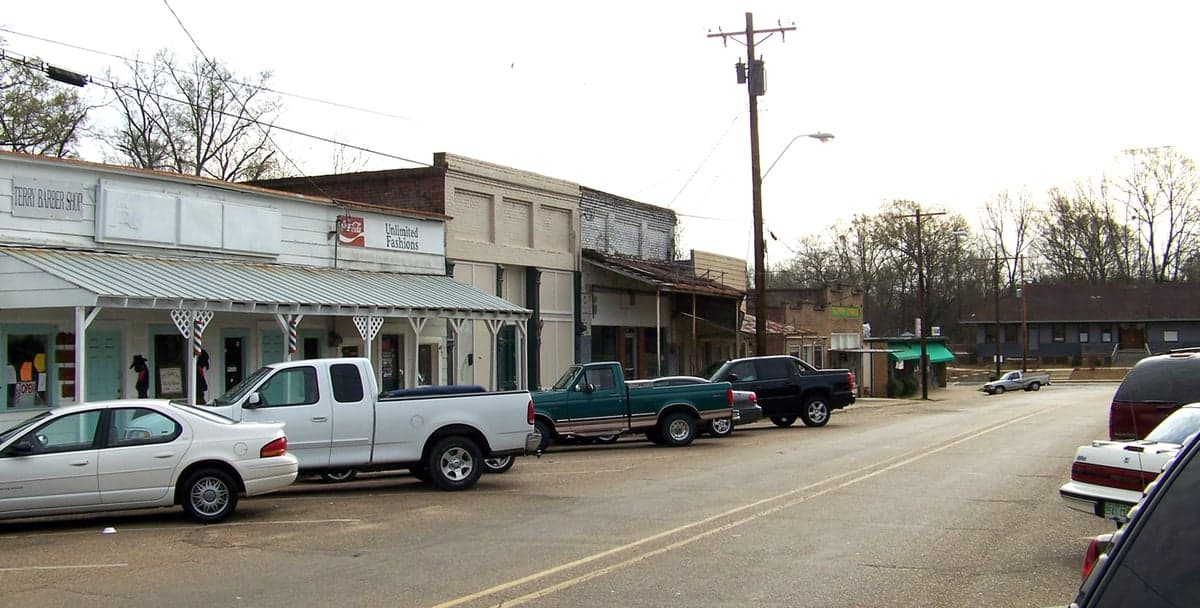
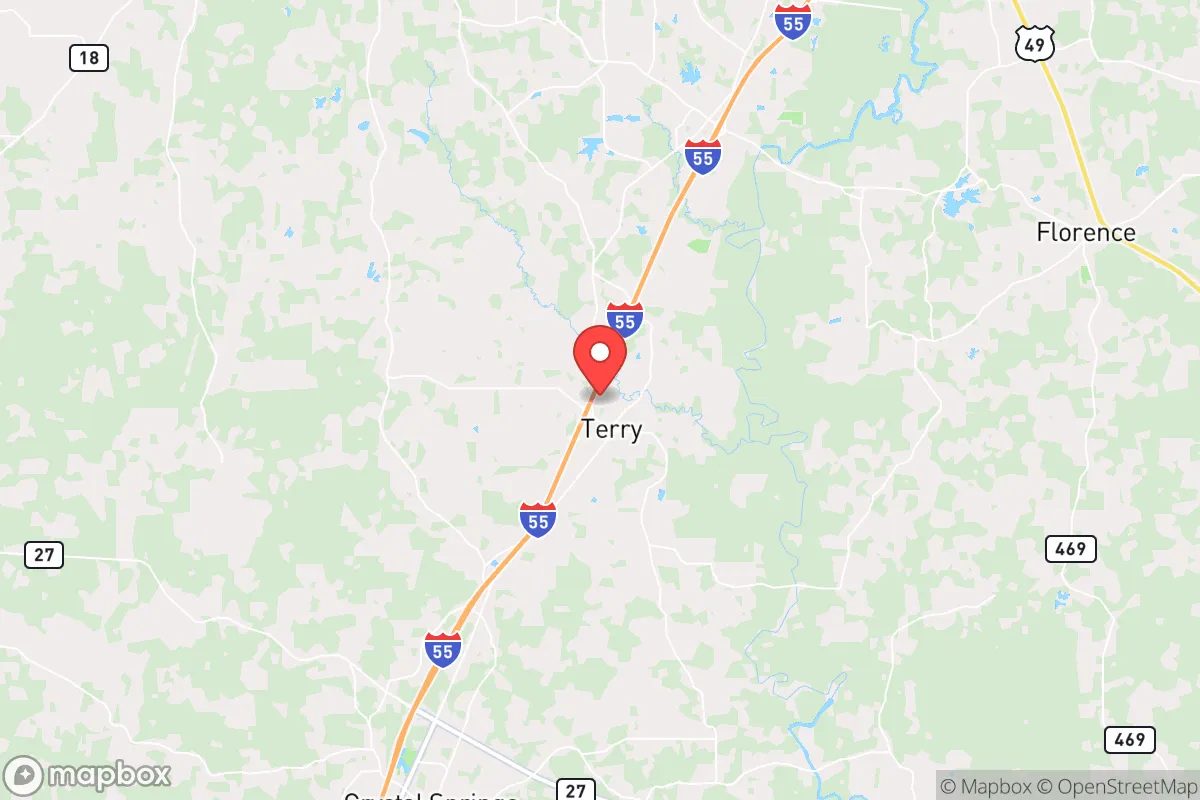
Terry, Mississippi, is a small town of roughly 2,300 residents in Hinds County, sitting about 20 miles south of Jackson along U.S. Highway 51. The population today is predominantly native-born — only 1.4% of residents are foreign-born — with a demographic makeup of 55.4% White, 36.9% Black, 3.6% Hispanic, and small East/Southeast Asian and Indian-subcontinent communities. It is a community with deep rural Southern roots, a working-class character, and a slower pace of life that increasingly attracts families seeking affordable housing within commuting distance of the state capital.
How the city was settled and grew
Terry traces its origins to the antebellum period, when the area was developed as cotton plantation land. The town itself was formally established in the 1870s, named after a local landowning family, and grew as a railroad stop along the Illinois Central line. The original population was a mix of White yeoman farmers and enslaved Black laborers whose descendants remained after emancipation as sharecroppers and tenant farmers. The historic core, centered around the old railroad depot and Main Street, was built by these early residents — Black families settled in the area now known as Old Terry, while White merchants and landowners clustered closer to the depot and the highway. The economy remained agricultural through the early 20th century, with cotton and timber as the primary drivers, and the population stayed small and stable until the post-war era.
Modern era (post-1965)
The 1965 Hart-Celler Act had little direct effect on Terry, as the town never attracted significant international immigration — the foreign-born share remains under 2% today. Instead, the modern era has been defined by domestic migration and suburban spillover from Jackson. Beginning in the 1970s and accelerating through the 1990s, White families moved south from the capital city seeking larger lots and lower taxes, developing subdivisions like Terry Estates and Lake Forest along the Highway 51 corridor. In the same period, Black families who had historically lived in the older sections began moving into newer developments such as Rolling Hills and Southwood, reflecting a gradual economic advancement and a shift away from the agricultural labor force. The Hispanic population, while small at 3.6%, began appearing in the 2000s, largely drawn by work in poultry processing and construction in the broader Hinds County area; these families have concentrated in rental properties near the highway rather than in established subdivisions. The East/Southeast Asian share (0.7%) and Indian-subcontinent share (0.3%) are minimal, consisting mostly of a handful of professional families and small business owners, primarily in the medical and retail sectors.
The future
Terry's population is slowly diversifying, though it remains overwhelmingly native-born and split nearly evenly between White and Black residents. The Hispanic share, while small, is the fastest-growing segment, and new residential construction is occurring in the Terry Crossing and North Terry areas, which are attracting a mix of young families and retirees priced out of Jackson's closer suburbs. The college-educated share stands at 24.2%, below the national average but rising as remote work allows more professionals to live in the area. Over the next 10-20 years, the town is likely to see continued slow growth, with the Black and Hispanic populations increasing modestly while the White share gradually declines. The cultural identity is shifting from a purely agricultural heritage toward a commuter-suburb character, though the town retains its Southern Baptist church culture, Friday-night football traditions, and a strong sense of local identity that newcomers are expected to assimilate into.
For someone moving to Terry today, the town offers a straightforward, affordable, and safe environment with a clear demographic trajectory: it is becoming more suburban, slightly more diverse, and more connected to Jackson's economy, but it remains a place where longtime residents set the tone. Newcomers will find a community that values self-reliance, neighborliness, and traditional institutions, and where the pace of change is deliberate rather than disruptive.

* Values derived from national, state, county, city and local statistics and may differ in a specific area. Last updated: 2026-10-27T04:33:10.000Z
Narrative content on this page is AI-generated and may contain mistakes. Verify any details that matter before acting on them.
ReloMaps may earn a commission from affiliate links at no extra cost to you.

