
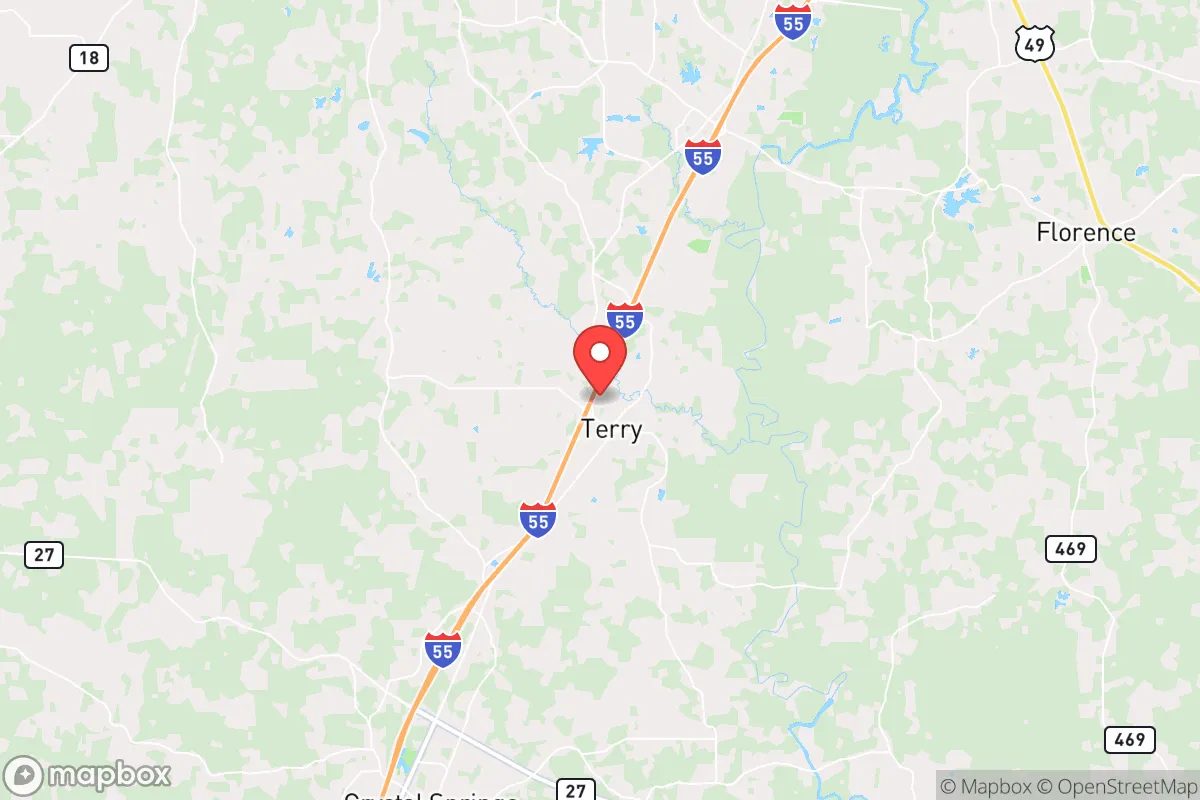
Photo: Wikipedia
Personal Sovereignty in Terry, MS
Viable for self-reliance. Generally workable, though some barriers may limit total independence.
What does Personal Sovereignty tell us?
Personal Sovereignty measures your capacity for self-reliance and independence with minimal government friction. Higher scores mean fewer barriers between you and the way you want to live... but it assumes you have the space you need and good neighbors.
What does this tell us?
Personal Sovereignty measures your capacity for self-reliance and independence with minimal government friction. Higher scores mean fewer barriers between you and the way you want to live... but it assumes you have the space you need and good neighbors.
State Policy
Energy independence: Importer (50% of energy produced in-state)
Personal Liberty
Homesteading

Personal Liberty Analysis
Terry, Mississippi, sits in a state that consistently ranks among the most freedom-oriented in the country for individuals who prioritize minimal government interference. For a resident of this Hinds County community, the operative reality is that Mississippi’s constitutional and statutory framework leans heavily toward personal autonomy, low taxation, and a light regulatory touch. The environment here is not one of radical libertarian experimentation, but rather a deeply traditional Southern posture where the default answer from the state is usually "yes, unless there is a compelling reason to say no." For a single person or family weighing relocation, the practical question is how this translates into daily life, property rights, and the ability to keep more of what you earn.
Tax burden and regulatory posture in Terry and Hinds County
Mississippi’s tax structure is among the most favorable in the nation for those seeking to minimize the state's claim on their income. The state imposes a flat 4.0% individual income tax rate on taxable income above $10,000, and the legislature has been actively phasing out the income tax entirely, with a full elimination scheduled by 2026. There is no state tax on Social Security benefits, and retirees receive a full exemption on qualified retirement income, making Terry a strategic location for those planning an independent retirement. Property taxes are notably low; the statewide average effective rate hovers around 0.65% of home value, and Hinds County’s millage rates, while higher than rural counties due to Jackson’s municipal services, remain well below the national average. The regulatory posture is equally restrained: Mississippi is a right-to-work state, has no state-level minimum wage above the federal $7.25, and maintains a one-stop business portal that allows a sole proprietorship to be registered in under an hour. For a homeowner in Terry, the absence of county-level zoning in unincorporated areas means fewer bureaucratic hurdles for outbuildings, fences, or home-based businesses than in neighboring incorporated towns like Byram or Richland.
Self-defense and gun law specifics for Terry residents
Mississippi is a constitutional carry state, meaning that as of 2016, any person 18 or older who is legally allowed to possess a firearm may carry it openly or concealed without a permit. Terry residents benefit from this directly: there is no requirement to obtain a license, pay a fee, or complete a training course to exercise the right to bear arms. The state’s "stand your ground" statute, codified in Mississippi Code § 97-3-15, removes any duty to retreat before using deadly force if you are in a place where you have a right to be and reasonably believe force is necessary to prevent death, great bodily harm, or a forcible felony. This applies to your home, your vehicle, and public spaces. Castle doctrine protections are explicit, and the state also provides civil immunity for those who use justified force, meaning a lawful self-defense shooting should not expose you to a civil lawsuit from the aggressor or their family. One practical note: while permits are not required for carry, Mississippi does issue enhanced carry permits for reciprocity with other states, which is worth considering if you travel frequently across state lines. Hinds County Sheriff’s Office processes these applications, and the turnaround is typically under 45 days.
Self-reliance and homesteading viability in the Terry area
Terry’s position in the southern portion of Hinds County, roughly 20 miles south of Jackson, places it in a sweet spot for self-reliance: close enough to urban amenities, yet surrounded by agricultural land and undeveloped parcels. Lot sizes in the unincorporated areas around Terry commonly range from one to five acres, with larger tracts of 10 to 40 acres available along Highway 18 and near the Copiah County line. Zoning is minimal in these unincorporated areas; Hinds County does not impose countywide zoning, so the primary constraints on land use come from state health department regulations and the Mississippi Department of Environmental Quality (MDEQ) for septic systems and water wells. Off-grid feasibility is genuinely high: the state has no net-metering mandate, but it also does not prohibit solar installations, and the abundant sunshine (average 215 sunny days per year) makes a photovoltaic system with battery storage a practical investment. Rainwater collection is legal and unregulated for outdoor use, though potable systems require a permit from MDEQ. For livestock, the county enforces no restrictions on chickens, goats, or cattle in unincorporated areas, though the Mississippi Livestock Brand and Theft Bureau does require a brand registration if you keep cattle. The growing season is long — roughly 240 days — and the soil in this part of the state, while clay-heavy, is workable with raised beds or amendments.
Personal liberties: parental rights, medical autonomy, and property
Mississippi’s legal climate is strongly protective of parental authority. The state has no mandatory vaccination requirements for school attendance that override a parent’s written exemption, and the Mississippi Parental Rights in Education Act, passed in 2022, prohibits school instruction on sexual orientation and gender identity for grades K-6. Parents also have explicit statutory authority to direct the upbringing, education, and health care of their minor children, and the state does not recognize any legal mechanism for a minor to consent to gender-transition procedures without parental approval. Medical autonomy for adults is similarly broad: Mississippi has no state-level mandate requiring COVID-19 vaccination, and the legislature passed a law in 2023 prohibiting employers from requiring a COVID-19 vaccine as a condition of employment. The state also maintains a robust conscience clause for medical professionals who decline to participate in procedures they find objectionable. On property rights, Mississippi is a strong "fee simple" state with no state-level inheritance tax and no estate tax, and homestead exemption laws protect up to $75,000 of a home’s assessed value from forced sale by creditors. Free speech protections are reinforced by the state’s 2021 law that prohibits social media platforms from deplatforming users based on political viewpoints, a rare statutory intervention that aligns with the state’s general posture of maximal individual expression.
Relative to other regions of the country, Terry and the broader Mississippi context offer a sovereignty profile that is distinctly above the national median. The combination of a disappearing income tax, constitutional carry, stand-your-ground protections, minimal zoning, and statutory parental rights creates an environment where the individual — not the state — is the default decision-maker. Compared to states like California or New York, where regulatory density and tax burdens are substantially higher, or even to neighboring states like Louisiana or Alabama, Mississippi’s legal code is consistently more permissive on the issues that matter most to freedom-oriented residents. For a family or single individual who values the ability to live, work, defend, and raise children with minimal state interference, Terry represents a practical, affordable, and legally supportive base of operations.

* Values derived from national, state, county, city and local statistics and may differ in a specific area. Last updated: 2026-10-27T04:33:10.000Z
Narrative content on this page is AI-generated and may contain mistakes. Verify any details that matter before acting on them.
ReloMaps may earn a commission from affiliate links at no extra cost to you.

