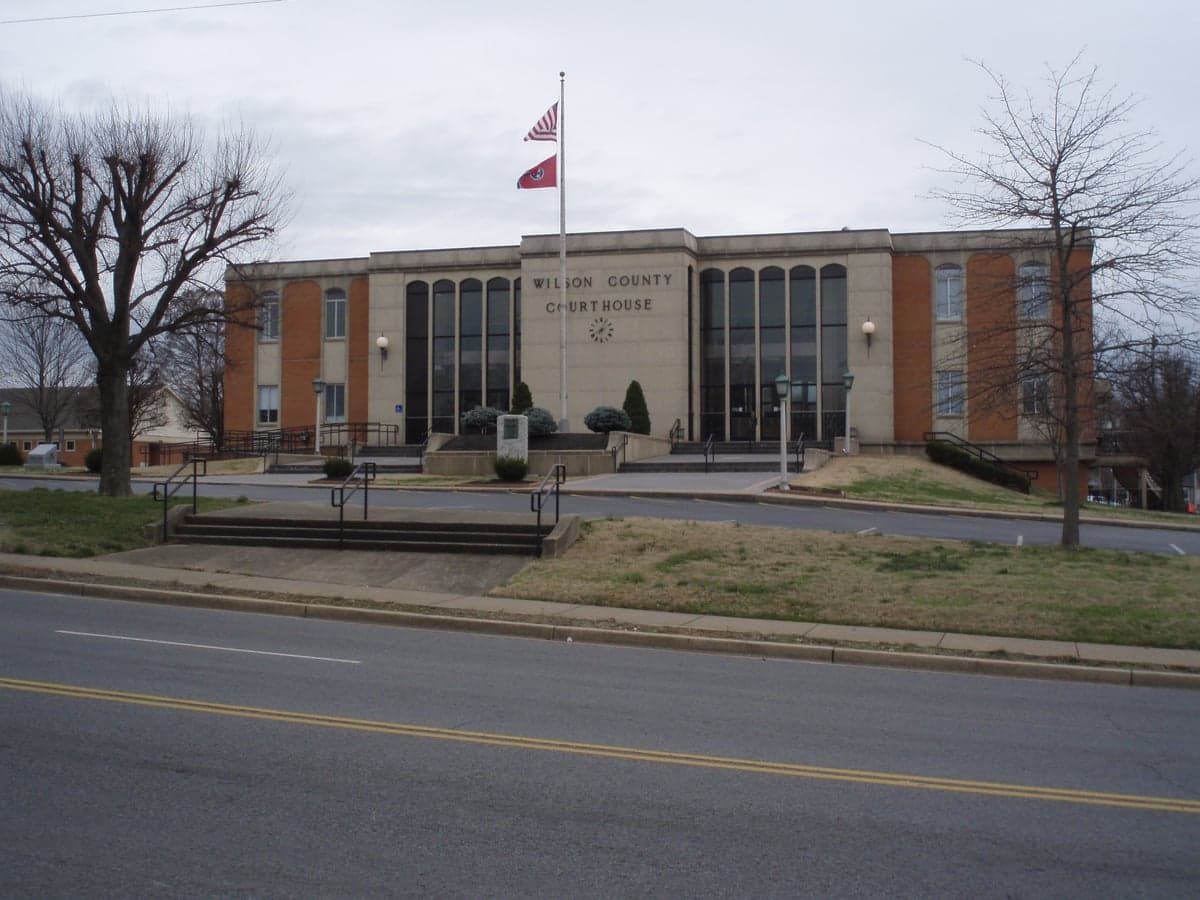
Photo: Wikipedia
Political ClimatePolitical Climate in Wilson County
Showing state-level results — no local-only data available.
Local Political AnalysisPolitical Analysis of Wilson County
Wilson County has long been a solidly conservative area, but it’s not the deep-red monolith some folks assume. The Cook PVI sits at R+8, which is reliably Republican but notably less intense than the statewide Tennessee PVI of R+13. That gap tells you a lot: while the state as a whole has shifted hard right over the past decade, Wilson County has seen its own brand of change, driven mostly by the influx of folks from Nashville and Davidson County who are bringing more moderate or even left-leaning views with them. The county still votes Republican in every major race, but the margins have tightened in some precincts, and the political vibe is definitely more mixed than it was twenty years ago.
How it compares
Compared to Tennessee as a whole, Wilson County is a bit of a bellwether for the state’s suburban evolution. The statewide R+13 PVI reflects a broad, rural-to-urban conservative dominance, but Wilson County’s R+8 shows a more competitive landscape, especially in its growing towns. For example, Lebanon and Mount Juliet are the two biggest population centers, and they’re where you see the real split. Mount Juliet, being closer to Nashville and full of new subdivisions, has precincts that lean more purple—some even went for Democratic candidates in recent local races, particularly in the areas around Providence and the newer developments near I-40. Lebanon’s historic downtown and older neighborhoods still vote reliably red, but the newer subdivisions on the south side of town are trending more moderate. Meanwhile, smaller towns like Watertown and Statesville remain deeply conservative, often voting 70% or more Republican. The swing precincts are almost entirely in the suburban sprawl zones along the I-40 corridor, where transplants from blue areas are settling in. If you look at the 2020 and 2022 results, those precincts shifted left by 3-5 points compared to 2016, which is a real warning sign for anyone who values limited government and personal freedoms.
What this means for residents
For those of us who’ve been here a while, the political shift is something you feel in daily life. The county commission and school board races are getting more contentious, with progressive-leaning candidates starting to run on platforms that sound a lot like what you’d hear in Davidson County—things like diversity, equity, and inclusion initiatives in schools, or zoning changes that prioritize density over property rights. That’s a red flag for anyone who believes in local control and minimal government overreach. The good news is that Wilson County still has a strong conservative majority, and the county’s Republican Party is well-organized. But the trend is clear: if you’re looking for a place where your Second Amendment rights are respected, where school boards aren’t pushing critical race theory, and where property taxes stay low, you need to pay attention to which part of the county you’re in. The rural areas are safe bets, but the suburban precincts are where the battle for the county’s soul is being fought.
Culturally, Wilson County still feels like Tennessee—church on Sunday, hunting on Saturday, and a general distrust of government meddling. But the new arrivals from Nashville are changing the conversation. You’ll hear more talk about bike lanes, public transit, and “affordable housing” mandates, which are code for more government control over private property. The county’s leadership has mostly held the line, but the pressure is mounting. If you’re considering a move here, I’d recommend sticking to the smaller towns or the older parts of Lebanon, where the conservative culture is still strong. The I-40 corridor is where the political winds are shifting, and that’s not a direction I’d bet on long-term if you value your freedoms.

State Political ClimatePolitical Climate in Tennessee
State Political AnalysisPolitical Environment in the State
Tennessee is a solidly conservative state, with a Cook Partisan Voting Index of R+13, meaning it votes about 13 points more Republican than the national average in presidential elections. The dominant coalition is a mix of rural and suburban conservatives, with the GOP holding supermajorities in both the state House and Senate. Over the last 10-20 years, the state has shifted decisively rightward—not just in voting patterns, but in policy—driven by in-migration from blue states and a deliberate legislative agenda that has made it one of the most reliably conservative states in the South. This isn't a purple state flirting with moderation; it's a state that has doubled down on its conservative identity, and that trajectory shows no sign of reversing.
Urban vs. rural divide
The political map of Tennessee is a textbook study in the urban-rural split. The major metros—Nashville (Davidson County) and Memphis (Shelby County)—are deep blue, with Nashville trending even more progressive in recent years. Nashville's growth has been fueled by a wave of out-of-state transplants, many from California and New York, which has shifted its local politics leftward on issues like transit, housing, and policing. Memphis remains reliably Democratic, driven by its large African American population and union legacy. Knoxville (Knox County) and Chattanooga (Hamilton County) are more competitive but lean Republican, with Knoxville's suburbs and exurbs pulling it right. The real engine of the state's conservatism is the vast rural and small-town expanse—places like Jackson, Cookeville, Johnson City, and Clarksville—where voters are reliably Republican and culturally traditional. The divide isn't just about party; it's about worldview. Rural Tennessee sees Nashville's growth as a threat to the state's character, and the legislature has responded by preempting Nashville's local ordinances on everything from gun laws to bathroom policies. This tension is the defining political dynamic of the state.
Policy environment
Tennessee's policy environment is aggressively conservative. There is no state income tax on wages, a major draw for relocators, and the sales tax is high (around 9.5% in most counties) to compensate. The regulatory posture is light-touch: no state-level occupational licensing for many trades, and a right-to-work law that keeps unions weak. On education, the state has leaned into school choice, with a robust charter school sector and a new Education Savings Account program that lets parents use state funds for private school or homeschooling—a direct challenge to the teachers' unions. Healthcare is a mixed bag: Tennessee did not expand Medicaid under the ACA, leaving a coverage gap, but the state has also passed laws to protect medical conscience rights and limit vaccine mandates. Election laws are strict: voter ID is required, early voting is available but not expansive, and the state has purged inactive voters from rolls. The legislature has also passed laws banning ranked-choice voting and limiting ballot drop boxes. For a conservative, this is a state that has built a policy fortress against progressive encroachment, with the legislature acting as a bulwark against local blue-city initiatives.
Trajectory & freedom
Tennessee is becoming more free in the sense of personal liberty, at least by conservative definitions. The 2021 permitless carry law (HB 786) allows any law-abiding adult to carry a concealed handgun without a permit, a major expansion of Second Amendment rights. The 2023 "Tennessee Freedom Act" prohibits enforcement of federal gun laws that the state deems unconstitutional, a direct nullification-style move. Parental rights have been strengthened: the 2022 "Parental Bill of Rights" (SB 795) gives parents explicit authority over their children's education, medical decisions, and school records. On medical autonomy, the state banned all abortion after a heartbeat is detected (about six weeks) in 2020, with no exceptions for rape or incest—a law that has withstood legal challenges. The 2023 law banning gender-affirming care for minors (SB 1) was a flashpoint, but it passed easily. Property rights are strong: Tennessee is a "right to farm" state, and there are no state-level rent control laws. The trajectory is clear: the legislature is actively expanding what it sees as traditional freedoms—gun rights, parental control, religious liberty—while restricting what it sees as progressive overreach. For a conservative relocator, this is a state that is actively fighting the culture war on your side.
Civil unrest & political movements
Tennessee has seen its share of political flashpoints. The 2023 Nashville Covenant School shooting sparked massive protests at the state capitol, with activists demanding gun control—but the legislature responded by passing a law to arm teachers, not restrict guns. The "Tennessee Three" (two Democratic state representatives expelled for protesting on the House floor) became national symbols of the left's frustration, but the GOP supermajority held firm. Immigration politics are heated: the state has passed laws requiring local law enforcement to cooperate with ICE, and there is a vocal movement to ban sanctuary cities, though none exist. There is no serious secessionist or nullification rhetoric beyond the gun nullification law, but the state's relationship with the federal government is adversarial on issues like environmental regulation and education mandates. Election integrity remains a live issue: the 2020 audit found no widespread fraud, but the legislature has tightened voting laws anyway. A new resident would notice the political energy at the capitol—protests are common, but they are overwhelmingly from the left, and the conservative majority is unapologetic. The atmosphere is not chaotic, but it is polarized, and the state's politics are a daily topic of conversation.
Projection
Over the next 5-10 years, Tennessee will likely become more conservative, not less. In-migration from blue states is accelerating, but the newcomers are a mixed bag: many are conservatives fleeing high taxes and regulation, and they are settling in red suburbs like Franklin (Williamson County) and Brentwood, which are among the most Republican counties in the nation. The progressive transplants tend to cluster in Nashville proper, which will remain a blue island but will have less influence as the legislature continues to preempt its policies. The state's demographics are shifting: the Hispanic population is growing, but it is not yet a voting bloc that tilts the state. The GOP supermajority is likely to hold, and the legislature will continue to push on school choice, gun rights, and cultural issues. The biggest wildcard is the federal courts: some of Tennessee's laws (like the abortion ban and the gender-affirming care ban) are being challenged, and a future Democratic administration could try to force compliance. But for a conservative moving in now, the expectation should be that Tennessee will remain a red state fortress, with policies that protect traditional values and personal liberty as defined by the right. The state is not trending purple; it's trending deeper red.
For a new resident, the bottom line is this: Tennessee offers a political environment where your conservative values are the law of the land, not something you have to fight for at the ballot box every cycle. You get no state income tax, strong gun rights, parental control over education, and a legislature that actively resists federal overreach. The trade-off is that you live in a state with a deep urban-rural divide, where the blue cities are culturally distinct and politically adversarial. But if you're looking for a state that is moving in your direction, not away from it, Tennessee is one of the safest bets in the country.
* Values derived from national, state, county, city and local statistics and may differ in a specific area. Last updated: 2026-05-12T07:34:08.000Z
Narrative content on this page is AI-generated and may contain mistakes. Verify any details that matter before acting on them.
ReloMaps may earn a commission from affiliate links at no extra cost to you.

