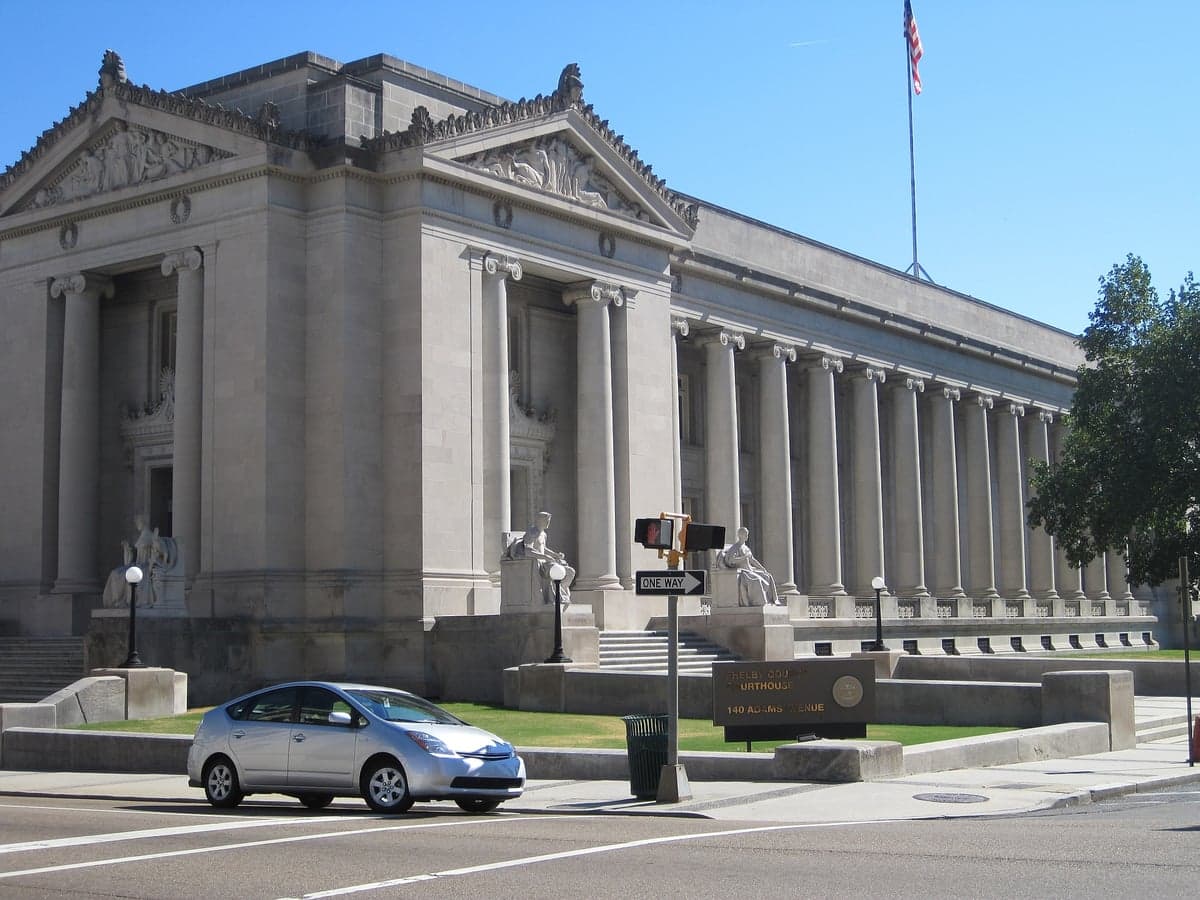
Photo: Wikipedia
Political ClimatePolitical Climate in Shelby County
Showing district-level results — no local-only data available.
Local Political AnalysisPolitical Analysis of Shelby County
Shelby County, Tennessee, is a deep-blue stronghold in a deeply red state, carrying a Cook Partisan Voting Index (PVI) of D+23. This makes it one of the most reliably Democratic urban counties in the South, a direct counterweight to the rest of Tennessee, which holds a PVI of R+13. The county hasn't voted for a Republican presidential candidate since 1988, and that trend has only solidified in recent cycles, with Democratic margins growing in Memphis and the inner-ring suburbs. However, the political reality is far from monolithic; the county is a patchwork of intense blue precincts in the city core and increasingly competitive, if not outright red, pockets in the eastern and northern exurbs.
How it compares
The contrast between Shelby County and the rest of Tennessee is stark and defines much of the state's political tension. While the state legislature in Nashville has been under firm Republican control for decades, passing laws on abortion, gun rights, and education that reflect a conservative majority, Shelby County's delegation in the General Assembly is almost entirely Democratic. This creates a dynamic where Memphis and its suburbs often feel like they are fighting a rear-guard action against state preemption laws. For example, the city of Memphis has repeatedly tried to implement local gun control measures, only to be blocked by state law. Within the county itself, the political geography is clear: Memphis proper is overwhelmingly Democratic, with precincts in Midtown, South Memphis, and Frayser routinely delivering 80-90% of the vote to Democrats. Germantown and Collierville have shifted rightward over the past decade, now reliably voting Republican in most races, though they still contain moderate swing precincts near the town centers. Bartlett and Arlington are more mixed, with Bartlett showing a slight Republican lean and Arlington trending redder as new development pushes east. Millington, a smaller, more working-class town in the north, leans Democratic but with a significant conservative, veteran-heavy population that can swing in local races.
What this means for residents
For a liberal resident living in Midtown Memphis, the local political climate is highly affirming. The city council and county commission are progressive on issues like criminal justice reform, affordable housing, and public transit. You can expect your vote to align with the majority on almost every local ballot. The frustration comes when looking at state-level policy, where Shelby County's influence is diluted by the rest of Tennessee's rural and suburban conservatism. For a conservative resident in Germantown or Collierville, the experience is the inverse. You may feel out of step with the countywide vote, but your vote counts heavily in state and federal races, and your local town council likely reflects your values. The practical effect is a kind of political whiplash: local elections in Shelby County are often decided in the Democratic primary, while the general election is a formality for countywide offices. Meanwhile, state legislative primaries in the eastern suburbs are where the real conservative battles are fought.
Cultural and policy distinctions
This political divide creates distinct cultural and policy realities. Shelby County, particularly Memphis, has a much stronger labor union presence than the rest of Tennessee, and a more visible network of community organizations focused on racial equity and poverty alleviation. The county also has a higher property tax rate than most of the state, funding a larger public school system (Shelby County Schools) and a more robust public library and park system than what you'd find in, say, rural West Tennessee. Conversely, the state's control over alcohol sales, gun laws, and abortion access means that even in deep-blue Shelby County, you'll find fewer liquor stores per capita than in Nashville, and the same permitless carry laws apply. The long-term trajectory suggests the county will remain a Democratic island, but the internal migration eastward toward Collierville and Lakeland is slowly expanding the red-leaning suburban footprint, making the county's overall partisan balance a bit less lopsided with each census cycle.

State Political ClimatePolitical Climate in Tennessee
State Political AnalysisPolitical Environment in the State
Tennessee is a solidly Republican state with a Cook PVI of R+13, meaning it votes about 13 points more Republican than the national average in presidential elections. The state has shifted rightward over the past 20 years, driven by the exodus of rural Democrats and the in-migration of conservatives from other states, particularly to the Nashville and Knoxville suburbs. While Democrats can still win in Memphis and parts of Nashville, the statewide GOP dominance is now baked in at every level, from the governor’s mansion to the legislature to the courts.
Urban vs. rural divide
The political map of Tennessee is a classic red-state split: the major cities are blue islands in a sea of red. Memphis (Shelby County) is the state’s most reliably Democratic stronghold, delivering margins of 60-70% for Democratic presidential candidates. Nashville (Davidson County) is also deeply blue, though its suburbs—like Franklin and Brentwood in Williamson County—are among the most Republican suburbs in the nation. Knoxville and Chattanooga are more purple, with Democratic-leaning city cores surrounded by heavily Republican exurbs and rural areas. The rural counties in Middle and East Tennessee—like Lincoln County (Fayetteville) or Greene County (Greeneville)—routinely vote 75-80% Republican. The divide is stark: in 2024, Donald Trump won 95 of Tennessee’s 95 counties, but lost Davidson and Shelby by double digits. The state’s political gravity is firmly rural and suburban, not urban.
Policy environment
Tennessee’s policy environment is aggressively conservative. The state has no income tax on wages, relying instead on a high sales tax (9.55% average combined rate) and relatively low property taxes. The regulatory posture is business-friendly: Tennessee is a right-to-work state, and the legislature has repeatedly preempted local ordinances on everything from minimum wage to plastic bag bans. Education policy has shifted rightward: the state expanded school vouchers in 2023 (the Education Freedom Scholarship Act) and has banned critical race theory and divisive concepts in public schools. Healthcare is a mixed bag: Tennessee did not expand Medicaid under the ACA, leaving roughly 300,000 residents in the coverage gap, but the state has a robust private insurance market. Election laws are restrictive: Tennessee requires a photo ID to vote, has strict voter ID laws for absentee ballots, and in 2023 passed a law making it a felony for election officials to send unsolicited absentee ballot applications. The state also has a near-total abortion ban (trigger law from 2019, effective June 2022) with no exceptions for rape or incest, only to save the mother’s life.
Recent policy direction
Recent legislation in Tennessee has pushed the state further to the right on nearly every front. On gun rights, Tennessee became a permitless carry state in 2021, allowing any adult 21 or older to carry a handgun without a permit. In 2023, the legislature passed a law allowing teachers to carry firearms on school grounds with approval from local law enforcement. On parental rights, the state passed the “Parental Bill of Rights” in 2022, giving parents the right to review curriculum and opt their children out of lessons they object to. On speech and education, the 2021 “Prohibited Concepts” law bans teaching that the U.S. is fundamentally racist or that an individual bears responsibility for past wrongs based on race. On privacy and surveillance, Tennessee passed a law in 2023 requiring age verification for adult websites, and the state has no broad data privacy law. On medical autonomy, the abortion ban is the most restrictive in the region, and the state has also banned gender-affirming care for minors (2023). On property rights, Tennessee is a strong “right-to-farm” state, limiting nuisance lawsuits against agricultural operations. On voting, the 2023 law making it a felony to send unsolicited absentee ballot applications was a direct response to 2020 election practices. The overall direction is toward more state preemption of local control, more restrictions on abortion and transgender care, and more expansive gun rights.
Civil unrest & political movements
Tennessee has seen its share of political flashpoints. The 2023 expulsion of two Black Democratic state representatives (Justin Jones and Justin Pearson) from the Tennessee House for leading a gun control protest on the floor after the Covenant School shooting in Nashville drew national attention and sparked protests at the state capitol. The state has a small but vocal secessionist movement in East Tennessee, where some rural counties have floated the idea of forming a separate state (the “State of Franklin” revival). Immigration politics are heated: Tennessee passed a law in 2024 requiring local law enforcement to cooperate with ICE, and the state has no sanctuary cities. Election integrity remains a live issue: the 2020 election saw no major fraud in Tennessee, but the legislature has continued to tighten voting laws, and some rural counties have passed resolutions questioning the 2020 results. The most visible flashpoint for a new resident would be the ongoing protests and counter-protests around the abortion ban, particularly in Nashville and Knoxville, where Planned Parenthood clinics have been targeted by both protesters and the state attorney general.
Projection
Over the next 5-10 years, Tennessee will likely become even more Republican, but with a twist. The in-migration from California, Illinois, and New York is heavily conservative, but it’s also suburban and educated—meaning the GOP may face internal tensions between the rural, Trump-aligned base and the more business-friendly, socially moderate suburbanites. The Nashville metro area is growing fast, and its suburbs (like Murfreesboro and Spring Hill) are becoming more diverse and slightly less Republican. However, the state’s rural counties are depopulating, and the legislature is likely to continue gerrymandering to protect GOP supermajorities. The abortion ban will remain a wedge issue, but the state is unlikely to moderate it unless the federal landscape changes. Expect more preemption of local ordinances, more school choice expansion, and continued resistance to Medicaid expansion. A new resident moving in now should expect a state that is reliably red, with a government that is responsive to conservative voters and largely unresponsive to urban Democratic concerns.
For a new resident, the bottom line is straightforward: if you are a conservative, you will find a state that aligns with your values on taxes, guns, education, and abortion. If you are a liberal, you will find a state where your vote in statewide elections is largely symbolic, but where you can still find community in Memphis, Nashville, or Knoxville’s urban cores. The state’s low taxes and business-friendly climate are real, but so are the trade-offs in public services and healthcare access. Tennessee is not a swing state, and it’s not trending that way—it’s a solidly red state that is getting redder, with all the policy consequences that entails.
* Values derived from national, state, county, city and local statistics and may differ in a specific area. Last updated: 2026-08-23T18:59:44.000Z
Narrative content on this page is AI-generated and may contain mistakes. Verify any details that matter before acting on them.
ReloMaps may earn a commission from affiliate links at no extra cost to you.

