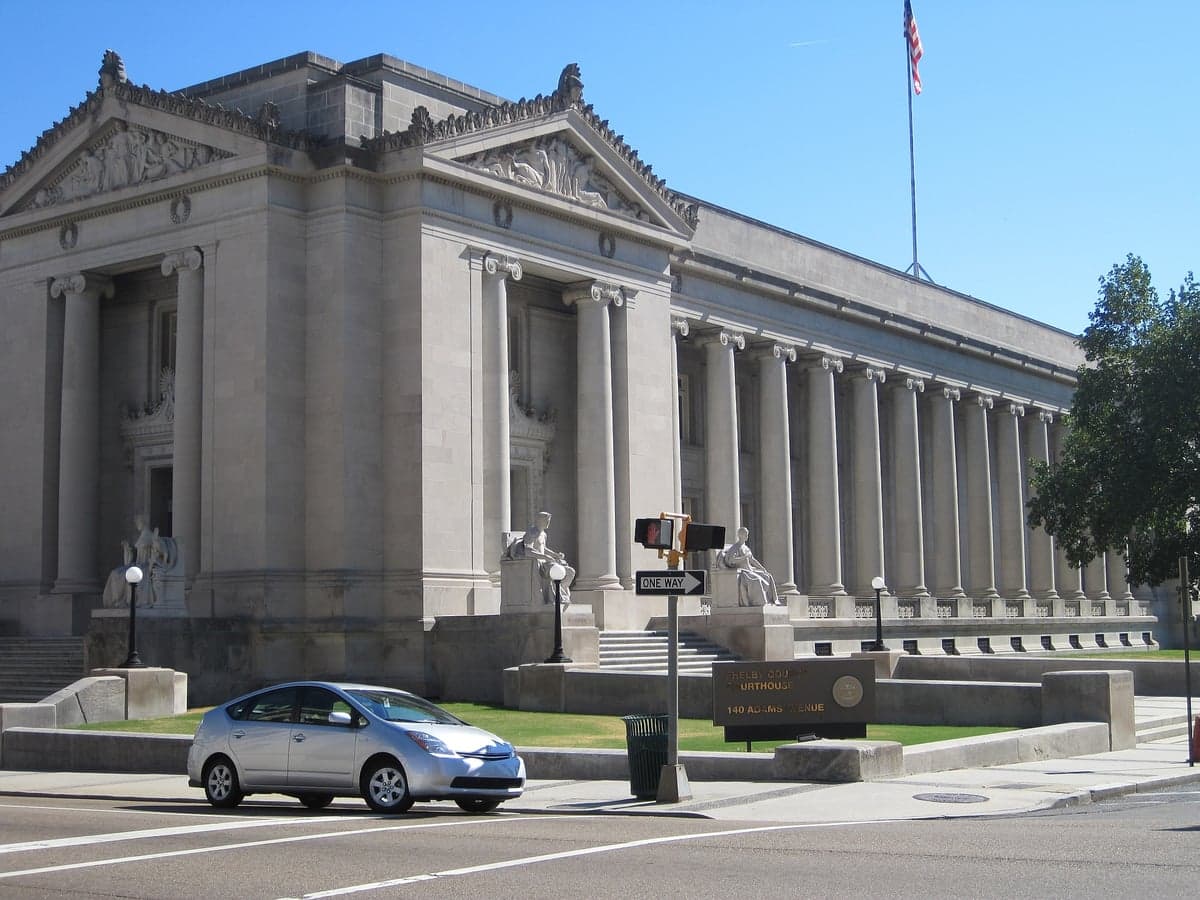
Photo: Wikipedia
Demographics of Shelby County
Affluence Level in Shelby County
A middle-class area roughly in line with national averages across income, home values, education, and employment.
People of Shelby County
Shelby County, Tennessee, is a majority-Black, politically and culturally significant region anchored by Memphis, where 52.6% of the 922,195 residents identify as Black or African American, 33.3% as White, 8.5% as Hispanic, and 1.5% as East/Southeast Asian, with 1.3% of Indian subcontinent ancestry. The county is densely populated for the Mid-South, with a character shaped by the Mississippi River, the legacy of the cotton economy, and a distinct musical and culinary identity that blends Deep South, Delta, and urban influences. Its people are predominantly native-born (95.2% U.S.-born), and the population is younger and more diverse than the state average, though it has experienced slow growth and suburban flight to adjacent counties over the past two decades.
Settlement & growth (pre-1960)
Long before European contact, the area that is now Shelby County was home to successive Native American cultures, most notably the Mississippian people who built the great ceremonial mound complex at what is now Chucalissa in southwest Memphis. By the time of European exploration, the region was occupied by the Chickasaw Nation, who controlled a vast territory across West Tennessee and northern Mississippi. The Spanish explorer Hernando de Soto is believed to have passed through the area in 1541, but no permanent European settlement followed for more than two centuries.
The United States acquired the region through the 1818 Jackson Purchase from the Chickasaw, and Shelby County was formally established in 1819. The first wave of settlers were largely Scots-Irish and English migrants from Virginia, North Carolina, and Kentucky, drawn by cheap, fertile land along the Mississippi River. The city of Memphis was founded that same year by John Overton, James Winchester, and Andrew Jackson, and quickly became a river port and cotton trading hub. The plantation economy, fueled by enslaved African labor, dominated the county's antebellum period. By 1860, enslaved people made up a majority of the county's population, a demographic reality that would persist in different forms for generations.
After the Civil War and Emancipation, freedmen and women remained in the county in large numbers, concentrating in Memphis and in rural communities like Millington and Bartlett. The late 19th and early 20th centuries saw the arrival of European immigrants, particularly Irish and German laborers who worked on the riverfront and railroads, settling in neighborhoods like Pinch District in north Memphis. A smaller wave of Italian and Jewish immigrants also arrived, establishing commercial districts and religious institutions in downtown Memphis and Cooper-Young.
The Great Migration (roughly 1915–1970) dramatically reshaped Shelby County. Hundreds of thousands of Black Americans fled the oppressive conditions of the rural Deep South for Memphis, which offered industrial jobs, a growing Black middle class, and a vibrant cultural scene. This influx made Memphis a majority-Black city by the 1970s and solidified Shelby County's Black political and cultural identity. The county also received a smaller but notable influx of rural white migrants from Arkansas, Mississippi, and Missouri during the Dust Bowl and World War II, who settled in working-class neighborhoods in Frayser and Raleigh.
Modern era (post-1965)
The 1965 Hart-Cellar Act opened immigration from Asia, Latin America, and Africa, but Shelby County's foreign-born population remains low at just 4.8%, far below the national average. The most significant post-1965 demographic shift has been domestic: the continued suburbanization of the white and Black middle class out of Memphis into the county's eastern and northern suburbs. Germantown, Collierville, and Arlington have grown rapidly since the 1980s, attracting families seeking newer housing, lower crime rates, and higher-performing schools. This pattern has left Memphis proper with a higher concentration of poverty and a Black population share that exceeds 60%, while the eastern suburbs remain predominantly white.
Hispanic immigration, though modest by national standards, has been the county's fastest-growing demographic trend since 2000. The Hispanic population now stands at 8.5%, concentrated in Hickory Hill and South Memphis, where Mexican and Central American immigrants work in construction, hospitality, and logistics. The East/Southeast Asian community (1.5%) is smaller but established, with Vietnamese and Chinese families concentrated in East Memphis and Cordova, often associated with the University of Tennessee Health Science Center and regional medical employers. The Indian subcontinent community (1.3%) is similarly professional, with many working in healthcare, IT, and engineering, and settling in Germantown and Collierville.
The county's Black population has become more suburbanized in recent decades, with significant growth in Bartlett, Millington, and Lakeland, though these communities remain less diverse than the city. Overall, Shelby County's racial geography is highly segregated by both race and class, a legacy of historic redlining, white flight, and ongoing economic disparities.
The future
Shelby County's population is projected to grow slowly, if at all, over the next 10–20 years, as domestic outmigration to neighboring counties in Mississippi and Arkansas, as well as to faster-growing Tennessee suburbs like Collierville and Arlington, offsets natural increase and modest international immigration. The county is becoming more diverse, but primarily through Hispanic growth, which is expected to rise from 8.5% to perhaps 12–15% by 2040, while the Black share remains stable and the white share continues a slow decline. The East/Southeast Asian and Indian subcontinent populations will likely grow modestly, driven by professional recruitment in healthcare and logistics, but will remain small in absolute terms.
The cultural identity of Shelby County is evolving from a binary Black-white dynamic toward a triracial or multiethnic one, though the pace is slower than in other Southern metros like Atlanta or Nashville. The county's future will be shaped by whether the eastern suburbs continue to attract diverse populations or remain predominantly white enclaves, and whether Memphis can reverse its population decline through economic revitalization and improved public safety. For a newcomer, Shelby County offers a deeply rooted, historically rich community with a strong sense of place, but also faces significant challenges in poverty, segregation, and public education that vary sharply by neighborhood and municipality.
Shelby County is becoming a more diverse, suburbanized, and economically stratified place, where the historic Black-majority core of Memphis coexists with predominantly white and increasingly Hispanic suburbs. For someone moving in now, the county offers a low cost of living, a rich cultural and musical heritage, and a range of community types from urban to exurban, but the choice of neighborhood will largely determine one's experience of safety, schools, and demographic environment.

* Values derived from national, state, county, city and local statistics and may differ in a specific area. Last updated: 2026-08-23T18:59:44.000Z
Narrative content on this page is AI-generated and may contain mistakes. Verify any details that matter before acting on them.
ReloMaps may earn a commission from affiliate links at no extra cost to you.

