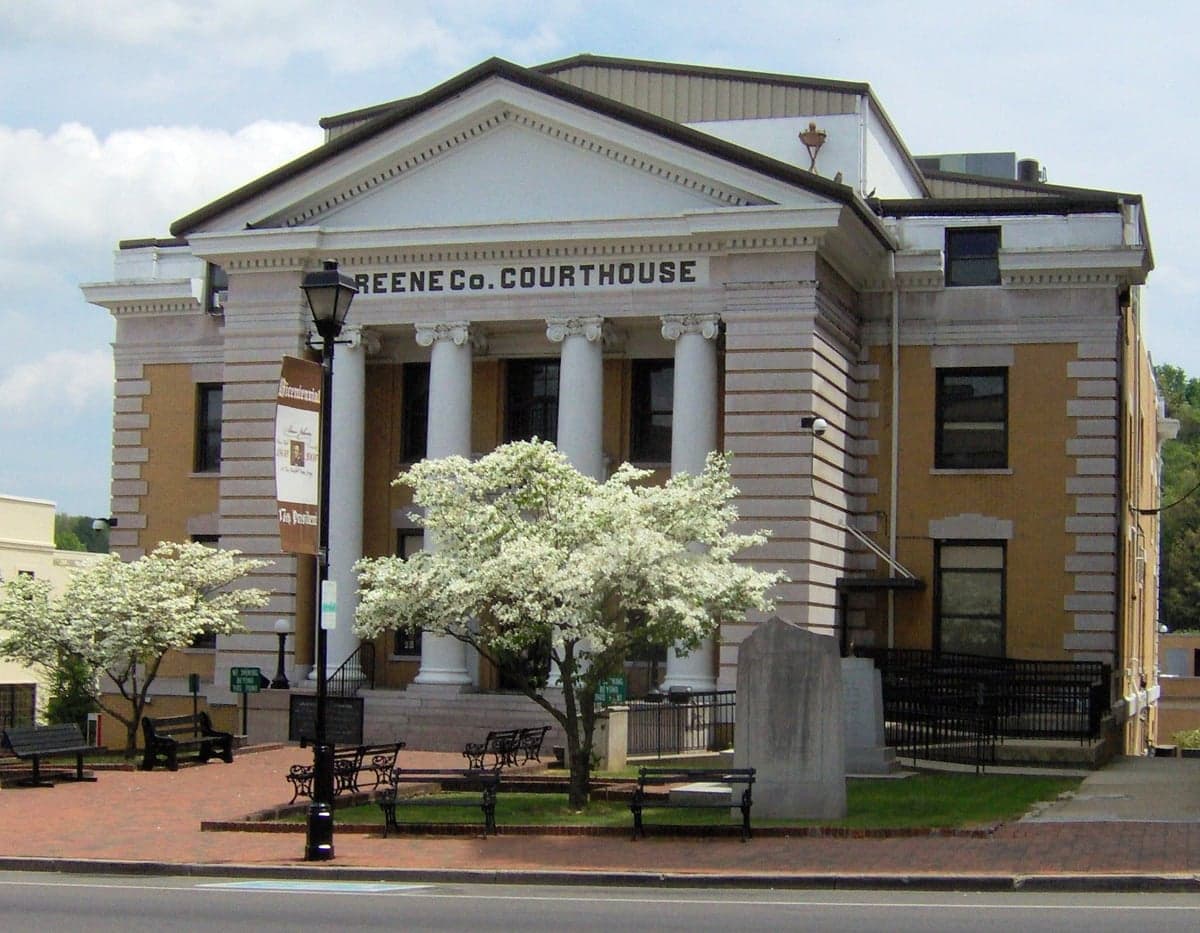
Photo: Wikipedia
Political ClimatePolitical Climate in Greene County
Showing district-level results — no local-only data available.
Local Political AnalysisPolitical Analysis of Greene County
Greene County is one of the most reliably Republican counties in Tennessee, carrying a Cook Partisan Voting Index (PVI) of R+29 — more than double the state’s already solid R+13 rating. That means the county votes about 29 points more Republican than the national average, a margin that has only widened over the last two cycles. The shift has been steady but not uniform: while the county seat, Greeneville, has long been a conservative stronghold, the smaller communities and rural precincts have moved even further right, while a few pockets — particularly around Tusculum University and the more affordable outskirts of Mosheim — have shown slightly more competitive numbers in local races. If you’re looking at the political trajectory, it’s not trending purple; it’s consolidating red.
How it compares
Tennessee as a whole is a deep-red state, but Greene County is in a different league. The state’s PVI of R+13 already puts it among the most Republican states in the country, but Greene County’s R+29 places it in the top tier of conservative counties east of the Mississippi. To put it in perspective: while Tennessee’s urban centers like Nashville (Davidson County) and Memphis (Shelby County) lean Democratic, Greene County has no such counterbalance. Even within the Tri-Cities region, Greene County is notably more conservative than Washington County (home to Johnson City), which sits at roughly R+18. The difference is driven by Greene County’s older demographic, lower population density, and a strong manufacturing and agricultural base that tends to favor Republican economic policies. In statewide races, Greene County reliably delivers margins of 70-75% for Republican candidates, while the state as a whole hovers around 60-65%.
What this means for residents
For conservative residents, Greene County’s political climate means local government, school boards, and law enforcement tend to align closely with their values. Tax policy is generally favorable, with county commissions historically hesitant to raise property taxes, and Second Amendment protections are taken seriously. For liberal or moderate residents, the reality is more isolating. There is no organized Democratic Party presence to speak of in the county, and progressive candidates rarely bother to run for local office. Socially, it can be difficult to find like-minded neighbors, especially in the more rural precincts around Baileyton and Chuckey. That said, the political homogeneity also means less overt conflict — most political disagreements happen quietly, and the county’s small-town culture tends to prioritize neighborliness over partisan debate. The biggest practical impact for all residents is in state representation: Greene County’s state legislators are among the most conservative in the Tennessee General Assembly, which means local concerns about education funding, healthcare access, and infrastructure are filtered through a reliably conservative lens.
Culturally, Greene County stands apart even from the rest of East Tennessee. The county’s strong ties to the Andrew Johnson heritage and its deep-rooted Baptist and Methodist traditions give local politics a distinctly moral and historical flavor. You won’t find the libertarian streak that shows up in parts of Knox County or the moderate Republicanism of the Nashville suburbs. Instead, the political culture here is more traditionalist — skeptical of rapid change, protective of local control, and deeply invested in the idea of self-reliance. For anyone moving to the area, understanding that cultural baseline is more important than the voting numbers. The politics are a reflection of a place that values stability, faith, and community above almost everything else.

State Political ClimatePolitical Climate in Tennessee
State Political AnalysisPolitical Environment in the State
Tennessee is a solidly Republican state with a Cook PVI of R+13, meaning it votes about 13 points more Republican than the national average in presidential elections. Over the past 20 years, the state has shifted rightward as rural and suburban voters consolidated behind the GOP, while Democratic strength has retreated almost entirely into the urban cores of Nashville, Memphis, and Knoxville. The 2024 election saw Donald Trump carry the state by roughly 30 points, continuing a trend where no Democrat has won Tennessee since Bill Clinton in 1996, and the state legislature has been under supermajority Republican control since 2010.
Urban vs. rural divide
The political map of Tennessee is defined by a sharp urban-rural split. Nashville (Davidson County) and Memphis (Shelby County) are the two major Democratic strongholds, consistently voting blue by 20-30 points in statewide races. Knoxville (Knox County) and Chattanooga (Hamilton County) are more competitive but have trended right in recent cycles, with Knox County now reliably Republican and Hamilton County leaning red outside of municipal elections. The rest of the state — from the Mississippi Delta counties like Haywood and Lauderdale to the Appalachian counties in the east like Johnson and Carter — votes overwhelmingly Republican. The Nashville suburbs, particularly Williamson County (Franklin, Brentwood) and Rutherford County (Murfreesboro), are among the most conservative in the nation, with Williamson County often voting 70%+ Republican. The I-24 corridor between Nashville and Chattanooga has seen some Democratic inroads as Nashville's growth spills outward, but the state's rural expanses remain deeply red.
Policy environment
Tennessee's policy environment is shaped by a low-tax, limited-government philosophy. The state has no personal income tax on wages, relying instead on a 7% sales tax (the highest in the nation) and a 1% tax on dividends and interest. Property taxes are relatively low, with a statewide average effective rate around 0.67%. The regulatory posture is business-friendly, with right-to-work laws and no state-level minimum wage above the federal $7.25. Education policy has shifted toward school choice, with the Education Savings Account program expanding in 2023 to cover more counties. Healthcare remains a flashpoint: Tennessee has not expanded Medicaid under the Affordable Care Act, leaving roughly 300,000 residents in the coverage gap. Election laws have tightened, with voter ID requirements and restrictions on absentee voting. The state also has a constitutional carry law (permitless carry of handguns) and a near-total abortion ban with no exceptions for rape or incest, enacted after the Dobbs decision.
Recent policy direction
Recent legislation in Tennessee has moved decisively toward expanding individual liberties in some areas while restricting them in others. On gun rights, the state passed permitless carry in 2021 and a "Second Amendment Sanctuary" resolution in 2022. On education, the 2023 "Age-Appropriate Materials Act" restricts classroom discussion of sexual orientation and gender identity in K-8, and the state has banned transgender athletes from competing in girls' sports. On speech and privacy, a 2024 law requires social media platforms to verify user ages and restricts minors' access to certain content. On medical autonomy, the 2023 abortion ban is among the strictest in the country, with no exceptions for rape or incest, and a 2024 law restricts gender-affirming care for minors. On property rights, the state has not passed a comprehensive eminent domain reform but has resisted local rent control ordinances. On voting, a 2023 law shortened the absentee ballot request window and increased penalties for voter registration errors. On taxes, the state has gradually reduced the Hall income tax on investment income, with full repeal scheduled for 2029. The overall direction is toward more conservative cultural policy and less government intervention in economic matters, but with significant constraints on personal medical decisions.
Civil unrest & political movements
Tennessee has seen its share of political activism, particularly around gun rights and abortion. The 2023 Covenant School shooting in Nashville sparked large, sustained protests at the state capitol, with activists demanding gun control measures like red flag laws and safe storage requirements. The legislature responded by passing a bill to arm teachers, which was signed into law. On the right, the Tennessee Firearms Association and local Second Amendment groups are highly active, organizing rallies and lobbying against any new restrictions. Immigration politics have been relatively quiet compared to border states, but a 2024 law requires local law enforcement to cooperate with federal immigration authorities and penalizes sanctuary city policies. No Tennessee city has declared itself a sanctuary city, though Nashville has resisted some cooperation. Election integrity controversies flared after 2020, with the state creating a Division of Election Integrity in 2021 to investigate voter fraud, though few cases have been prosecuted. Secession or nullification rhetoric is minimal, though some rural counties have passed resolutions asserting local control over federal land management. A new resident would notice the strong presence of political signage, especially in rural areas, and the occasional protest at the capitol, but daily life is generally calm and politically engaged rather than volatile.
Projection
Over the next 5-10 years, Tennessee's political trajectory points toward continued Republican dominance, but with potential shifts driven by in-migration. The state is growing rapidly, particularly in the Nashville and Knoxville metros, attracting newcomers from blue states like California, New York, and Illinois. Many of these transplants are conservative-leaning, drawn by low taxes and business-friendly policies, but some are moderates who could soften the state's hard-right edge. The urban cores of Nashville and Memphis are likely to remain Democratic, while the suburbs may become more competitive as they diversify. The state's rural areas will stay deeply red, but their political weight will diminish as population concentrates in the cities. The biggest wildcard is the abortion issue: if the strict ban proves unpopular with suburban women, it could create openings for Democrats in legislative races, though the supermajority is likely to hold through the next redistricting cycle. Expect continued battles over school choice, transgender rights, and gun policy, with the legislature pushing further right on cultural issues while maintaining its low-tax economic posture. A new resident moving in now should expect a state that remains reliably Republican but with growing internal tension between its urban, suburban, and rural factions.
For a new resident, the bottom line is that Tennessee offers a low-tax, business-friendly environment with strong protections for gun rights and traditional values, but also significant restrictions on abortion and transgender care. Conservatives will find a welcoming policy landscape and a legislature that shares their priorities. Liberals will find themselves in a clear minority, with limited political influence outside of Nashville and Memphis, but with a vibrant urban culture and growing communities of like-minded people. The state's political climate is stable but not static, and the ongoing in-migration from other states will continue to shape its future. If you're moving here, expect a place where politics is taken seriously but doesn't dominate daily life, and where the conservative majority sets the tone for state policy while leaving room for local variation in the cities.
* Values derived from national, state, county, city and local statistics and may differ in a specific area. Last updated: 2026-07-03T15:11:44.000Z
Narrative content on this page is AI-generated and may contain mistakes. Verify any details that matter before acting on them.
ReloMaps may earn a commission from affiliate links at no extra cost to you.

