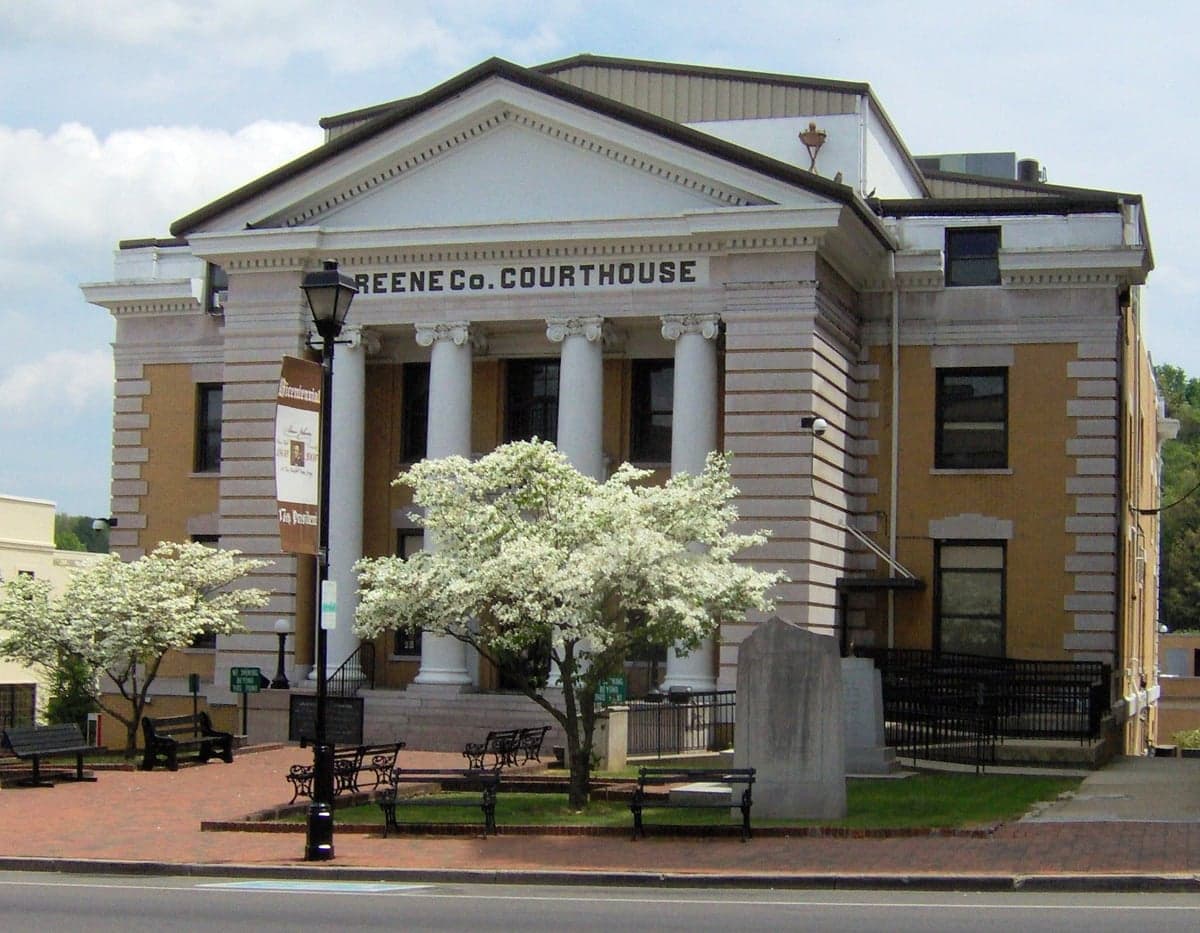
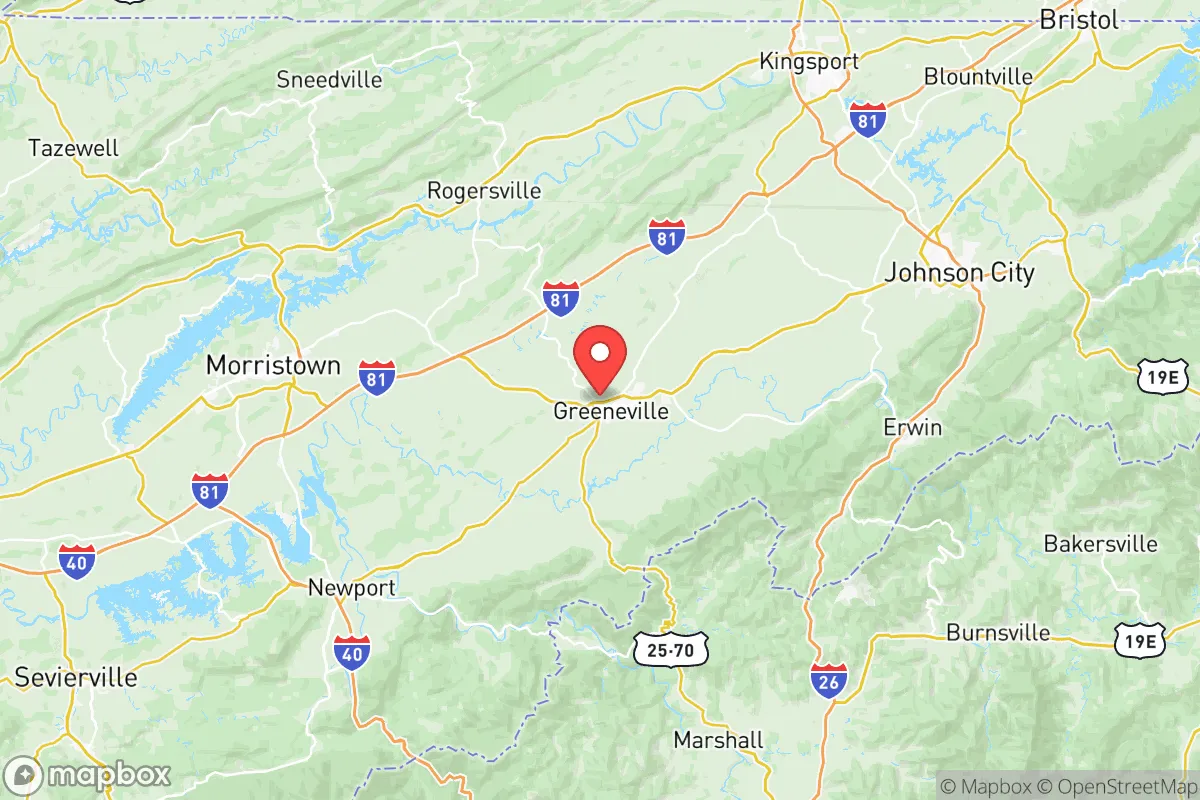
Photo: Wikipedia
Demographics of Greene County
Affluence Level in Greene County
A middle-class area roughly in line with national averages across income, home values, education, and employment.
People of Greene County
Today, Greene County, Tennessee is home to roughly 70,919 residents, a population that remains overwhelmingly white (91.3%) and native-born (99.1% U.S.-born), with a small but growing Hispanic community (3.8%) and a Black population of 1.9%. The county’s character is deeply rooted in its Appalachian and Scots-Irish heritage, shaped by centuries of agricultural life, tobacco farming, and a strong manufacturing base centered around the city of Greeneville. With only 17.7% of adults holding a college degree, the population skews working-class and conservative, and the area retains a distinct sense of place—marked by a slower pace, strong church attendance, and a pride in its role as the home of President Andrew Johnson. The people of Greene County are not newcomers; they are overwhelmingly the descendants of families who have been here for generations, and that continuity gives the county a cultural stability rare in fast-growing parts of the Sun Belt.
Settlement & growth (pre-1960)
Long before European settlers arrived, the land that is now Greene County was part of the hunting grounds of the Cherokee Nation, who used the fertile valleys of the Nolichucky River for seasonal camps and trails. The Cherokee had no permanent towns within the county's boundaries, but their presence shaped the region's early history, including conflicts and treaties that eventually opened the area to white settlement after the 1785 Treaty of Hopewell and the later forced removals along the Trail of Tears in the 1830s.
The first permanent European settlers were overwhelmingly Scots-Irish from Pennsylvania, Virginia, and North Carolina, who began arriving in the 1770s and 1780s. They were drawn by the promise of cheap, fertile land in the Nolichucky Valley and the relative independence of the frontier. These families—names like Rader, Dickson, and Donelson—established homesteads along the river and founded the earliest settlements, including Greeneville (named after Revolutionary War General Nathanael Greene) in 1783, which became the county seat. A second early settlement, Chuckey, grew up along the Nolichucky River and became a center for milling and trade. The Scots-Irish brought with them a fierce independence, a Presbyterian religious tradition, and a suspicion of distant authority—traits that still echo in the county's political culture today.
Through the 19th century, the population grew slowly but steadily, driven by natural increase and a trickle of additional settlers from the Upper South. The county was overwhelmingly agricultural, with tobacco becoming the dominant cash crop after the War of 1812. Small hamlets like Mosheim and Bulls Gap emerged as trading posts and railroad stops after the East Tennessee and Virginia Railroad arrived in the 1850s. The Civil War deeply divided Greene County—East Tennessee was largely Unionist, and the county sent soldiers to both sides—but the postwar period saw little new immigration. The population remained almost entirely native-born white, with a small Black population of freedmen who concentrated in and around Greeneville, working as sharecroppers and laborers.
The late 19th and early 20th centuries brought modest industrial development, particularly in Greeneville, where tobacco warehouses, flour mills, and furniture factories provided non-farm employment. The arrival of the L&N Railroad in the 1880s connected the county to broader markets. However, the region saw none of the large-scale immigration from Southern and Eastern Europe that transformed Northern industrial cities. A small number of German and Irish families settled in Greeneville and Baileyton, but they were absorbed quickly into the existing population. The Great Depression hit the tobacco-dependent economy hard, and many residents left for factory jobs in the Midwest, but the county's population remained stable, hovering around 35,000 through the 1930s and 1940s.
After World War II, Greene County experienced a modest economic boost from the construction of the Cherokee Dam (completed 1942) and the Nolichucky Dam, which brought electricity and flood control to the valley. The 1950s saw the beginnings of suburban-style development around Greeneville, but the county remained deeply rural. The population reached 50,000 by 1960, still overwhelmingly white and native-born, with the Black share declining to about 4% as many African American families left for urban centers in the North during the Second Great Migration.
Modern era (post-1965)
The 1965 Hart-Cellar Act, which dramatically reshaped American immigration, had almost no effect on Greene County. Unlike metropolitan areas that saw waves of new arrivals from Asia, Latin America, and Africa, Greene County's foreign-born population today stands at just 0.9%—one of the lowest rates in Tennessee. The county did not become a destination for post-1965 immigrants, and its demographic profile has remained remarkably stable compared to the rest of the country.
The most significant demographic shift since 1965 has been the gradual growth of the Hispanic population, which rose from negligible levels in 1990 to 3.8% today. This growth is almost entirely the result of domestic migration—Hispanic families moving from other parts of Tennessee and the Southeast—rather than direct immigration. Many work in agriculture (tobacco, nursery plants, and Christmas tree farms), in poultry processing at plants in Greeneville and nearby Midway, and in construction. The Hispanic community is dispersed across the county rather than concentrated in a single enclave, though a small cluster of Hispanic-owned businesses has emerged along West Main Street in Greeneville.
Domestic migration patterns have also brought a small but steady inflow of retirees and remote workers from the Northeast and Midwest, drawn by the low cost of living, the scenic beauty of the Appalachian foothills, and the conservative political climate. These newcomers tend to settle in the more rural parts of the county, particularly around Camp Creek and the Greeneville outskirts, where land is still affordable. However, the county has not experienced the explosive growth seen in neighboring Washington County (home to Johnson City) or Knox County. The population grew from 60,000 in 1990 to 70,919 in 2024, a modest 18% increase over 34 years—well below the Tennessee state average.
The Black population has continued its slow decline, now at 1.9%, as younger African American residents leave for larger cities with more economic opportunities. The East/Southeast Asian population (0.5%) and Indian subcontinent population (0.1%) are tiny and consist almost entirely of professionals working at Greeneville's major employers, including the Greeneville City Schools system, Laughlin Memorial Hospital, and the various manufacturing plants (Bush Brothers, Parker Hannifin, and others) that anchor the local economy. These families are scattered across Greeneville and Tusculum, a small town that is home to Tusculum University, the oldest university in Tennessee.
The future
Greene County is likely to remain one of Tennessee's least diverse counties over the next 10-20 years. The Hispanic share may continue to grow slowly, potentially reaching 6-8% by 2040, driven by natural increase and continued domestic migration from other parts of the Southeast. However, the county is not positioned to attract significant international immigration; its low college attainment rate, limited public transit, and lack of major urban amenities make it an unlikely destination for the skilled immigrants who are reshaping Nashville and Chattanooga.
The white population will continue to age and, absent significant in-migration, may begin to decline in absolute numbers as deaths outpace births—a pattern already visible in many rural Appalachian counties. The population center will remain Greeneville, which is projected to grow modestly as it absorbs some spillover from the Tri-Cities metro area (Johnson City, Kingsport, Bristol). The smaller communities—Mosheim, Bulls Gap, Baileyton, and Chuckey—are likely to see continued population stagnation or slight decline, as young people leave for larger cities and the remaining population ages in place.
Culturally, Greene County will remain a deeply conservative, religiously observant, and family-oriented place. The influx of remote workers and retirees may bring some political diversity, but the county's fundamental identity—white, native-born, working-class, and rooted in the land—is unlikely to change dramatically. The biggest demographic wild card is whether the Tri-Cities region as a whole begins to attract more domestic migrants from high-cost states, which could accelerate growth in Greene County's more scenic and affordable rural areas.
For someone moving in now, Greene County offers a stable, predictable community where the population is not rapidly changing—a place where neighbors are likely to have deep family roots, where church and community are central, and where the pace of life remains slow. The trade-off is limited diversity, a small pool of college-educated peers, and a local economy that still depends heavily on manufacturing and agriculture. It is a place for those who value continuity over change, and who are comfortable in a community that looks and feels much as it did a generation ago.

* Values derived from national, state, county, city and local statistics and may differ in a specific area. Last updated: 2026-07-03T15:11:44.000Z
Narrative content on this page is AI-generated and may contain mistakes. Verify any details that matter before acting on them.
ReloMaps may earn a commission from affiliate links at no extra cost to you.

