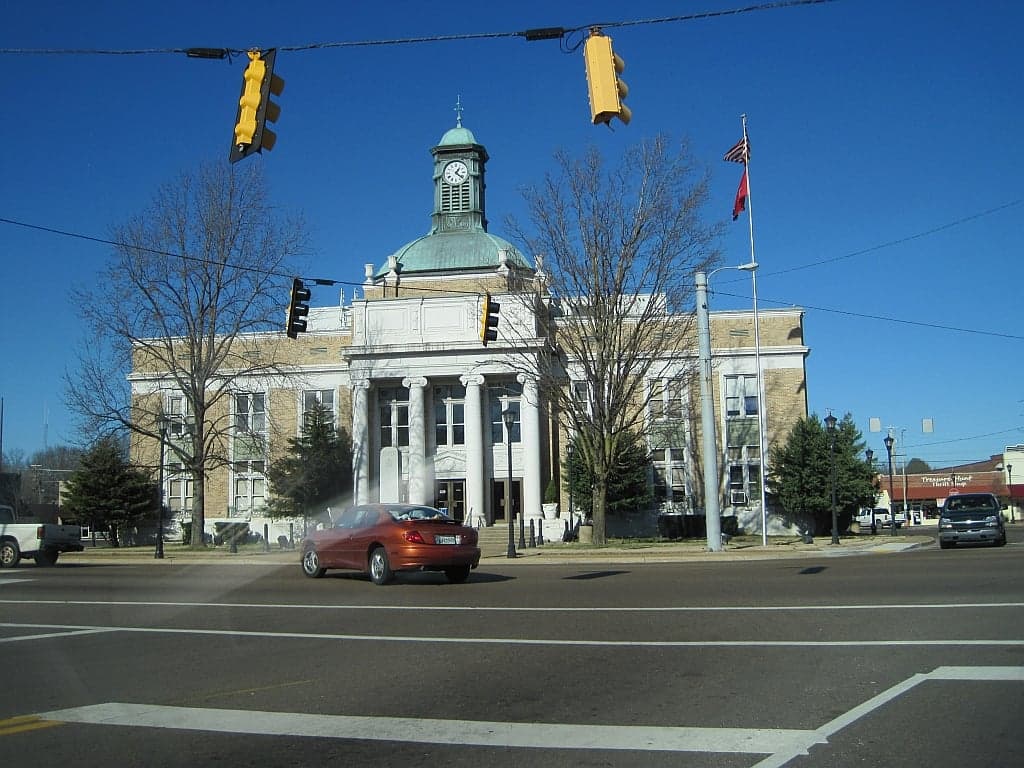
Photo: Wikipedia
Demographics of Fayette County
Affluence Level in Fayette County
A middle-class area roughly in line with national averages across income, home values, education, and employment.
People of Fayette County
Fayette County, Tennessee, is a rural county of 42,653 residents where the population is roughly two-thirds White and just over a quarter Black, with a very small foreign-born share of 1.4%. The county’s identity is shaped by its deep agricultural roots, its location in the Memphis metropolitan area’s eastern exurbs, and a history of plantation-era settlement followed by a long period of outmigration and recent suburban spillover. Distinctively, Fayette County has a higher Black population share than most Tennessee counties outside Shelby County, reflecting its antebellum past, while its modern growth is driven by White families seeking larger lots and lower taxes than neighboring Shelby County offers.
Settlement & growth (pre-1960)
Before European settlement, the area that is now Fayette County was part of the hunting grounds of the Chickasaw Nation. The Chickasaw ceded the land in the 1818 Jackson Purchase, opening it to American settlers. The county was formally established in 1824, named for the Marquis de Lafayette, and the first wave of settlers were primarily Scots-Irish and English farmers from Virginia, North Carolina, and Kentucky. They were drawn by the fertile, rolling loess soil of the region, ideal for cotton cultivation. These early settlers founded the county seat of Somerville (1825) and the town of Moscow (1830s), which became early trading centers.
The plantation economy took hold quickly, and by 1860, enslaved African Americans made up a majority of the county’s population. This demographic fact—a Black population share that exceeded 60% in the mid-19th century—set the county apart from most of Middle and East Tennessee. After the Civil War and Emancipation, many freedmen remained in the county as sharecroppers and tenant farmers, establishing communities such as Oakland and La Grange. The post-Reconstruction era saw the imposition of Jim Crow laws, but the Black population remained numerically dominant in the county through the early 20th century.
The early 1900s brought little new immigration to Fayette County. Unlike the industrial cities of the North, the county’s agricultural economy did not attract Southern or Eastern European immigrants. The foreign-born population was negligible throughout this period. The Great Migration (roughly 1915–1970) dramatically reshaped the county: tens of thousands of Black residents left Fayette County for Memphis, Chicago, and other industrial cities, seeking better jobs and escaping the oppressive sharecropping system and racial violence. This outmigration reduced the Black population share from a majority to a large minority. By 1960, the county’s population had fallen to around 28,000, down from a peak of over 37,000 in 1900.
The town of Rossville, located on the Shelby County line, became a notable point of departure for many Black families moving to Memphis. Meanwhile, the White population remained relatively stable, concentrated in Somerville, Moscow, and the smaller hamlets of Williston and Braden.
Modern era (post-1965)
The 1965 Hart-Cellar Act had minimal direct impact on Fayette County, as the county never became a destination for post-1965 immigration. The foreign-born population today stands at just 1.4%, and the Asian (East/Southeast Asian) share is 0.6%, with no measurable Indian-subcontinent population. The Hispanic share is 3.6%, a modest increase from near-zero in 1990, driven primarily by a small number of Mexican and Central American workers in agriculture and construction. These Hispanic residents are dispersed across the county, with small clusters in Somerville and Oakland.
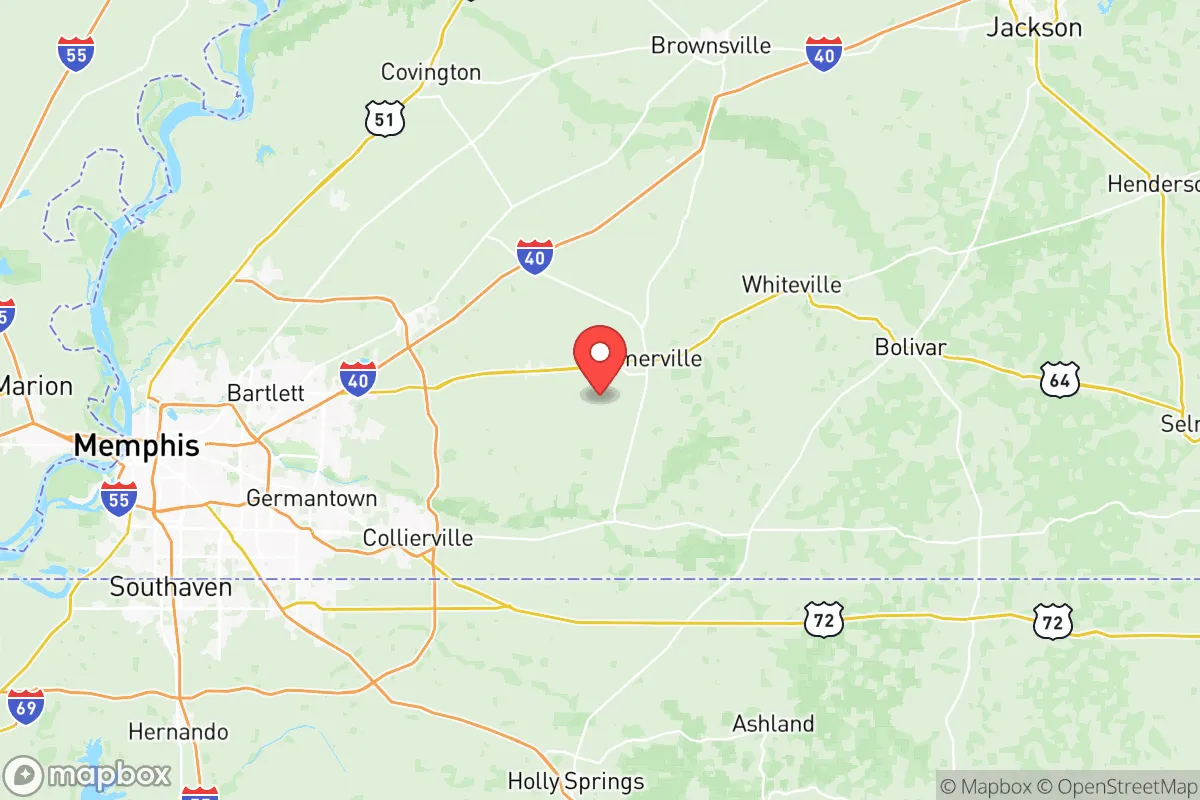
The major demographic shift in the modern era has been domestic: the suburbanization of the Memphis metropolitan area. Beginning in the 1990s and accelerating after 2000, White families from Shelby County began moving east into Fayette County, seeking larger lots, lower property taxes, and what they perceived as better schools and lower crime rates. This wave concentrated in the western part of the county, closest to Memphis. The town of Oakland has been the primary beneficiary, growing from a village of a few hundred in 1990 to over 8,000 residents today. Piperton, a small town on the Shelby County line, has also seen significant new subdivision development, attracting upper-middle-class families. This influx has shifted the county’s racial composition: the White share rose from roughly 60% in 1990 to 66.1% today, while the Black share declined from around 38% to 26.8% over the same period, as many Black families also moved to Memphis suburbs or other parts of the South.
The county’s college-educated share is 26.9%, below the national average of roughly 33%, reflecting its rural character and the blue-collar nature of many local jobs. Employment is concentrated in manufacturing, logistics (due to proximity to Memphis’s distribution hub), and agriculture. The largest employers include the Fayette County Public Schools, the county government, and several manufacturing plants in Somerville and Oakland.
The future
Fayette County is projected to continue growing, driven by the ongoing eastward expansion of the Memphis suburbs. The population is expected to reach roughly 50,000 by 2040, with most new residents settling in the western corridor from Piperton through Oakland to Somerville. This growth will likely make the county more White and more affluent, as the new subdivisions attract higher-income families. The Black population share may continue to decline slowly, though the county will remain more diverse than most rural Tennessee counties. The Hispanic share is expected to rise modestly, potentially reaching 5-6% by 2040, as agricultural and construction labor demand continues.
The county’s cultural identity is evolving from a quiet, deeply rural agricultural community into a hybrid exurban-rural area. Longtime residents, both Black and White, often express concern about losing the county’s small-town character, while newcomers are drawn by the space and lower costs. The political character, historically conservative, has become more uniformly Republican as the new arrivals from Shelby County tend to be conservative-leaning as well.
For someone moving in now, Fayette County offers a middle ground: more space and lower taxes than Memphis or its inner suburbs, but with a growing set of amenities in Oakland and Somerville. The county is becoming a bedroom community for Memphis workers, while still retaining its agricultural heritage and a slower pace of life. The population is becoming slightly less diverse, slightly more educated, and more oriented toward the Memphis economy, but the county’s deep-rooted sense of place—shaped by its plantation history, the Great Migration, and the recent suburban wave—remains intact.

* Values derived from national, state, county, city and local statistics and may differ in a specific area. Last updated: 2026-10-24T03:12:37.000Z
Narrative content on this page is AI-generated and may contain mistakes. Verify any details that matter before acting on them.
ReloMaps may earn a commission from affiliate links at no extra cost to you.

