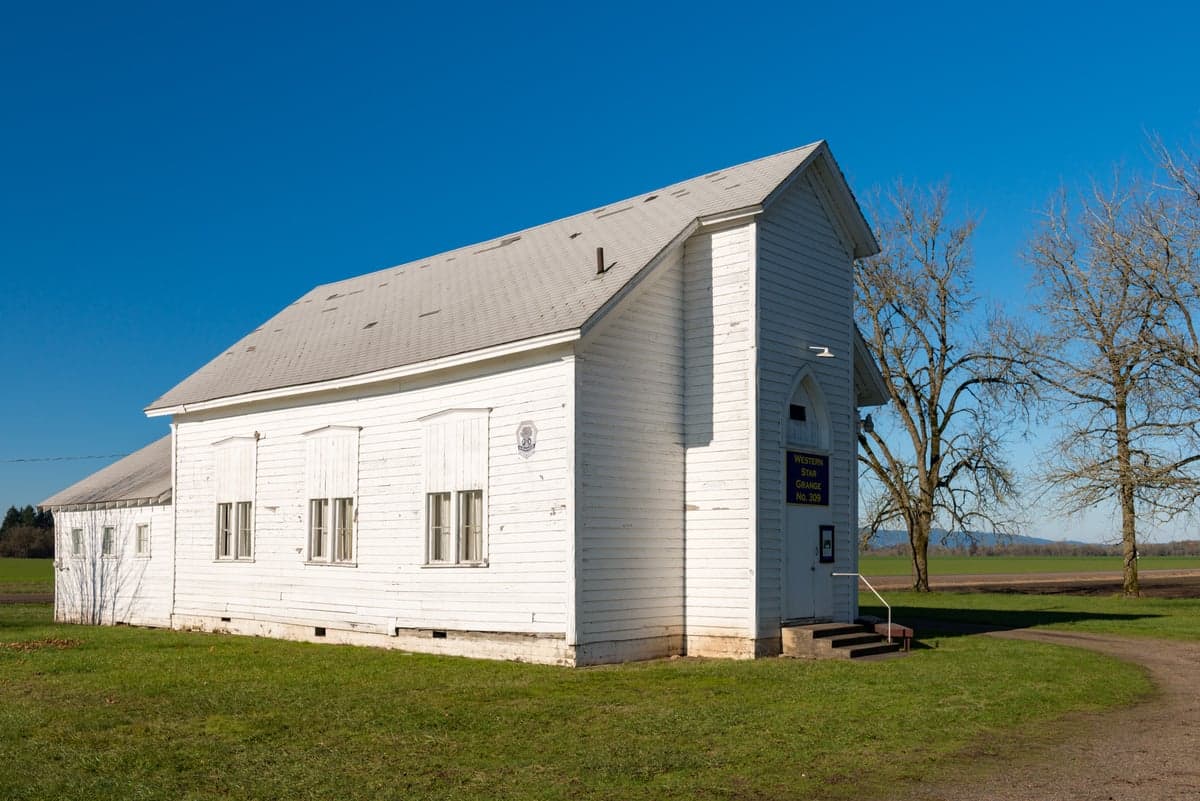
Photo: Wikipedia
Demographics of Tangent, OR
Affluence Level in Tangent, OR
A middle-class area roughly in line with national averages across income, home values, education, and employment.
People of Tangent, OR
Today, Tangent, Oregon, is a small, tight-knit community of 1,303 residents that retains a distinctly rural, agricultural character. The population is predominantly White (85.2%) with a growing Hispanic minority (11.4%), reflecting the area's deep roots in farming and its more recent role as a bedroom community for nearby Albany and Corvallis. With a low foreign-born population of just 3.4% and a college attainment rate of 19.8%, Tangent's identity is shaped by multi-generational families, working landowners, and a quiet, self-reliant culture that values space and tradition over urban amenities.
How the city was settled and grew
Tangent's human history begins with the Donation Land Claim Act of 1850, which drew American settlers of primarily English, Irish, and German stock to the fertile Willamette Valley. The area was originally part of the Calapooia tribe's homeland, but by the 1850s, Euro-American families had taken up claims along the Calapooia River. The town itself was platted in 1888 when the Oregon and California Railroad laid tracks through the area, naming the stop "Tangent" for the straight line of the rail bed. The earliest settlers clustered around what is now Old Town Tangent, a small historic core near the railroad crossing where the first general store, blacksmith, and church were built. These founding families—names like Kiger, Heltzel, and Bilyeu—established a pattern of small-scale farming and timber that defined the community for generations. By the early 20th century, a second wave of settlers, including German-Russian families seeking farmland, moved into the South Tangent Flats area, where they established dairy and hop farms. The population remained under 500 through the 1950s, with growth limited by the area's reliance on agriculture and the lack of major industry.
Modern era (post-1965)
After the 1965 Immigration and Nationality Act, Tangent saw little direct impact from new international migration, as the foreign-born share remains low at 3.4%. Instead, the modern era has been defined by domestic in-migration from within Oregon and the broader Pacific Northwest. Beginning in the 1980s, families seeking affordable land and a slower pace began moving into Tangent Hills, a residential subdivision on the town's eastern edge, and Calapooia Meadows, a newer development near the river. These neighborhoods attracted a mix of retirees from the Willamette Valley and younger families priced out of Corvallis and Eugene. The Hispanic population, now 11.4%, grew primarily through agricultural labor in the surrounding nurseries and grass-seed farms, with many families settling in the River Road Corridor area south of town. Unlike larger Oregon cities, Tangent has not experienced significant growth from East/Southeast Asian or Indian subcontinent communities—Asian residents make up just 0.2% and Indian residents 0.5% of the population. The Black population is 0.0%. This demographic stability reflects the town's limited housing stock, lack of rental options, and the economic draw of farming rather than professional or tech sectors.
The future
Tangent's population is projected to grow slowly, likely reaching 1,500–1,600 by 2040, driven by spillover from Albany's expansion and the continued appeal of rural living for conservative-leaning families. The Hispanic share is expected to rise modestly as younger families in the River Road Corridor and South Tangent Flats areas remain in agriculture and related trades. However, the town's overall diversity is unlikely to increase dramatically, as new construction remains limited and the housing market favors single-family homes on large lots rather than multi-family or rental units. The Old Town Tangent area is seeing some infill, but no major subdivisions are planned. Culturally, Tangent is becoming slightly more suburban in its political and social outlook, though it retains a strong agricultural identity. For someone moving in now, Tangent offers a stable, low-diversity community where property values are rising but still affordable relative to Corvallis, and where the population is aging slightly but remains family-oriented.
Tangent is becoming a quieter, more residential version of its agricultural past—a place where long-time farming families and newer arrivals seeking space and safety coexist, but where demographic change is gradual and the cultural character remains overwhelmingly White and rural. For a relocation buyer who values privacy, low taxes, and a community where neighbors know each other, Tangent offers a predictable and stable environment with little of the rapid change seen in Oregon's larger cities.

* Values derived from national, state, county, city and local statistics and may differ in a specific area. Last updated: 2026-11-17T00:22:00.000Z
Narrative content on this page is AI-generated and may contain mistakes. Verify any details that matter before acting on them.
ReloMaps may earn a commission from affiliate links at no extra cost to you.

