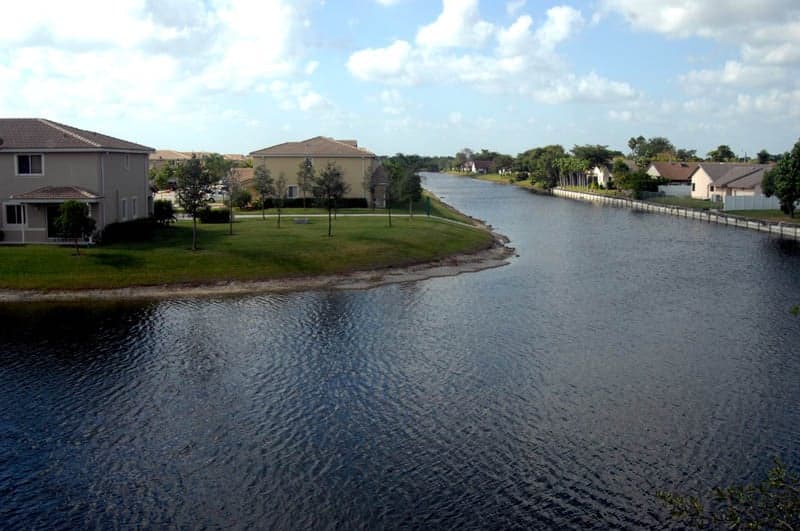
Photo: Wikipedia
Demographics of Tamarac, FL
Affluence Level in Tamarac, FL
A below-average socioeconomic profile. Incomes, home values, and educational attainment trail the U.S., with higher poverty and unemployment.
People of Tamarac, FL
Tamarac, Florida, is a diverse, middle-class suburb of 71,887 residents defined by its striking tri-ethnic balance: roughly one-third White (29.1%), one-third Hispanic (31.5%), and one-third Black (33.4%). The city is a post-1960s planned community that has evolved from a retirement haven for Northeastern Jewish seniors into a magnet for Caribbean, Latin American, and domestic migrants seeking affordable single-family homes near Fort Lauderdale. With a foreign-born population of 10.5% and a college attainment rate of 28.0%, Tamarac today is a stable, family-oriented suburb where ethnic enclaves are giving way to integrated neighborhoods, though distinct pockets remain.
How the city was settled and grew
Tamarac has no colonial or pioneer history; it was a planned retirement community incorporated in 1963. The original population was almost entirely White, Jewish, and elderly, drawn by developer Ken Behring’s vision of an affordable, active-adult suburb. The first wave of residents—mostly middle-class retirees from New York, New Jersey, and Pennsylvania—settled in the original Mainlands and Woodlands neighborhoods, which featured ranch-style homes and golf courses. These early condominium communities, such as those along Nob Hill Road, were marketed as “the city with a heart” and quickly filled with snowbirds and permanent retirees. By 1970, Tamarac’s population was over 95% White, with a median age above 60. The city’s growth was fueled by the expansion of Florida’s Turnpike and the development of nearby commercial corridors like University Drive, which connected retirees to medical facilities and shopping.
Modern era (post-1965)
The Hart-Cellar Act of 1965 had little immediate effect on Tamarac, but by the 1980s, two forces reshaped the population: the aging-out of the original retirees and the suburban spillover from Fort Lauderdale and Miami. As the original Jewish residents passed away or moved to assisted living, their homes were bought by younger, more diverse families. The Kings Point neighborhood—a massive 55+ condominium complex—remained a White, Jewish stronghold through the 1990s, but surrounding areas shifted. The Westwood and Woodmont neighborhoods saw an influx of Black and Afro-Caribbean families, particularly from Jamaica, Haiti, and Trinidad, drawn by affordable housing and proximity to I-95. Simultaneously, Hispanic residents—primarily Puerto Ricans, Cubans, and Colombians—moved into areas around Commercial Boulevard and Rock Island Road, establishing small businesses and churches. By 2010, Tamarac had become a majority-minority city, with Black and Hispanic populations each surpassing 25%. The White population, now 29.1%, is concentrated in the age-restricted enclaves of Kings Point and the Mainlands, while younger families of all backgrounds live in the single-family home subdivisions east of University Drive.
The future
Tamarac’s population is trending toward greater integration rather than tribalization. The city’s Hispanic and Black shares have plateaued since 2020, while the White share continues a slow decline as older residents pass away. The East/Southeast Asian population (1.4%) and Indian-subcontinent population (1.2%) are small but growing, with new arrivals settling in the Savanna and Bristol neighborhoods near the Turnpike. The city’s median age has dropped from 60 in 1990 to 42 today, reflecting a shift toward working families. Over the next 10–20 years, Tamarac will likely become a majority-Hispanic city, mirroring Broward County trends, as younger Hispanic families replace aging White and Black populations. However, the city’s housing stock—dominated by 1960s-era condos and ranch homes—may limit new construction, keeping growth modest. The planned Tamarac Town Square redevelopment aims to attract millennials and empty-nesters, but the city’s identity will remain that of a stable, mid-market suburb, not a boomtown.
For a conservative-leaning mover today, Tamarac offers a solid, affordable alternative to pricier coastal suburbs, with a population that is increasingly younger, family-oriented, and ethnically blended. The city is no longer a retirement enclave but a working- and middle-class community where homeownership rates are high (above 70%) and crime is moderate. The key trade-off is that Tamarac lacks the high-end amenities of Weston or Parkland but provides a stable, diverse environment with good access to Broward County’s job centers.

* Values derived from national, state, county, city and local statistics and may differ in a specific area. Last updated: 2026-05-03T20:22:27.000Z
Narrative content on this page is AI-generated and may contain mistakes. Verify any details that matter before acting on them.
ReloMaps may earn a commission from affiliate links at no extra cost to you.

