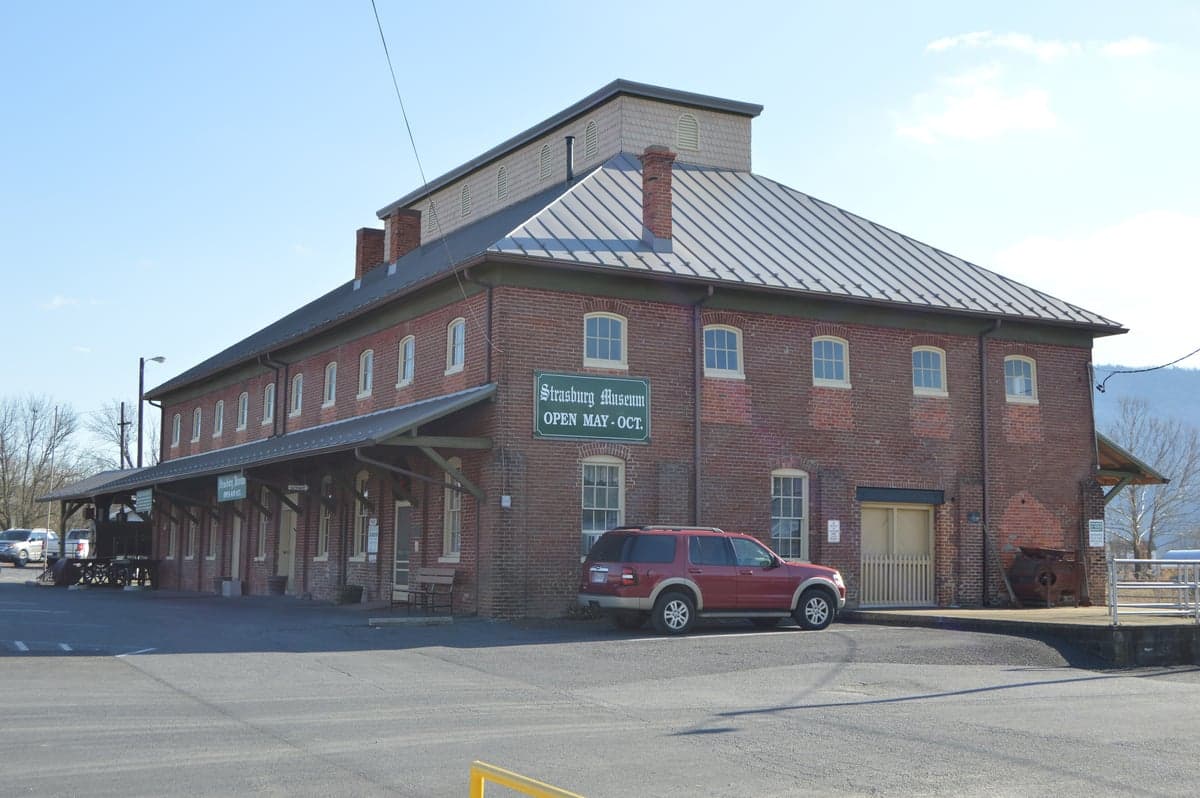
 Popular
Photo: Wikipedia
Strategic Assessment of Strasburg, VA
Meaningful friction. Expect exposure to either population pressure, blast zones, or natural disaster risk. Consider buying a retreat property.
What does the Strategic Assessment tell us?
Our Strategic Assessment grades tactical survivability of an area. Major population centers, military targets, fallout zones, natural disasters, and border exposure all drive risk — lower exposure means a more defensible position in a crisis.
This is heavily inspired by Joel Skousen's Strategic Relocation book. Highly recommended you checkout the book ($)What does this tell us?
Our Strategic Assessment grades tactical survivability of an area. Major population centers, military targets, fallout zones, natural disasters, and border exposure all drive risk — lower exposure means a more defensible position in a crisis.
This is heavily inspired by Joel Skousen's Strategic Relocation book. Highly recommended you checkout the book ($)Strategic Pillars

Key Distances
Regional Safe Places
Below is our recommended "safe zones" in Virginia and the surrounding area based on our strategic heuristics. For most people, it's unrealistic to live in a “safe zone” full-time due to work, family or other personal reasons. They tend to be more rural. However, many of these areas are perfect for second homes and retreat properties that double as a vacation home or even a short-term rental.
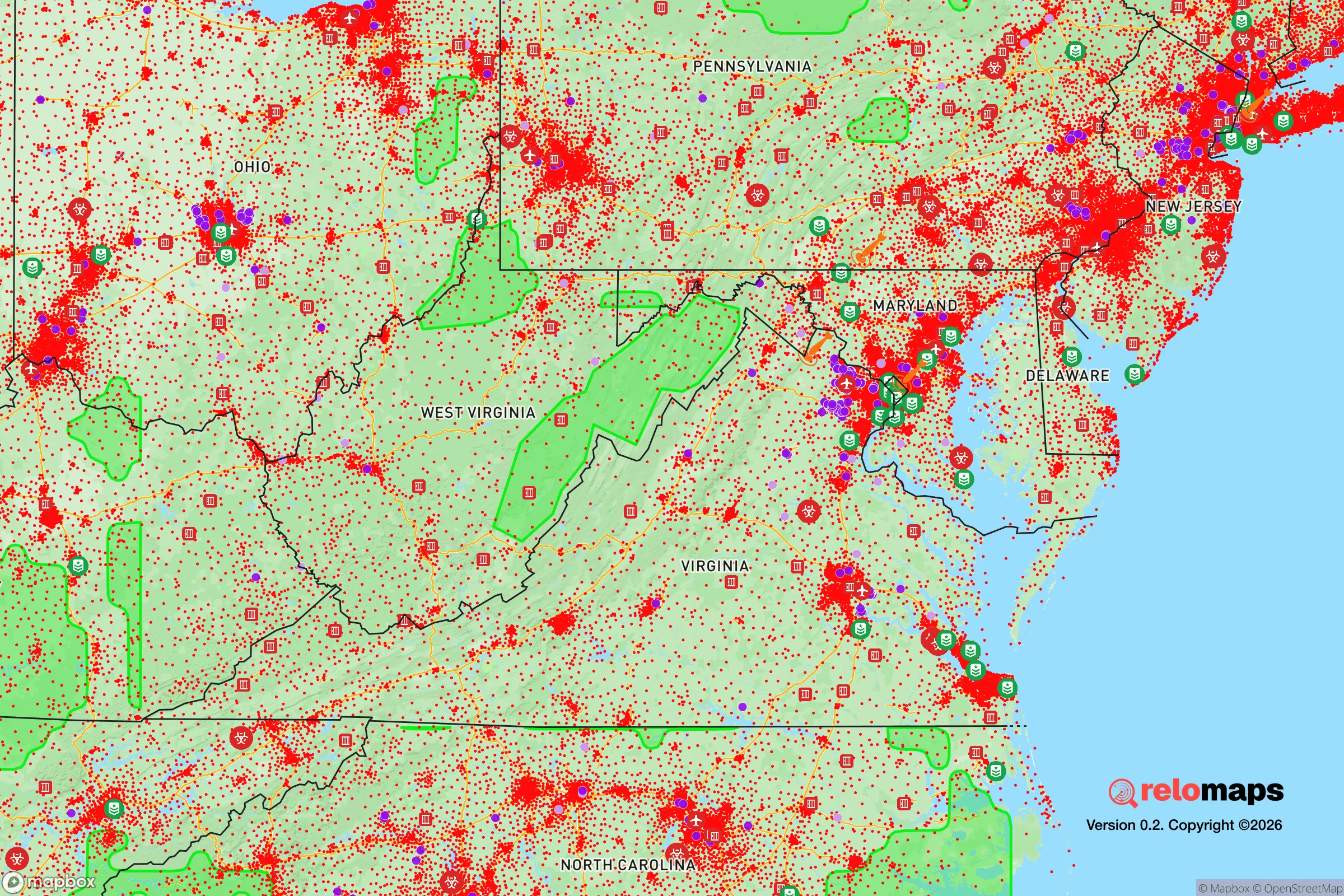
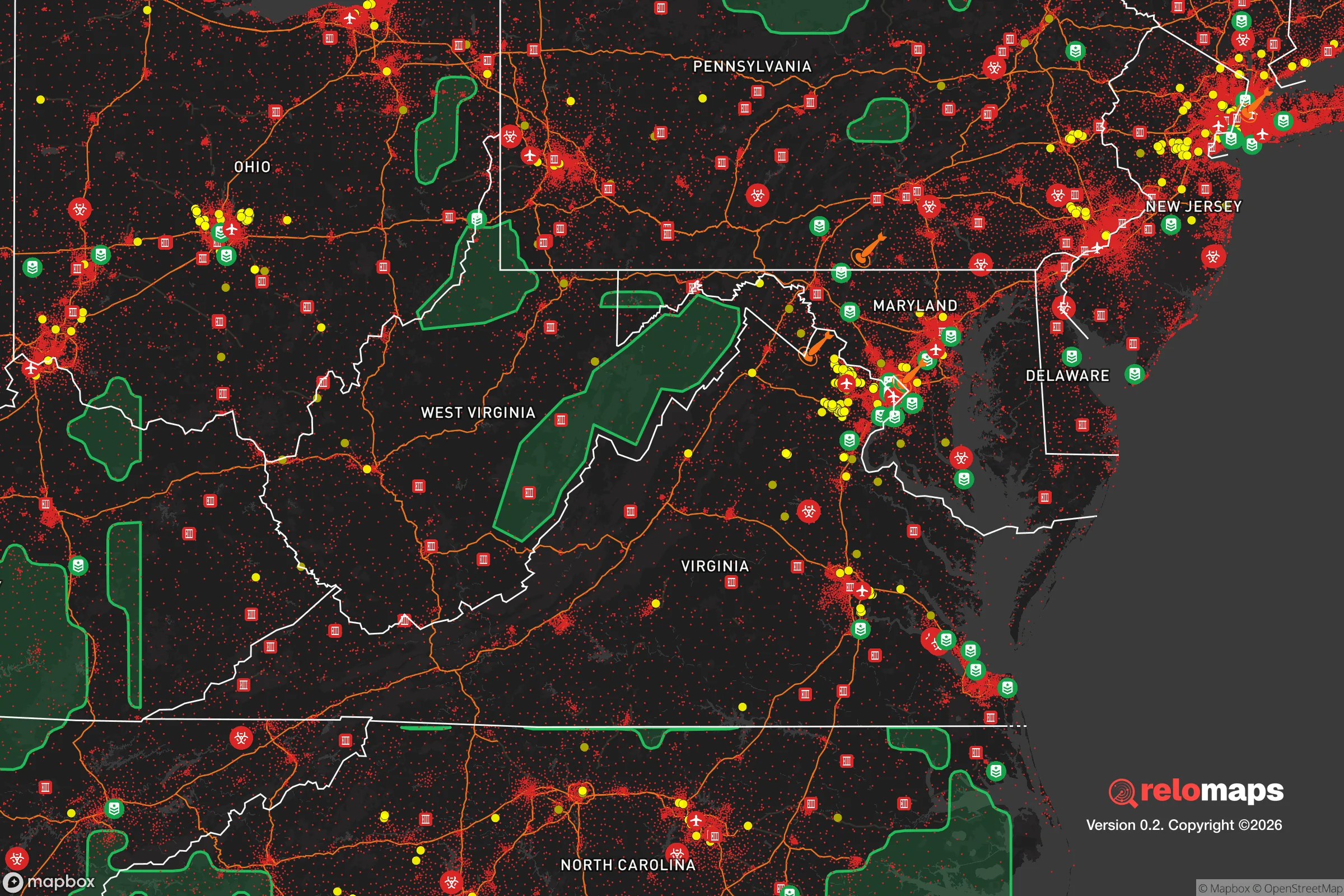


Important Note: For informational purposes only. This does not mean nothing bad ever happens in the green zones. Please use common sense. This is based on public data and modeled with AI. We tried to take a conservative approach but mistakes happen. We update this regularly as new information becomes available.
Solar Generator Recommendations
Backup power matters more here than in safer locations. We've picked three solar generators across budgets and capacity tiers — start with the budget unit if you only need a few essentials, or step up if you want to run a fridge and HVAC for days at a time.

Jackery Portable Power Station Explorer 300
Budget OptionPower on the Go: Weighing only 11 lbs, it's convenient to set up and store with book-sized foldable solar panels

BLUETTI Portable Power Station AC180
Designed for both indoor and outdoor scenarios, AC180 is highly capable as it has a robost capacity and continuous output power.

EF ECOFLOW DELTA Pro Ultra Power Station
Upgraded PickEcoFlow DELTA Pro Ultra is a whole-home energy system designed to grow with your family. Integrated with the Smart Home Panel 2, it scales to meet your evolving energy needs — keeping your home powered, intelligent, and secure through every stage of life.
We earn a commission, at no additional cost to you.
Strategic Assessment Analysis
Strasburg, Virginia, offers a compelling mix of strategic depth and practical vulnerability for the relocation-minded reader focused on resilience and self-sufficiency. Nestled in the northern Shenandoah Valley, this town of roughly 7,000 people benefits from a position that is both geographically sheltered and logistically connected, but it is not without significant exposure to risks that demand careful planning. For a single individual or family looking to balance access to resources with a measure of security, Strasburg presents a workable, if not perfect, base—provided you understand the trade-offs.
Geographic position and natural advantages for long-term stability
Strasburg’s primary strategic asset is its location within the Shenandoah Valley, a natural corridor flanked by the Blue Ridge Mountains to the east and the Massanutten Mountain range to the west. This topography provides a degree of physical shielding from certain weather extremes and offers multiple natural barriers that could slow or complicate movement in a crisis. The town sits at the confluence of the North Fork and South Fork of the Shenandoah River, which merge just north of town to form the main stem. This water abundance is a genuine advantage for a self-sufficiency plan—surface water is readily available, and the underlying karst geology means groundwater is generally accessible via wells, though depth and yield vary by specific lot.
The surrounding landscape is dominated by agricultural land, much of it in active production. This is not a suburban sprawl; it is a working valley. For a relocator interested in local food sourcing or small-scale farming, the soil quality in the bottomlands is excellent, and the growing season is reliable. The area’s elevation (roughly 570 feet) and latitude mean summers are warm but not oppressive, and winters are cold enough to provide a natural pest cycle but rarely severe enough to cause prolonged isolation. Strasburg is also positioned roughly 70 miles west of Washington, D.C., and 90 miles northwest of Richmond—close enough to access major medical and supply hubs in normal times, but far enough to avoid the immediate blast and fallout zones of a major metropolitan target. The town’s position along Interstate 81 is a double-edged sword: it provides excellent logistics for supply and travel, but also makes it a potential thoroughfare for evacuation or military movement in a crisis.
Risks, exposures, and proximity to fallout-relevant landmarks
The most serious risk for Strasburg is its proximity to multiple high-value strategic targets. The town lies roughly 40 miles from the Pentagon and the national capital region, which would be a primary target in any large-scale conflict. Additionally, the Shenandoah Valley is home to several defense-related installations, including the U.S. Army’s Fort Belvoir (about 60 miles east) and the Naval Surface Warfare Center Dahlgren (about 70 miles southeast). The nearby Dulles International Airport and the data centers in Loudoun County—often called “Data Center Alley”—are also potential secondary targets. In a nuclear exchange scenario, prevailing winds from the east would carry fallout directly over Strasburg from a D.C.-area strike. This is not alarmist; it is a straightforward geographic reality. The town’s valley position could trap airborne contaminants, and the lack of deep underground shelters in most residential construction is a concern.
Natural risks are more manageable but still present. The Shenandoah River is prone to flooding, particularly in the spring and after heavy rain events. The 1996 flood, for example, caused significant damage in low-lying areas of Strasburg. The town’s location in a valley also means it is subject to temperature inversions that can trap air pollution, though this is a minor issue compared to urban areas. Earthquake risk is low, but the region is not seismically inert—the 2011 Mineral, Virginia earthquake (magnitude 5.8) was felt strongly here. Tornadoes are rare but not unheard of; the valley’s topography tends to disrupt supercell formation, but a direct hit is possible. Wildfire risk is low in the town itself, but the surrounding forested ridges can burn, and a major fire could cut off access routes.
Practical resilience for a relocator: food, water, energy, and defensibility
For the self-sufficient relocator, Strasburg’s practical resilience is a mixed bag. On the positive side, the agricultural base means local food production is a realistic option. The town has a small but active farmers’ market (seasonal), and several farms in the county offer CSA shares, raw milk, and pasture-raised meats. The ability to grow your own food is excellent, provided you have the land and the know-how. Water is abundant, but it is not free. Municipal water comes from the Shenandoah River and is treated, but a well on your own property is the gold standard for resilience. Drilling costs in the area typically run $15–$30 per foot, and depths of 150–300 feet are common. A hand pump or solar-powered pump on a well gives you a genuine off-grid water supply.
Energy resilience is more challenging. The local grid is served by Rappahannock Electric Cooperative and Shenandoah Valley Electric Cooperative, both of which have reasonable reliability but are not hardened against major events. Outages during winter storms and summer thunderstorms are common, typically lasting a few hours to a day. For a serious preparedness plan, solar panels with battery storage or a whole-house generator are strongly recommended. Natural gas is available in parts of town, but many rural properties rely on propane or heating oil. Wood heat is a viable option given the surrounding forests, but it requires labor and storage space.
Defensibility is a nuanced topic. Strasburg is not a fortress, but its layout offers some advantages. The town is compact, with a historic core that is walkable and has good sightlines. The surrounding mountains and river create natural chokepoints on the main roads (I-81, US-11, VA-55). A determined group could control access to the town with relative ease, but this also means you could be trapped if the exits are blocked. The local population is generally rural and self-reliant, with a strong hunting and firearms culture—this is a plus for community defense, but it also means that in a prolonged crisis, competition for resources could become intense. The nearest major hospital is in Front Royal (about 15 minutes north), with a Level III trauma center in Winchester (30 minutes north). For serious medical emergencies, you are looking at a 45–60 minute drive to a higher-level facility.
The overall strategic picture for Strasburg is one of calculated trade-offs. It offers genuine advantages in water availability, agricultural potential, and a degree of geographic shielding from the worst of a national crisis. Its proximity to high-value targets in the D.C. area is a real and sobering risk, but one that can be mitigated with proper planning—fallout shelters, stored supplies, and a clear evacuation route west into the Allegheny Mountains. For a relocator who is serious about preparedness and willing to invest in infrastructure (well, solar, food storage), Strasburg is a viable option. It is not a remote bunker; it is a working town with a community that understands hard work and self-reliance. If you are looking for a place that balances access to civilization with a measure of security, and you are willing to accept the risks that come with being within 100 miles of the nation’s capital, Strasburg deserves a hard look. Just don’t expect it to be a secret—many others have already made the same calculation.

* Values derived from national, state, county, city and local statistics and may differ in a specific area. Last updated: 2026-09-11T01:16:31.000Z
Narrative content on this page is AI-generated and may contain mistakes. Verify any details that matter before acting on them.
ReloMaps may earn a commission from affiliate links at no extra cost to you.

